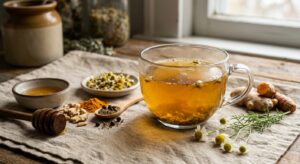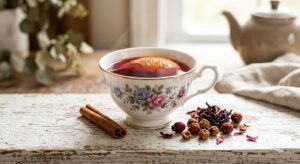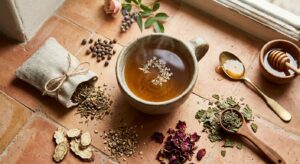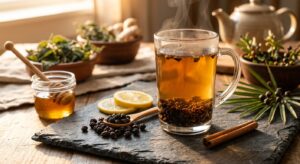
Long before modern fertility clinics existed, women around the world turned to the plant kingdom for support on their journey to motherhood. Red clover (Trifolium pratense) was prized by Native American tribes and European folk healers alike for its gentle phytoestrogenic properties, helping to nourish the uterine lining and balance estrogen levels. Red raspberry leaf (Rubus idaeus), a staple of 19th-century midwifery, was celebrated as a uterine tonic, while vitex berry (Vitex agnus-castus), also called chaste tree berry, was recorded in ancient Greek and Roman medicine as a remedy for menstrual irregularities and hormonal imbalance. Together, these three herbs form a deeply synergistic blend that respects the wisdom of traditional plant medicine while standing up to modern scientific scrutiny.
What makes this blend particularly thoughtful is the way each herb targets a different phase of the hormonal cycle. Red clover provides isoflavones that gently modulate estrogen activity, red raspberry leaf tones and strengthens the uterine muscle with its impressive array of minerals including magnesium, calcium, and iron, and vitex works at the pituitary level to encourage healthy progesterone production in the luteal phase. This layered approach mirrors the complexity of the female reproductive cycle itself, offering broad-spectrum support rather than a single-point intervention.
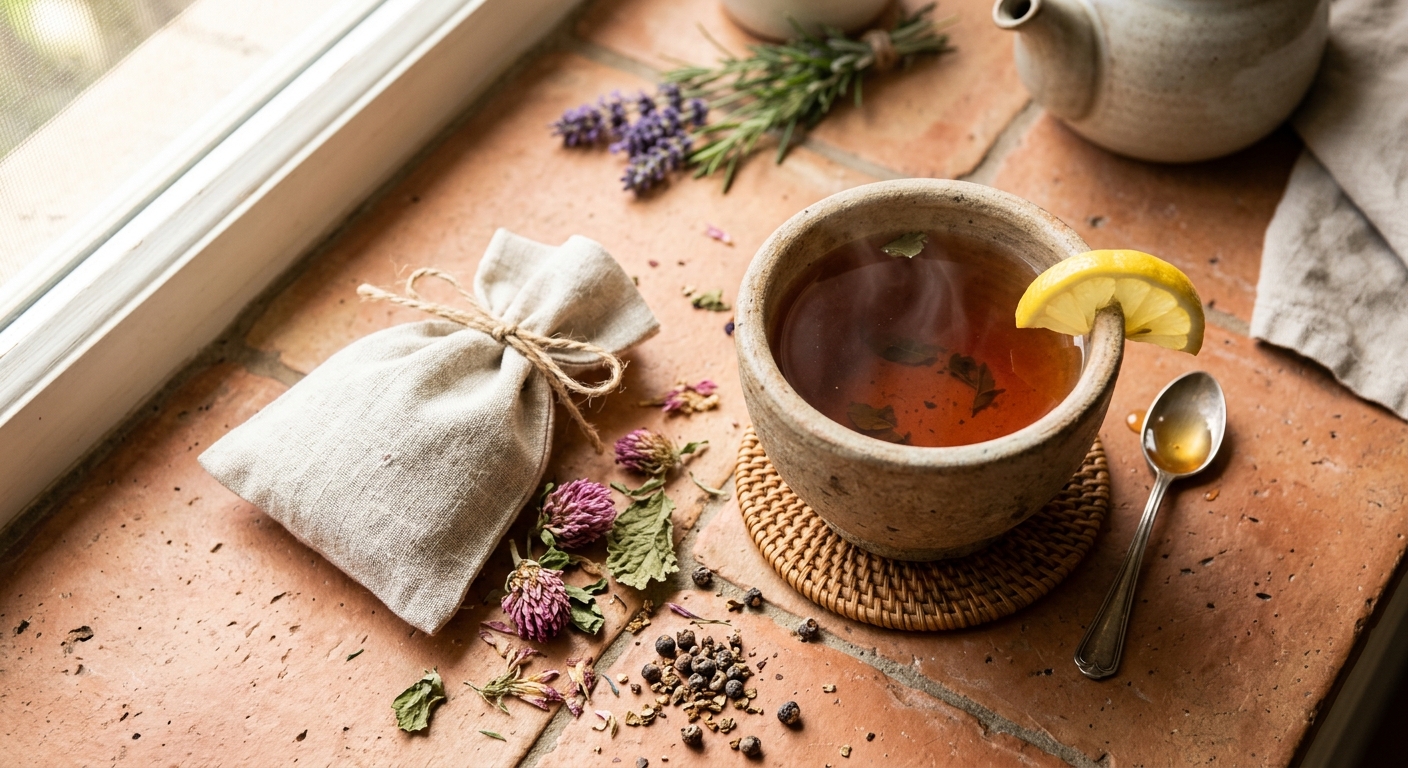
The experience of drinking this tea is as grounding as its purpose. Red clover lends a soft, mildly sweet, and slightly grassy flavor that evokes meadow wildflowers. Raspberry leaf adds a pleasant, slightly astringent earthiness reminiscent of green tea, while vitex contributes warm, peppery, and faintly spicy depth. Brewed together, the cup is aromatic, complex, and deeply satisfying, a daily ritual that connects you with centuries of herbal wisdom and signals to your body that you are preparing, nourishing, and caring for yourself.
2
cups
Ingredients
- 2 tspdried red clover blossoms
- 2 tspdried red raspberry leaf
- 1 tspdried vitex berries, lightly crushed
- 480 mlwater (95°C / 203°F)
- —raw honey to taste (optional)
- —a squeeze of fresh lemon juice (optional)
How to Brew
Click on an item below to shop for the recommended items for this recipe on Amazon.
As an Amazon Associate, we earn from qualifying purchases.
- Lightly crush the dried vitex berries using a mortar and pestle or the back of a spoon to break open the hard seed coat and release their volatile oils before combining with the other herbs.
- Combine 2 teaspoons dried red clover blossoms, 2 teaspoons dried red raspberry leaf, and 1 teaspoon crushed vitex berries in a tea infuser or muslin drawstring bag.
- Heat filtered water to approximately 95°C (203°F), just below a rolling boil. Avoid boiling water as it can degrade some of the delicate phytoestrogenic compounds in red clover.
- Place the infuser in a pre-warmed mug or teapot and pour the hot water directly over the herbs. Cover with a lid or small saucer to trap the volatile aromatic compounds.
- Steep for 10 to 15 minutes. A longer steep of closer to 15 minutes is ideal for the most therapeutic extraction, especially of the vitex berry constituents.
- Remove the infuser, add raw honey and a squeeze of lemon if desired, and sip slowly. Drink 1 to 2 cups daily, ideally in the morning.
- Lightly crush the vitex berries using a mortar and pestle or the back of a spoon to help release their active compounds even during cold extraction.
- Add 3 teaspoons dried red clover blossoms, 3 teaspoons dried red raspberry leaf, and 1.5 teaspoons crushed vitex berries to a clean glass jar. Use slightly more herb than the hot brew method to compensate for the lower extraction efficiency of cold water.
- Pour 700 ml of cold filtered water over the herbs, making sure all plant material is fully submerged. Stir gently with a long spoon.
- Cover the jar tightly and leave at room temperature for 30 minutes, then transfer to the refrigerator.
- Allow to steep in the refrigerator for 8 to 12 hours or overnight. The slower, cooler extraction preserves more of the delicate floral notes from the red clover.
- Strain through a fine mesh strainer into a glass, pressing the spent herbs gently. Serve over ice and sweeten with honey or a drizzle of agave if desired. Consume within 48 hours and keep refrigerated.
- Increase the herb quantity significantly for a nourishing infusion: use 1 tablespoon dried red clover blossoms, 1 tablespoon dried red raspberry leaf, and 1 teaspoon crushed vitex berries per 500 ml of water.
- Place the herbs directly into a quart-sized glass jar or heatproof vessel without an infuser, allowing the plant material to circulate freely in the water for maximum extraction.
- Bring filtered water to a near boil at 95 to 100°C (203 to 212°F) and pour it over the herbs in the jar, filling it completely. The full jar helps exclude oxygen and preserve the brew.
- Seal the jar tightly with a lid and wrap it in a thick towel to retain heat. Allow the infusion to steep on the countertop for a minimum of 4 hours, or ideally overnight for up to 8 hours.
- Strain the deeply colored, richly flavored liquid through a fine mesh strainer or cheesecloth, pressing the herbs firmly to extract every last drop of mineral-rich liquid.
- Drink 1 to 2 cups of the nourishing infusion daily, warming individual cups gently as needed. The brew will be stronger, darker, and more mineral-tasting than a standard cup of tea. Refrigerate the remainder and consume within 36 hours.
Health Benefits
The isoflavones formononetin and biochanin A in red clover act as selective estrogen receptor modulators, helping to normalize estrogen levels. This can be especially beneficial for women with estrogen deficiency or irregular cycles.
Vitex agnus-castus has been studied in multiple randomized controlled trials and found to reduce hyperprolactinemia, a common cause of short luteal phases and progesterone deficiency. Normalizing prolactin levels creates a more favorable environment for implantation.
Red raspberry leaf has a long tradition of use as a uterine tonic. Its fragrine content is thought to improve the tone and elasticity of uterine smooth muscle, while its high mineral content, particularly magnesium and calcium, supports overall reproductive tissue health.
Clinical studies on vitex have shown statistically significant improvements in cycle regularity and mid-cycle LH surges, which are critical for timed ovulation. Women with oligomenorrhea and secondary amenorrhea have shown improvements in cycle length.
Red raspberry leaf is notably rich in bioavailable iron, calcium, magnesium, and manganese. These minerals are foundational for building the uterine lining, supporting egg quality, and reducing deficiencies that can impair fertility.
🧪 Key Bioactive Compounds
The Science Behind Red Clover
The fertility-supporting reputation of this herbal blend has a compelling biochemical basis. Red clover (Trifolium pratense) contains some of the highest concentrations of isoflavones found in any plant, including formononetin, biochanin A, daidzein, and genistein. These compounds are classified as phytoestrogens because they structurally resemble 17-beta-estradiol and can bind to both estrogen receptor alpha (ER-alpha) and estrogen receptor beta (ER-beta). Crucially, isoflavones tend to exhibit selective receptor modulation, meaning they can exert mildly estrogenic effects in tissues where estrogen is deficient while also acting as competitive antagonists in tissues where estrogen is excessive. This bidirectional adaptogenic quality makes red clover particularly useful for women whose fertility challenges are rooted in estrogen imbalance rather than excess.
Vitex agnus-castus operates through a fundamentally different mechanism, targeting the hypothalamic-pituitary axis rather than estrogen receptors directly. Its primary active compounds, including agnuside and casticin, have been shown to bind to dopamine D2 receptors in the anterior pituitary gland. This action suppresses the release of prolactin, a hormone that, when chronically elevated even mildly, can suppress ovulation by interfering with gonadotropin-releasing hormone (GnRH) pulsatility. Multiple double-blind placebo-controlled trials, including a 2013 study published in the Journal of Reproductive Medicine, have demonstrated that standardized vitex extract significantly reduces hyperprolactinemia, normalizes LH to FSH ratios, and increases mid-luteal progesterone levels compared to placebo. These are precisely the hormonal conditions that support regular ovulation and successful implantation.
Red raspberry leaf contributes to this blend through a different pathway entirely: nutritional and tonal support rather than direct hormonal modulation. Analyses of Rubus idaeus leaf have confirmed it to be unusually rich in easily absorbable calcium, magnesium, iron, and potassium, all of which are required for healthy smooth muscle function, oxygen-carrying capacity, and cellular energy metabolism in reproductive tissues. The presence of fragrine, a unique plant alkaloid, is thought to produce a toning effect on uterine smooth muscle by modulating calcium influx into muscle cells, potentially improving the contractile quality of the uterine wall and supporting the robustness of the endometrium. While robust clinical trials specifically on red raspberry leaf for fertility remain limited, its long empirical record in midwifery and its impressive phytochemical profile make it a well-reasoned addition to any preconception wellness protocol.
Brewing Tips
- Consistency is essential with this blend, particularly for the vitex berry component. Research suggests vitex needs a minimum of 3 months of daily use to meaningfully shift prolactin and progesterone levels, so commit to a daily cup as a ritual rather than a remedy.
- Store dried vitex berries whole and crush them fresh before each brew. The volatile oils responsible for their pituitary-active compounds dissipate quickly once ground, so pre-grinding reduces potency significantly.
- Cycle awareness matters: some herbalists recommend drinking this full blend throughout the entire cycle, while others suggest pausing vitex during menstruation. Listen to your body and consider working with a trained herbalist to personalize the protocol to your specific hormonal pattern.