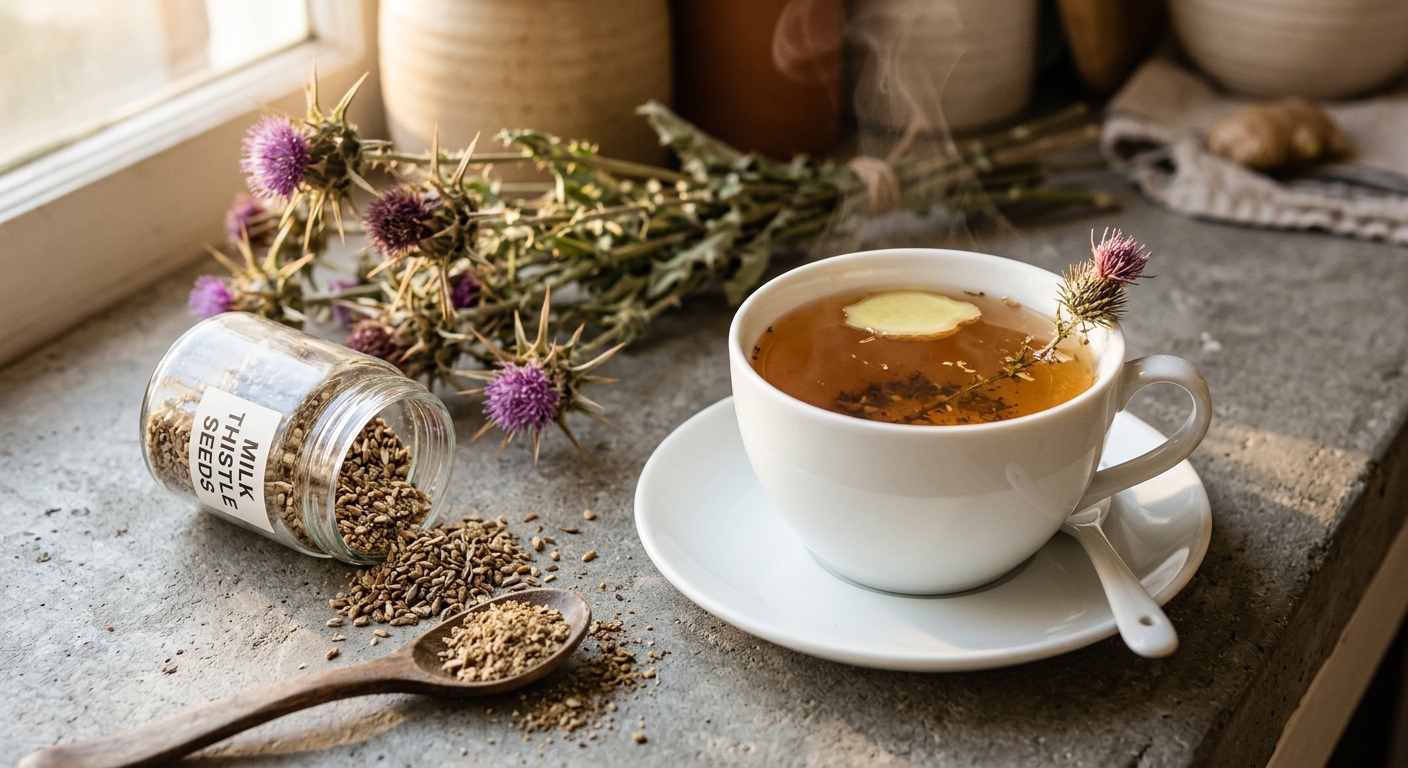
Few plants carry a medicinal reputation as long and well-documented as milk thistle. Native to the Mediterranean basin and now naturalized across Europe, the Americas, and Australia, Silybum marianum has been used in herbal medicine for over two thousand years. Ancient Greek physician Dioscorides recorded its use for liver complaints in the first century CE, and by the Middle Ages European herbalists were prescribing it for jaundice, gallbladder troubles, and sluggish digestion. The plant’s common name comes from the milky white veins that streak its glossy leaves, said in Christian folklore to have appeared when drops of the Virgin Mary’s milk fell upon the plant as she nursed the infant Jesus.
What sets milk thistle apart from most folk remedies is that modern science has largely validated what healers observed empirically. The seeds of the plant contain a concentrated group of flavonolignans collectively known as silymarin, with silybin being the most biologically active component. These compounds have been studied extensively for their ability to protect liver cells from toxins, reduce oxidative stress, and support the regeneration of damaged hepatic tissue. Today, standardized milk thistle extracts are used clinically in parts of Europe and Asia for conditions ranging from alcoholic liver disease to mushroom poisoning.
As a tea, milk thistle offers a gentler, more holistic experience than concentrated capsule extracts. The brewed drink carries a pleasantly earthy, slightly bitter taste reminiscent of roasted dandelion with faint nutty undertones. It is most often enjoyed before or after meals to stimulate bile secretion and ease the digestion of fatty foods. Whether you are looking to support daily liver health, calm a turbulent gut, or simply explore one of herbalism’s most storied remedies, milk thistle tea is a deeply nourishing place to begin.
2
cups
Ingredients
- 2 tbspcrushed or lightly ground milk thistle seeds
- 480 mlwater (95°C / 203°F)
- —raw honey or maple syrup to taste (optional)
- —a thin slice of fresh ginger (optional, to brighten flavor)
How to Brew
Click on an item below to shop for the recommended items for this recipe on Amazon.
As an Amazon Associate, we earn from qualifying purchases.
- Measure 1 tablespoon of milk thistle seeds per cup. Place the seeds in a mortar and pestle or spice grinder and crush them coarsely – you want them cracked and fragrant, not powdered into fine dust. This ruptures the seed coat and allows the silymarin compounds to steep into the water.
- Bring filtered water to 93 to 96°C (200 to 205°F). Avoid a full rolling boil, which can degrade some of the more delicate flavonoid compounds. An electric kettle with temperature control is ideal; alternatively, bring water to a boil and let it rest for 60 to 90 seconds.
- Place the crushed seeds into a fine-mesh tea infuser, a stainless steel strainer, or directly into a small saucepan. Pour the hot water over the seeds and cover the vessel with a lid or small saucer to trap volatile aromatic compounds and heat.
- Steep for 10 to 15 minutes. A longer steep extracts more silymarin but also intensifies the bitterness. If you are new to milk thistle, start at 10 minutes and adjust to taste in future brews.
- Strain carefully through a fine-mesh sieve to remove all seed particles and any fine debris. Milk thistle seeds are small enough that some fragments can pass through a coarser strainer.
- Pour into warmed mugs and sweeten with raw honey or maple syrup if desired. A slice of fresh ginger stirred in during the last 2 minutes of steeping adds warmth and helps balance the earthy bitterness.
- Lightly crush 2 tablespoons of milk thistle seeds using a mortar and pestle. The seeds should be cracked open but not ground fine. Cold water extracts bioactive compounds more slowly than hot water, so cracking the seeds is especially important here to ensure adequate silymarin release over the long steep.
- Place the crushed seeds into a clean glass jar or a cold brew pitcher fitted with a strainer insert. Add 480 ml (2 cups) of cold, filtered water. Stir briefly to ensure all the seeds are submerged and none are clinging to the side of the jar.
- Leave the jar at room temperature for the first 1 to 2 hours, then seal and transfer to the refrigerator. Allow to steep for a total of 8 to 12 hours or overnight. The cooler temperature slows oxidation and preserves the delicate grassy and nutty aromatic notes.
- After steeping, strain the liquid through a fine-mesh sieve lined with a coffee filter or nut milk bag to remove all seed particles. The resulting liquid will be a cool, clear pale gold.
- Serve over ice in tall glasses. Cold brew milk thistle pairs beautifully with a squeeze of fresh lemon juice and a few mint leaves. It keeps refrigerated in a sealed jar for up to 48 hours.
- Measure 3 tablespoons of milk thistle seeds for 2 servings. Crush them coarsely using a mortar and pestle or spice grinder. Place the crushed seeds directly into a small stainless steel or ceramic saucepan. Add 600 ml of cold, filtered water, which allows for evaporation during simmering.
- Place the saucepan over medium heat and bring the water to a gentle simmer. Do not allow it to reach a hard boil. Reduce the heat to maintain a steady, quiet simmer with small bubbles rising gently from the bottom of the pan.
- Simmer uncovered for 20 to 25 minutes. As the decoction reduces, the liquid will deepen slightly in color and the aroma will become richer and more roasted. Stir occasionally to prevent any seeds from settling and scorching on the bottom.
- Remove from heat and allow the decoction to rest for 5 minutes off the burner. This rest period allows a final gentle infusion of the remaining aromatics as the temperature slowly drops.
- Strain through a fine-mesh sieve lined with a coffee filter into warmed mugs, pressing the spent seeds gently with the back of a spoon to extract any remaining liquid. You should have roughly 400 ml after evaporation, yielding two rich servings.
- Sweeten with raw honey if desired and sip slowly. The decoction is considerably stronger and more bitter than the hot brew, so consider blending with a teaspoon of dried peppermint or licorice root to round out the flavor. Traditionally this preparation was taken 20 to 30 minutes before meals to prime bile flow and prepare the digestive system.
Health Benefits
The silymarin complex in milk thistle seeds, particularly silybin, has been shown in multiple clinical trials to reduce liver enzyme levels (ALT and AST) in patients with liver disease, indicating reduced hepatocellular damage. It works by stabilizing hepatocyte membranes against toxin penetration and stimulating ribosomal RNA synthesis to accelerate liver cell repair.
Milk thistle has a choleretic effect, meaning it increases the production and secretion of bile from the liver and gallbladder. This supports the digestion and emulsification of dietary fats, reduces bloating and sluggishness after rich meals, and helps prevent the stagnation that can contribute to gallstone formation.
The anti-inflammatory flavonolignans in milk thistle help calm irritation along the gastrointestinal tract, including the stomach lining and intestinal walls. Traditional European herbalism long used milk thistle to relieve dyspepsia, and preliminary research supports its role in reducing inflammatory markers in gut tissue.
Silymarin is one of the most powerful antioxidant complexes found in any medicinal plant, with free-radical scavenging activity significantly greater than that of vitamin E in some in vitro studies. Regular consumption helps reduce systemic oxidative stress, which is a contributing factor to aging, metabolic syndrome, and chronic disease.
Emerging clinical research suggests that silymarin may improve insulin sensitivity and reduce fasting blood glucose levels in people with type 2 diabetes or metabolic syndrome. Several randomized controlled trials have shown statistically significant reductions in HbA1c with standardized milk thistle supplementation, likely through mechanisms involving PPAR-gamma activation and reduced hepatic gluconeogenesis.
🧪 Key Bioactive Compounds
The Science Behind Milk Thistle
The therapeutic power of milk thistle is rooted almost entirely in a family of compounds called flavonolignans, collectively marketed and researched under the umbrella name silymarin. Silymarin is extracted primarily from the ripe seeds and comprises roughly 65 to 80 percent silybin (also spelled silibinin), along with silychristin, silydianin, isosilybin A and B, and the flavonoid taxifolin. These compounds are structurally unusual in that they are formed from the bonding of a flavonoid unit with a phenylpropanoid, producing molecules with both strong antioxidant activity and the ability to interact directly with cell membrane phospholipids. This membrane-stabilizing property is fundamental to how silybin protects liver cells: by binding to receptor sites on the outer hepatocyte membrane, it physically competes with and blocks the entry of certain hepatotoxins, including the deadly amatoxins produced by Amanita phalloides (death cap mushroom).
Beyond membrane protection, silybin exerts a pro-regenerative effect on the liver by stimulating ribosomal RNA polymerase I activity in hepatocytes. This means it actively promotes the synthesis of new proteins needed for liver cell repair and regeneration, not merely slowing damage but accelerating recovery. Multiple randomized controlled trials have demonstrated that silymarin supplementation significantly reduces serum levels of alanine aminotransferase (ALT) and aspartate aminotransferase (AST), two liver enzymes that rise when hepatocytes are damaged, in patients with alcoholic liver disease, non-alcoholic fatty liver disease (NAFLD), and viral hepatitis. A 2005 meta-analysis published in the American Journal of Gastroenterology concluded that silymarin showed statistically significant liver-protective effects across the reviewed studies, though researchers noted the need for larger standardized trials.
The digestive benefits of milk thistle are closely linked to its choleretic and anti-inflammatory properties. Silymarin stimulates bile acid secretion from hepatocytes and promotes gallbladder contraction, increasing bile flow into the small intestine. Adequate bile is essential for the emulsification of dietary fats and the absorption of fat-soluble vitamins A, D, E, and K. Without sufficient bile, undigested fats can irritate the intestinal lining, contribute to bloating and steatorrhea, and disrupt the balance of gut microbiota. By improving bile dynamics, milk thistle tea effectively supports the entire upstream process of digestion. Additionally, the anti-inflammatory activity of the silymarin complex, mediated in part through inhibition of nuclear factor kappa-B (NF-kB) and leukotriene synthesis, helps reduce low-grade inflammatory signaling throughout the gastrointestinal tract, offering systemic digestive support that extends well beyond the liver alone.
Brewing Tips
- Always crush or lightly grind milk thistle seeds immediately before brewing rather than in advance. Silymarin compounds are fat-soluble and can begin to oxidize once the seed coat is broken, so fresh grinding preserves potency and enhances flavor.
- If you find the tea too bitter on its own, add a small piece of licorice root or a teaspoon of fennel seeds to the brew. Both herbs are also digestive aids and their natural sweetness rounds out the astringency of the milk thistle without masking its therapeutic character.
- For best digestive results, drink milk thistle tea 20 to 30 minutes before a large or fatty meal. This timing allows the choleretic effect to build before food arrives in the small intestine, priming your digestive system for efficient fat breakdown and nutrient absorption.