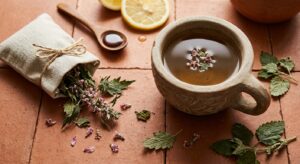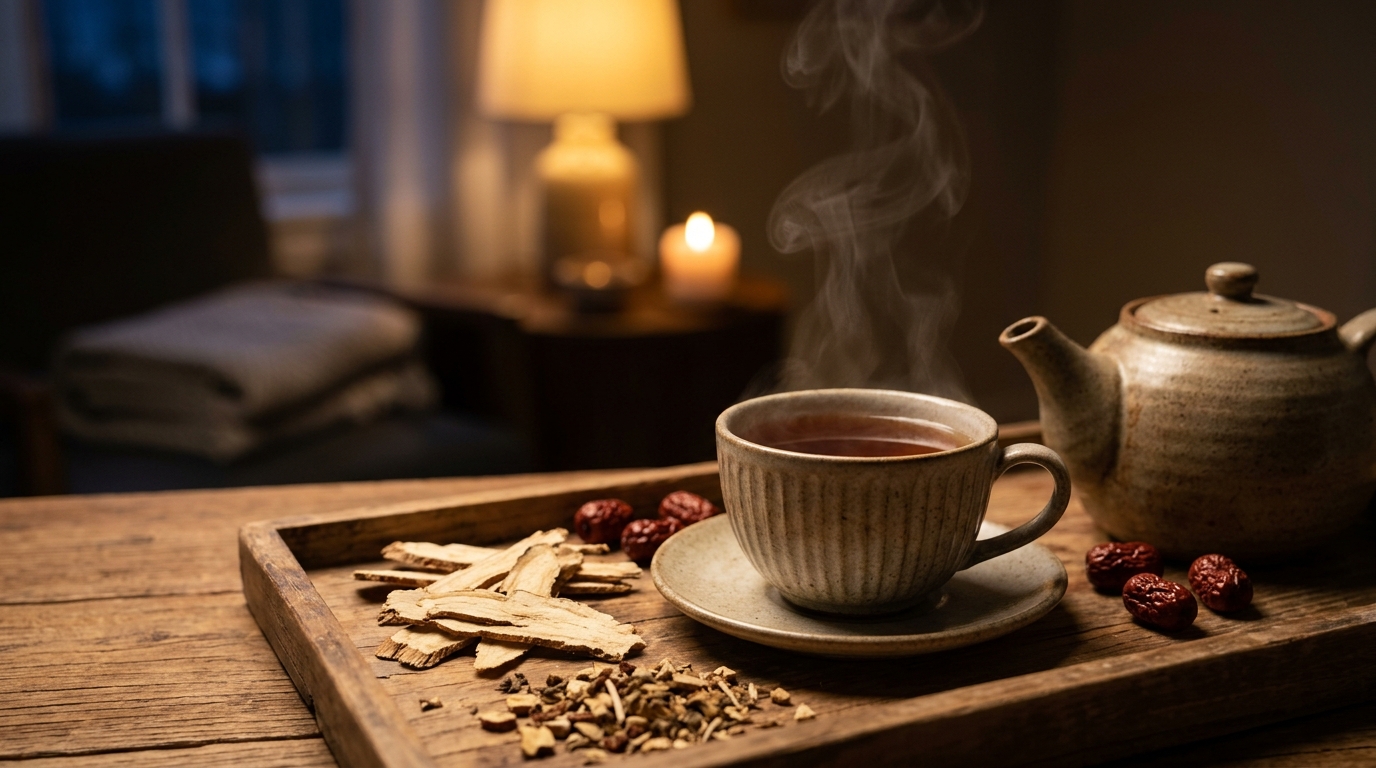
Few herbs carry as much cultural weight in women’s health as dong quai. Known in Chinese as danggui, a name often translated as ‘state of return’ or ‘proper order,’ this aromatic root of Angelica sinensis has been recorded in Chinese herbal texts for well over two thousand years. It was traditionally prescribed to restore balance after childbirth, ease menstrual discomfort, and support women through the transitions of midlife. In Traditional Chinese Medicine, it is often called the ‘female ginseng,’ though it shares no botanical kinship with true ginseng.
Growing in the cool, high-altitude mountain regions of China, Korea, and Japan, the plant produces a thick, branching root with a distinctive scent: sweet, earthy, and faintly celery-like, with a warming, almost medicinal depth. Herbalists describe the root as ‘moistening’ and ‘warming,’ qualities that make it a natural fit for a calming evening cup. In classical formulas, it is rarely used alone, but is often paired with peony, licorice, or ginger to round out its character.
Today, dong quai tea is a quiet evening ritual for many women navigating perimenopause and menopause. While modern research on dong quai alone is mixed, and honesty matters here, the traditional use is deep and the sensory experience is undeniably soothing. Brewed slowly as a decoction or steeped gently, it turns the end of the day into a deliberate pause: a warm, fragrant cup to mark the transition from busy to still.
2
cups
Ingredients
- 2 tspdried dong quai root slices or pieces
- 480 mlfiltered water
- 2 slicesfresh ginger (optional, for warmth)
- —raw honey or a small piece of dried jujube date to sweeten (optional)
How to Brew
Click on an item below to shop for the recommended items for this recipe on Amazon.
As an Amazon Associate, we earn from qualifying purchases.
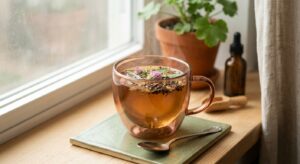
- Measure 2 teaspoons of dried dong quai root slices into a teapot or heat-safe mug with an infuser. If your pieces are large and woody, gently break them up or rinse them quickly under cool water to remove any dust.
- Bring filtered water to a full boil, then pour 240 ml over the root. Dense roots release their compounds best in water just off the boil.
- Cover the pot or mug immediately with a lid or small plate. This traps the fragrant volatile oils that would otherwise escape with the steam.
- Steep for 10 to 15 minutes. Taste at 10 minutes; the tea will deepen from pale gold to a richer amber and grow more earthy and slightly bitter the longer it steeps.
- Strain out the root, stir in a little honey or add a slice of fresh ginger if you like, and sip slowly about an hour before bed as part of your wind-down routine.
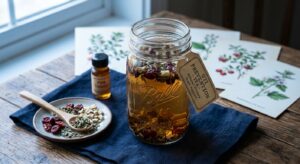
- Add 2 teaspoons of dried dong quai root slices to a clean glass jar. Pour in 480 ml of cool filtered water and stir once to wet all of the root.
- Seal the jar and place it in the refrigerator. The cold, slow extraction coaxes out the root’s natural sweetness while leaving much of the harsh bitterness behind.
- Let it steep for 8 to 10 hours, ideally overnight. Because the root is dense, it will not over-extract the way delicate herbs can, but avoid going beyond 12 hours.
- Strain through a fine-mesh sieve into a clean glass, pressing gently on the root to release the last of the liquid.
- Serve chilled, plain or over ice with a thin slice of orange. Drink within 24 hours, and keep refrigerated at all times.
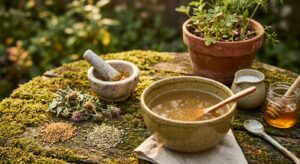
- Place 2 teaspoons of dong quai root slices and 480 ml of cold filtered water into a small stainless steel or enamel saucepan. Starting with cold water lets the root hydrate gradually as it heats.
- Bring the pot to a boil over medium heat, then immediately reduce to the lowest setting so the water barely simmers. Add 2 slices of fresh ginger and, if you like, one dried jujube date for natural sweetness.
- Partially cover the pot and simmer gently for 20 to 30 minutes, until the liquid has reduced by roughly a quarter and turned a deep, rich amber.
- Remove from heat and let the decoction rest, covered, for 5 minutes so the flavors settle and the aroma deepens.
- Strain through a fine-mesh sieve into a warmed mug. Sip slowly while warm. Leftover decoction keeps in the refrigerator for up to 2 days and can be gently reheated.
Health Benefits
Dong quai has been used for centuries in Chinese herbal formulas for menopausal symptoms. Modern clinical evidence is mixed: a notable randomized trial of dong quai alone found no significant improvement over placebo, though it is often used in combination formulas that show more promise.
Phthalides such as ligustilide act as smooth-muscle relaxants, which may explain dong quai’s long-standing use for uterine cramping and pelvic discomfort.
Ferulic acid and coumarins may help dilate blood vessels and improve peripheral blood flow, aligning with its traditional role as a warming blood tonic.
While not a strong sedative, the warm, aromatic cup and mild relaxant compounds make dong quai a soothing part of a wind-down routine, which can indirectly support better sleep during a restless menopausal transition.
Phenolic compounds like ferulic acid scavenge free radicals in laboratory studies, contributing general antioxidant support, though more human research is needed.
🧪 Key Bioactive Compounds
The Science Behind Dong Quai
The scientific picture of dong quai is a fascinating mix of well-characterized chemistry and still-developing clinical evidence. The root’s signature aroma comes from phthalides, especially Z-ligustilide, which laboratory studies suggest can relax smooth muscle and reduce inflammation. These actions plausibly explain the herb’s traditional use for cramping, though extrapolating from cell studies to a cup of tea requires caution.
Dong quai is sometimes described as a phytoestrogen, but the evidence here is nuanced. Unlike soy or red clover, which contain well-known isoflavones, dong quai appears to have little direct estrogenic activity in most studies. Its effects, if they occur, may instead come from influencing circulation, inflammation, and smooth muscle tone rather than binding strongly to estrogen receptors. This is one reason why it is typically used within multi-herb formulas in Chinese medicine rather than as a standalone remedy.
On the clinical side, results are mixed. A well-known randomized, placebo-controlled trial of dong quai alone in postmenopausal women found no significant benefit for hot flashes compared to placebo, while studies of combination formulas and traditional preparations have reported more favorable outcomes, though often with methodological limitations. The honest takeaway is that dong quai is best viewed as a time-honored traditional herb and a comforting ritual, not a guaranteed treatment, and it works best as one part of a broader approach to menopausal wellbeing.
Brewing Tips
- Choose whole or sliced dong quai root over powders for tea; slices are easier to strain, brew more cleanly, and let you judge the quality by scent and color.
- Buy from a reputable herb supplier and look for roots that are pale yellow-brown inside, oily, and strongly aromatic. Dry, scentless, or moldy roots are past their prime.
- Reuse the root once: a second, longer simmer will yield a milder but still pleasant cup, making a small bag of root go further.
- Pair your evening cup with a consistent routine, such as dim lights, a few minutes of stretching, and no screens, to magnify the calming effect of the ritual.
- Start with a single cup a day to see how your body responds, and keep a short journal of hot flashes and sleep to notice any real patterns over several weeks.