Few herbs carry as much historical weight as sage. Its botanical name, Salvia officinalis, comes from the Latin salvere, meaning ‘to save’ or ‘to heal,’ and medieval European herbalists took that promise seriously. A well-known proverb asked, ‘Why should a man die while sage grows in his garden?’ Monastic gardens, apothecary shelves, and kitchen windowsills all held it. Sage was prized not only as a remedy for sore throats and digestive complaints but as a herb of memory. English herbalists such as John Gerard and Nicholas Culpeper wrote of its power to quicken the senses and sharpen the mind, and Gerard noted that it was ‘singularly good for the head and brain.’
Peppermint has a more recent origin story but an equally devoted following. The plant is a natural hybrid of watermint and spearmint, and it was formally described in England in the late 17th century. Ancient Egyptians, Greeks, and Romans used its relatives for digestion and refreshment, and peppermint soon became a staple of European and American home remedies. Its sharp, cooling menthol notes have been used for generations to soothe upset stomachs, clear the head, and lift a flagging mood.
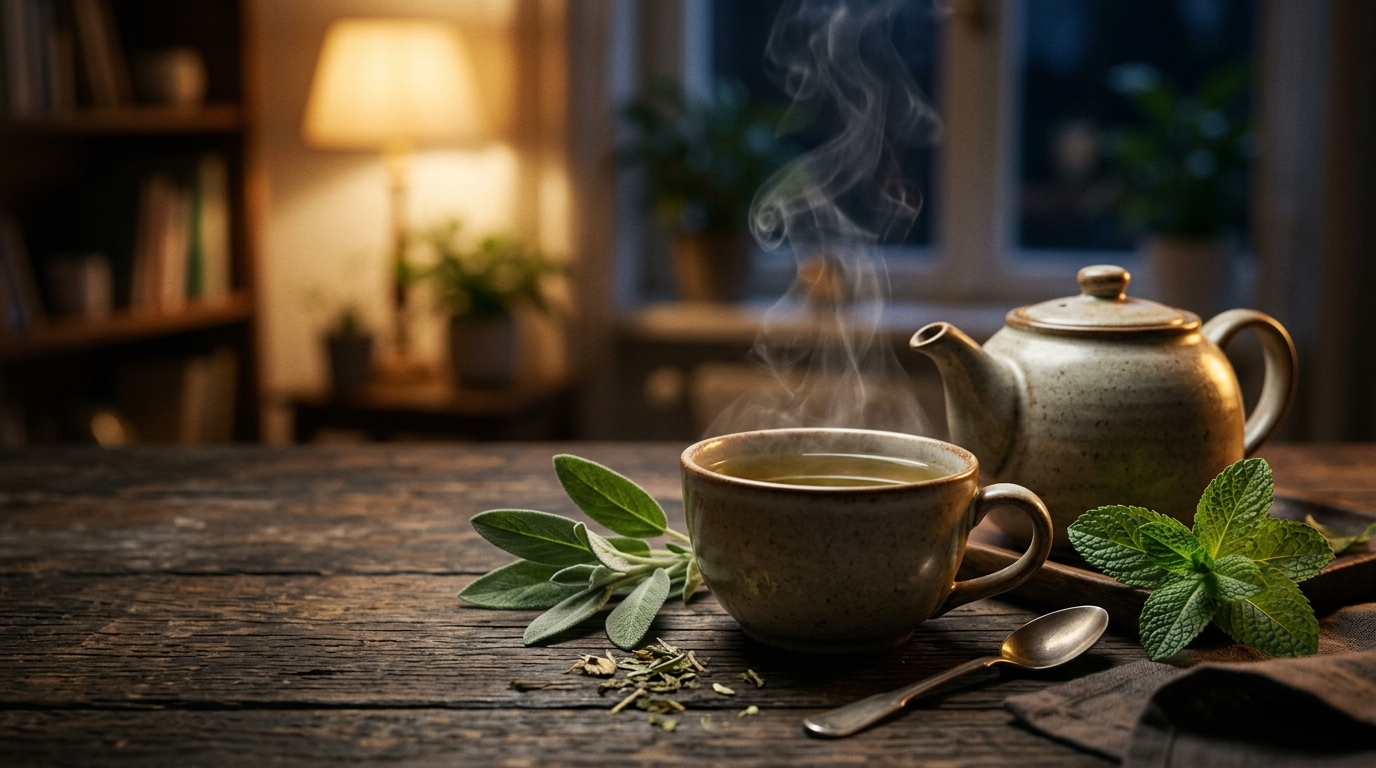
Brought together, these two herbs make a pairing that feels both classic and quietly modern. Sage brings warmth, depth, and a gentle savory edge, while peppermint adds brightness, sweetness, and a clean finish. The result is a tea suited to the hours after dinner, when you want to stay mentally present for reading, journaling, or a quiet conversation without reaching for coffee. It is a caffeine-free ritual that tastes like a walk through a kitchen garden at dusk.
2
cups
Ingredients
- 2 tspdried sage leaves (Salvia officinalis)
- 2 tspdried peppermint leaves
- 480 mlwater (95°C / 203°F)
- —fresh lemon wedge (optional)
- —raw honey to taste (optional)
How to Brew
Click on an item below to shop for the recommended items for this recipe on Amazon.
As an Amazon Associate, we earn from qualifying purchases.
- Bring fresh, cold water to a near boil and let it rest for about 30 seconds so it settles at roughly 95°C (203°F). Sage and peppermint both tolerate hot water well, and the heat helps release their aromatic oils.
- Measure 2 teaspoons of dried sage leaves and 2 teaspoons of dried peppermint leaves into a teapot or large mug. If your sage leaves are whole, crush them lightly between your fingers first to open up their oils.
- Pour the hot water over the herbs, then cover the vessel immediately with a lid or small saucer. Covering is important because peppermint’s volatile menthol oils escape quickly with the steam.
- Steep for 5 to 7 minutes. Stay closer to 5 minutes for a lighter, more mint-forward cup, and go to 7 minutes if you prefer the deeper, more savory character of sage. Avoid steeping much beyond 8 minutes, as sage can turn bitter and astringent.
- Strain through a fine mesh strainer into two cups, pressing the herbs gently to extract the last of the liquid. Add a squeeze of lemon or a small spoonful of raw honey if desired, and sip slowly.
- Add 2 tablespoons of dried sage leaves and 2 tablespoons of dried peppermint leaves to a clean glass jar. The ratio is higher than the hot brew because cold water extracts more slowly and less completely.
- Pour 1 liter of cool, filtered water over the herbs. Stir gently with a long spoon to make sure all the leaves are submerged and nothing is floating dry on the surface.
- Seal the jar and place it in the refrigerator for 8 to 10 hours, or overnight. Do not leave it longer than 12 hours, as the flavor can become flat and the tea does not keep as well once the herbs have fully released their contents.
- Strain the tea through a fine mesh strainer or a piece of muslin into a clean pitcher, discarding the spent herbs.
- Serve over ice with a lemon slice or a sprig of fresh mint. Store any leftover tea in a sealed container in the refrigerator and drink within 48 hours.
- Add 2 teaspoons of dried sage leaves to a small saucepan with 500 ml of cold water. Starting in cold water allows the tougher sage leaves to release their compounds gradually.
- Heat the saucepan over medium-low heat until small bubbles begin to form at the edges, just below a full simmer. Keep the heat low and let the sage gently steep for about 10 minutes, covered with a lid.
- Remove the pan from the heat and immediately add 2 teaspoons of dried peppermint leaves. Stir once, cover again, and let everything rest for 5 minutes. Adding the mint off the heat protects its menthol-rich oils from evaporating.
- Strain the tea through a fine mesh strainer into two warmed mugs. The tea will be a deeper gold and noticeably more savory than the standard hot brew.
- Sweeten with honey if you like, and consider adding a thin slice of fresh ginger to the simmer for extra warmth on a cold evening.
Health Benefits
Several small human trials have found that sage extracts and essential oil can improve memory recall and attention, likely through inhibition of acetylcholinesterase, an enzyme that breaks down a key learning neurotransmitter. Results come from concentrated extracts rather than tea, so effects from a cup are likely milder.
Peppermint’s menthol relaxes the smooth muscle of the gastrointestinal tract, which can reduce bloating, gas, and cramping after a meal. Sage has a long tradition as a digestive herb as well, particularly for heavy or rich foods.
The aroma of peppermint has been associated in small studies with improved alertness and reduced mental fatigue, while sage’s traditional calming qualities temper any stimulation. The combination suits evening focus without caffeine.
Both herbs are rich in phenolic compounds such as rosmarinic acid that scavenge free radicals in laboratory settings. Regular consumption as part of a plant-rich diet may contribute to overall antioxidant intake.
Sage has long been used as a gargle and tea for sore throats, and studies of sage-based throat preparations suggest modest relief. Warm peppermint tea adds a cooling, soothing sensation that many people find comforting.
🧪 Key Bioactive Compounds
The Science Behind Sage
The cognitive reputation of sage is one of the better-studied claims in herbal medicine. Researchers at Northumbria University have run multiple trials in which participants given sage extract or essential oil showed improved performance on memory and attention tasks compared to placebo. The leading explanation involves sage’s ability to inhibit acetylcholinesterase, the enzyme that breaks down acetylcholine, a neurotransmitter central to learning and memory. Compounds such as 1,8-cineole, carnosic acid, and rosmarinic acid are thought to contribute. It is worth noting that many of these trials used standardized extracts or inhaled essential oils, so the effect from a cup of tea is likely subtler.
Peppermint’s effects are driven largely by menthol, which activates TRPM8 receptors, the same cold-sensing receptors in the skin and mucous membranes that give mint its characteristic cooling sensation. In the digestive tract, menthol acts as a calcium channel blocker in smooth muscle, which helps explain why peppermint preparations are well supported for relieving irritable bowel symptoms. Inhaled peppermint aroma has also been linked in small studies to increased subjective alertness and reduced fatigue, which may explain why the tea feels clarifying.
The two herbs share an important antioxidant, rosmarinic acid, which means the blend delivers an overlapping, reinforcing dose of this phenolic compound. Because sage is more potent and contains thujone, the practical approach is to treat this tea as an everyday herbal drink in moderate amounts rather than a continuous high-dose remedy. A cup in the evening fits well within traditional and safe patterns of use.
Brewing Tips
- Crush dried sage leaves lightly between your fingers before steeping to release more of their aromatic oils.
- Always cover your cup or teapot while steeping, since peppermint’s menthol oils evaporate quickly with the steam.
- If you grow your own herbs, use about three times the amount of fresh leaves (roughly 2 tablespoons each) in place of dried, and bruise them gently before brewing.