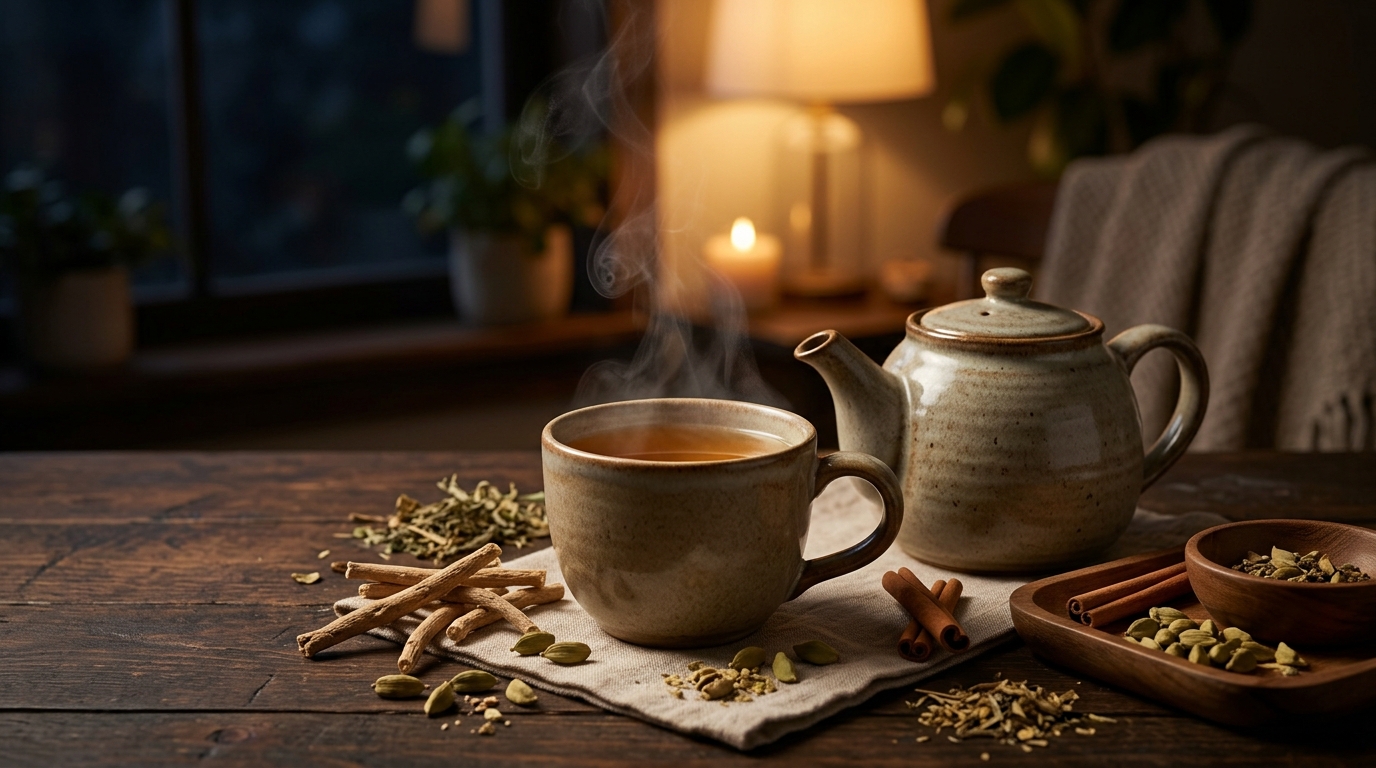
Ashwagandha (Withania somnifera) has been a cornerstone of Ayurveda for more than 3,000 years. Its Sanskrit name roughly translates to “smell of the horse,” a nod to the root’s distinctive earthy, musky aroma and the traditional belief that it imparts the vigor and resilience of a stallion. Healers in India classified it as a rasayana, a rejuvenating tonic used to build strength, support sleep, and steady the mind during times of strain. It is often called Indian ginseng, though the two plants are unrelated.
Green cardamom (Elettaria cardamomum), known as the “queen of spices,” has an equally long pedigree. Prized in Indian, Arabic, and Scandinavian kitchens, it was traditionally used to ease digestion, freshen the breath, and lift the spirits. Its bright, eucalyptus-and-citrus perfume turns out to be an ideal partner for ashwagandha, whose flavor on its own can be bitter and rather medicinal. Cardamom rounds the edges and adds a fragrant sweetness.
Together, they make a tea that feels like a ritual rather than a remedy. The root is simmered gently, the pods are cracked open to release their seeds, and a splash of warm milk or a spoonful of honey turns the whole thing into a creamy, golden evening cup. It is best sipped slowly, an hour or so before bed, as a signal to the nervous system that the day is done.
2
cups
Ingredients
- 1 tspdried ashwagandha root powder (or 2 tsp cut and sifted root)
- 4 podsgreen cardamom, lightly crushed
- 480 mlfiltered water
- 120 mlmilk of choice (dairy, oat, or almond)
- —raw honey or maple syrup to taste (optional)
- —a small pinch of ground cinnamon or nutmeg (optional)
How to Brew
Click on an item below to shop for the recommended items for this recipe on Amazon.
As an Amazon Associate, we earn from qualifying purchases.
- Lightly crush the cardamom pods with the flat of a knife or a mortar and pestle so each pod splits open, exposing the aromatic seeds inside.
- Add the water, ashwagandha, and crushed cardamom to a small saucepan. Bring to a boil over medium heat, then immediately reduce to the lowest simmer.
- Simmer uncovered for 10 to 12 minutes, stirring occasionally, until the liquid has reduced by about a quarter and turned a warm tan color.
- Pour in the milk and warm gently for 2 to 3 minutes without letting it boil hard. Remove from heat and let the tea rest, covered, for 3 minutes to deepen the flavor.
- Strain through a fine mesh sieve into two mugs, pressing the solids lightly. Sweeten with honey or maple syrup once the tea has cooled slightly, and finish with a pinch of cinnamon.
- Combine 2 tablespoons of cut and sifted ashwagandha root and 6 lightly crushed cardamom pods in a clean glass jar. Powder will make the brew cloudy and harder to strain, so use cut root if possible.
- Pour in 700 ml of cold filtered water, stir well, and seal the jar with a lid.
- Refrigerate for 10 to 12 hours, giving the jar a gentle shake once or twice if convenient.
- Strain through a fine mesh sieve lined with a piece of muslin or a coffee filter to remove all fine root particles.
- Serve over ice with a splash of oat milk and a drizzle of honey, or warm a single portion gently on the stove if you prefer a cozy cup. Drink within 48 hours.
- Add 3 tablespoons of cut and sifted ashwagandha root, 8 crushed cardamom pods, and 1 liter of cold water to a heavy-bottomed pot. Starting with cold water draws out more of the root’s compounds as it heats.
- Bring slowly to a boil, then reduce the heat, cover partially, and simmer for 25 to 30 minutes until the liquid has reduced to roughly half its original volume.
- Turn off the heat and let the concentrate stand, covered, for 10 minutes so the cardamom aromatics settle into the brew.
- Strain thoroughly through a fine mesh sieve into a clean glass jar. Allow to cool, then seal and refrigerate for up to 4 days.
- To serve, combine 120 ml of concentrate with 120 ml of hot milk or water, warm through, and sweeten as desired.
Health Benefits
Several randomized controlled trials have found that standardized ashwagandha root extract reduced serum cortisol and scores on stress scales compared with placebo, supporting its classification as an adaptogen.
Ashwagandha has shown modest improvements in sleep onset and overall sleep quality in clinical studies, particularly in people with stress-related sleeplessness. Its leaves contain triethylene glycol, a compound linked to sleep induction in animal research.
Meta-analyses of human trials suggest ashwagandha may reduce anxiety symptoms, possibly by modulating the HPA axis and GABAergic signaling.
Cardamom has a long traditional use as a carminative, and its volatile oils may help relax the digestive tract, reducing bloating and discomfort after a meal.
Both ashwagandha’s withanolides and cardamom’s phenolic compounds show free-radical scavenging activity in laboratory studies, though evidence in humans is still developing.
🧪 Key Bioactive Compounds
The Science Behind Ashwagandha
Ashwagandha’s reputation as an adaptogen rests largely on a family of compounds called withanolides, steroidal lactones concentrated in the root. These molecules appear to influence the hypothalamic-pituitary-adrenal (HPA) axis, the body’s central stress-response system. In human trials, daily doses of standardized root extract, typically 300 to 600 mg, have been associated with meaningful reductions in serum cortisol and in self-reported stress. Withanolides may also interact with GABA receptors, which could help explain the calming, sleep-supporting effect many people notice.
It is worth noting that most clinical studies use concentrated, standardized extracts rather than simmered tea. A homemade decoction delivers a lower and less predictable dose of withanolides, so tea should be viewed as a supportive daily ritual rather than a precise therapeutic dose. Withanolides are only modestly water-soluble, which is one reason the traditional preparation includes milk or a little ghee: the fat helps carry the more lipophilic compounds into the cup.
Cardamom contributes its own set of benefits. Its essential oil is rich in 1,8-cineole and alpha-terpinyl acetate, aromatic compounds that give the spice its fresh, camphor-citrus scent and may support digestion by relaxing smooth muscle in the gut. The sensory experience matters too: warm, fragrant steam and a calm, repeatable routine can themselves lower arousal, which means the ritual of preparing this tea likely complements the herb’s pharmacology.
Brewing Tips
- Crack cardamom pods just before brewing rather than using pre-ground spice, since the volatile oils fade quickly once the seeds are exposed.
- Choose cut and sifted root over powder if you dislike sediment, and strain through muslin for a silky cup.
- Drink this tea about 60 to 90 minutes before bed, and avoid pairing it with caffeine so the calming effect is not undermined.
- If the flavor is too earthy, add a splash of oat milk and a little raw honey or maple syrup, or start with half a teaspoon of powder and build up.
- Buy root from a reputable supplier that tests for heavy metals and verifies the species, as quality varies widely across ashwagandha products.