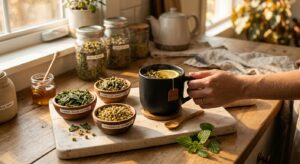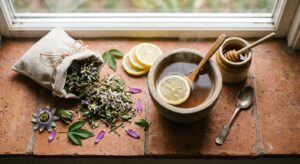
In India, holy basil (Ocimum tenuiflorum, also called tulsi) is far more than a kitchen herb. It is planted in courtyards and temple gardens, tended daily, and revered as a living goddess in the Hindu tradition. Ayurvedic practitioners have prescribed tulsi for thousands of years as a rasayana, a rejuvenating tonic believed to support resilience, clarity, and longevity. Its nickname, ‘The Incomparable One,’ hints at just how highly it has been regarded.
Rose petals have their own long history as a calming botanical. Persian, Unani, and Ayurvedic traditions all use rose (Rosa damascena and Rosa centifolia) to cool the body, soften the heart, and ease nervous tension. The scent alone has been studied for its relaxing effects, and rose water and petal infusions appear in everything from Moroccan tea blends to Indian gulkand preserves.
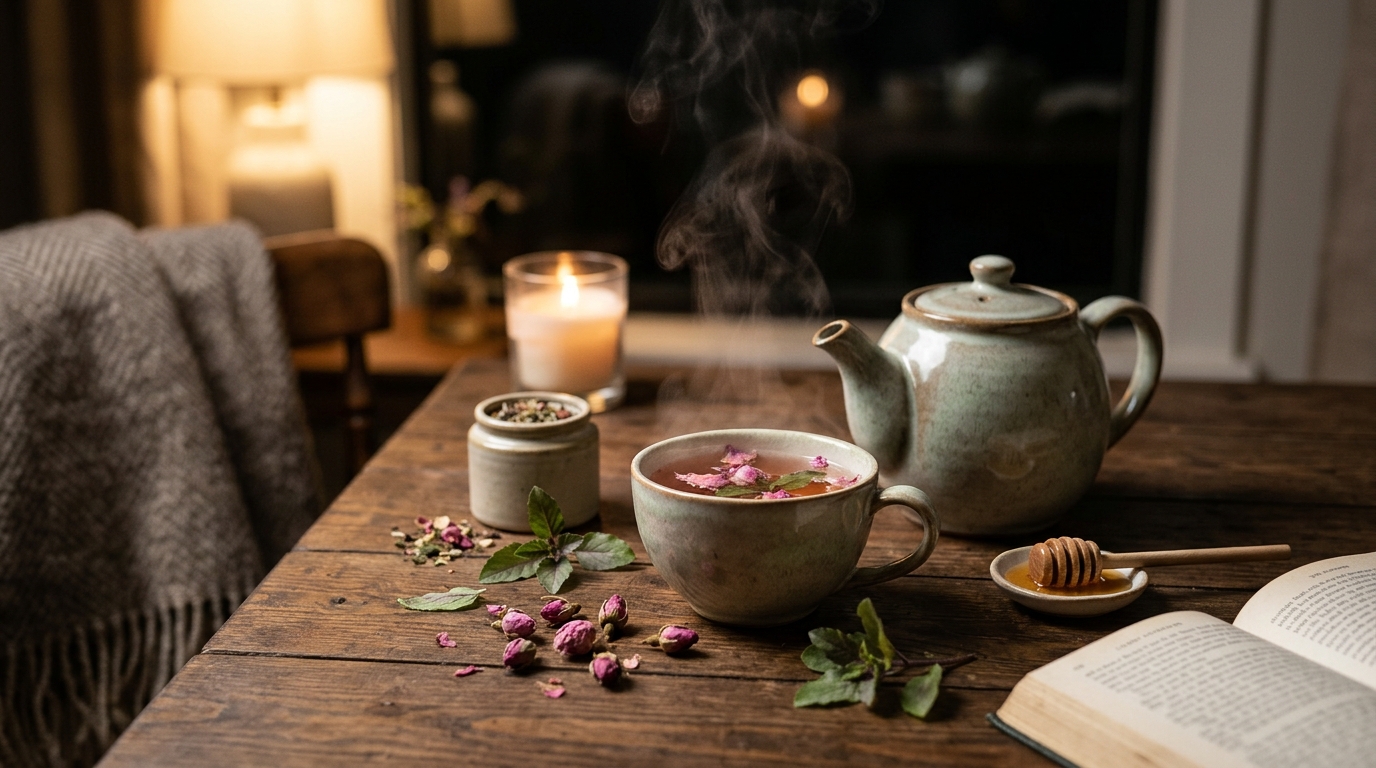
Together, the two make a beautifully balanced evening ritual. Tulsi brings warm, clove-like spice and a peppery, minty brightness, while rose adds a soft floral sweetness and a rounded, perfumed finish. The result is a cup that smells like a garden at dusk and tastes like an exhale. Sipped slowly and without a screen in sight, it becomes a small ceremony that signals to the body that the day is finished.
2
cups
Ingredients
- 2 tspdried holy basil (tulsi) leaves, Rama or Krishna variety
- 1 tbspdried culinary rose petals (unsprayed)
- 480 mlwater (95°C / 203°F)
- —raw honey or a few drops of lemon juice to taste (optional)
How to Brew
Click on an item below to shop for the recommended items for this recipe on Amazon.
As an Amazon Associate, we earn from qualifying purchases.
- Bring fresh, filtered water to a boil, then let it rest for about 30 seconds so it settles near 95°C (203°F). Water straight off a hard boil can make tulsi taste sharp.
- Measure the dried tulsi leaves and rose petals into a teapot or a large infuser basket. Gently crush the tulsi between your fingers first to release more of its aromatic oils.
- Pour the hot water over the herbs, cover the pot or mug with a lid or saucer, and steep for 5 to 7 minutes. Covering traps the volatile aromatics that would otherwise drift away with the steam.
- Strain out the leaves and petals. Taste, and add a small spoonful of honey or a squeeze of lemon if you like a rounder, sweeter cup.
- Sip slowly in a quiet spot. The tea is best enjoyed warm, about 30 to 60 minutes before bed.
- Combine the dried tulsi and rose petals in a clean glass jar or pitcher. Use the same amount of herbs as the hot brew but increase the water to 700 ml, since cold extraction is slower and gentler.
- Pour cold, filtered water over the herbs and stir once to saturate everything. Rose petals will float, so press them down gently with a spoon.
- Seal the jar and refrigerate for 8 to 12 hours, or overnight. Do not leave it beyond 12 hours, as the flavor can turn grassy and the herbs may begin to spoil.
- Strain through a fine mesh strainer into a clean glass or bottle, pressing lightly on the herbs to release the last of the liquid.
- Serve chilled over a few ice cubes, with a rose petal or a lemon twist as garnish. Drink within 48 hours and keep refrigerated.
- Place 2 tablespoons of dried tulsi and 1 tablespoon of rose petals into a heatproof quart jar or a French press. This is a stronger ratio than the hot brew, about double the herb per cup.
- Pour 500 ml of just-boiled water over the herbs, then immediately cover the jar with a tight-fitting lid. A lid is essential here to hold in the volatile oils during the long steep.
- Allow the infusion to steep undisturbed for 15 to 20 minutes, until the liquid is a deeper golden amber and the aroma is richly spiced.
- Strain thoroughly, pressing the herbs against the strainer to extract every drop. The liquid will taste stronger and slightly more astringent than the standard hot brew.
- Dilute with a splash of hot water if it is too intense, or sweeten lightly with honey. Reheat gently if needed, but avoid boiling it again.
Health Benefits
Tulsi is classified as an adaptogen, and small human trials suggest it may reduce self-reported stress and lower markers like cortisol, though larger studies are still needed.
Early clinical studies on holy basil extracts reported improvements in anxiety and mood, and the aroma of rose has been shown in small studies to promote relaxation and lower perceived anxiety.
The warm, caffeine-free ritual of sipping an aromatic tea helps cue the nervous system to slow down, and the herbs’ gentle calming compounds support a more restful transition to sleep.
Both tulsi and rose petals are rich in polyphenols such as rosmarinic acid and quercetin, which help neutralize free radicals and support overall cellular health.
Tulsi has a long traditional use for easing bloating and an unsettled stomach, and the mild carminative action of its essential oils is consistent with this folk use.
🧪 Key Bioactive Compounds
The Science Behind Holy Basil
The calming reputation of holy basil rests on a rich chemistry. Its leaves contain essential oils dominated by eugenol, along with ursolic acid, rosmarinic acid, and a range of flavonoids including apigenin and luteolin. Researchers describe tulsi as an adaptogen, a term for substances thought to help the body maintain balance under stress. In small human trials, tulsi extract has been associated with reductions in stress, anxiety, and low mood, and animal work points to effects on cortisol and on the hypothalamic-pituitary-adrenal axis. The human evidence is encouraging but still limited by small sample sizes and varied preparations.
Rose petals contribute a different but complementary set of compounds. They are a source of phenolic acids, flavonoids such as quercetin and kaempferol, and aromatic terpenes like geraniol, citronellol, and phenylethyl alcohol. Inhalation of rose aroma has been studied for its ability to promote relaxation, with some trials reporting reduced anxiety and lower physiological arousal. Part of the benefit of a rose-infused tea may therefore come simply from breathing in the steam as you sip.
It is worth being honest about what the science can and cannot say. A cup of tea delivers a much smaller dose of these compounds than a concentrated extract used in clinical studies, so the effect is best understood as gentle and supportive rather than dramatic. Much of the value lies in the ritual itself: a warm, fragrant, caffeine-free pause that, repeated nightly, helps train the mind and body to shift gears toward rest.
Brewing Tips
- Gently crush dried tulsi leaves in your palm before steeping to release more of their essential oils and deepen the flavor.
- Always cover your cup or pot while steeping so the delicate volatile aromatics stay in the tea instead of escaping as steam.
- Buy culinary-grade, unsprayed rose petals from a reputable herb supplier, never florist roses, which are often treated with pesticides.
- Store both herbs in airtight glass jars away from light and heat, and use within 6 to 12 months for the best aroma and potency.
- For a stronger stress-relief ritual, drink this tea at the same time each evening so the routine itself becomes a calming cue.