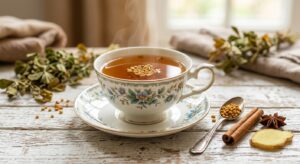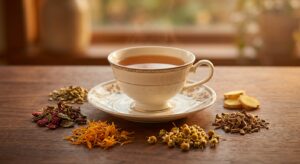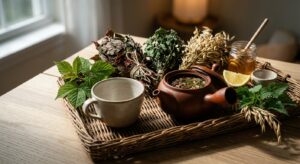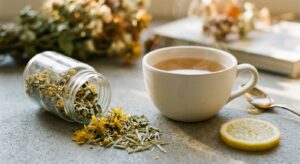
Spearmint has been woven into human life for thousands of years. Greek and Roman writers prized it for freshening the breath and settling the stomach, and the plant traveled with traders and monks across Europe and Asia. In Moroccan culture, spearmint is the soul of the daily tea ceremony, poured from a height into small glasses. In Middle Eastern and South Asian kitchens, it has long been used both as food and as a gentle household remedy for digestive upset and tension.
What makes spearmint especially interesting to modern herbalists is its role in women’s health. Small clinical studies have found that drinking spearmint tea twice daily lowered free and total testosterone in women with hirsutism and polycystic ovary syndrome (PCOS). Because excess androgens drive oil production and clogged pores, especially along the jawline and chin, spearmint tea has become a popular nightly ritual among women dealing with hormonal breakouts.
It is important to be honest about what a cup of tea can do. Spearmint is not a cure for acne, and the research is limited to small, short-term trials. But as a caffeine-free, pleasantly sweet evening tea, it fits easily into a wind-down routine, and its mild effects are best viewed as one supportive piece of a larger plan that includes skincare, sleep, nutrition, and medical guidance when needed.
2
cups
Ingredients
- 2 tbspdried spearmint leaves (or 4 tbsp fresh leaves, lightly bruised)
- 480 mlwater (95°C / 203°F)
- —fresh lemon slice (optional)
- —raw honey or a few drops of stevia (optional)
How to Brew
Click on an item below to shop for the recommended items for this recipe on Amazon.
As an Amazon Associate, we earn from qualifying purchases.
- Bring fresh, filtered water to a near boil, then let it rest for about 30 seconds so it settles at roughly 95°C (203°F). Fully boiling water can dull the delicate mint aroma.
- Measure 2 tablespoons of dried spearmint leaves into a teapot or large mug. If using fresh leaves, bruise them gently between your palms first to release the oils.
- Pour the hot water over the leaves and immediately cover with a saucer or lid to trap the aromatic oils.
- Steep for 5 to 7 minutes. Five minutes gives a light, sweet cup; seven gives a fuller, more robust mint flavor.
- Strain into two cups, add a lemon slice or a touch of honey if desired, and sip slowly about an hour before bed.
- Add 3 tablespoons of dried spearmint leaves (a slightly higher ratio, since cold water extracts more slowly) to a clean glass jar.
- Pour in 700 ml of cold, filtered water and stir gently with a spoon to make sure all the leaves are submerged.
- Seal the jar and refrigerate for 8 to 12 hours. Do not leave it longer than 12 hours or the flavor can turn grassy.
- Strain through a fine mesh strainer into a clean pitcher or glass, pressing lightly on the leaves to release the last of the liquid.
- Serve over ice with a lemon wheel, or pour a glass and let it come to room temperature for a gentle evening sip. Drink within 24 hours.
- Heat 240 ml of water to 95°C (203°F) and pour it over 3 tablespoons of dried spearmint in a heatproof jug. This makes a double-strength brew.
- Cover and steep for only 4 to 5 minutes. A shorter steep with extra leaf keeps the tea sweet instead of bitter.
- Strain the hot concentrate into a tall glass filled with ice, then add 120 ml of cold water to balance the strength.
- Stir well to chill quickly. Garnish with a fresh spearmint sprig and a lemon wheel, and sweeten lightly if you like.
- Sip slowly in the evening. Because ice dilutes the tea, mix a fresh batch rather than storing it for more than a day.
Health Benefits
Small clinical trials in women with PCOS and hirsutism found that spearmint tea twice daily reduced free and total testosterone over about 30 days. This anti-androgen action is the main reason it is used for hormonal acne, though larger studies are needed.
Rosmarinic acid and luteolin have antioxidant and anti-inflammatory properties in laboratory research. While drinking tea is not a direct skin treatment, these compounds may support a lower inflammatory load.
Spearmint has a long traditional use for bloating, gas, and an upset stomach, and carvone appears to gently relax digestive smooth muscle. A settled gut can be a helpful part of an evening routine.
As a naturally caffeine-free tea with a soothing aroma, spearmint makes an ideal wind-down ritual. Reducing evening stress may indirectly support hormone balance, since stress and poor sleep can worsen breakouts.
The aromatic oils in spearmint have a traditional history as a natural breath freshener, making it a pleasant end-of-day drink.
🧪 Key Bioactive Compounds
The Science Behind Spearmint
The strongest evidence for spearmint and hormonal acne comes from a handful of small human studies, mostly in women with excess androgens. In a well-known Turkish trial, women with hirsutism who drank spearmint tea twice a day for five days during the follicular phase of their cycle showed decreased free and total testosterone and increased luteinizing hormone and follicle-stimulating hormone. A later randomized trial in women with PCOS found a similar drop in free testosterone after 30 days. Because androgens stimulate the sebaceous glands to produce more oil, lowering them is a plausible route to fewer breakouts.
The precise mechanism is not fully understood. Researchers suspect that certain flavonoids and phenolic compounds in spearmint may interfere with androgen signaling or production, though the work has largely been done in small groups and short time frames. Notably, these trials measured hormone levels more reliably than they measured acne itself, so it is fair to say the effect on pimples specifically is still unproven.
Beyond hormones, spearmint is rich in rosmarinic acid, a polyphenol studied for its antioxidant and anti-inflammatory activity, and carvone, the compound that gives the plant its characteristic aroma. These likely contribute to its soothing character in the body, but they are not a substitute for clinical treatment. The most honest takeaway is that spearmint tea is a low-risk, pleasant habit with some promising early research, best used alongside, not instead of, proven acne care.
Brewing Tips
- Use two cups a day for the best parallel to the research, one in the morning and one in the evening, and give it at least a month before judging results.
- Choose organic, high-quality spearmint (Mentha spicata) rather than generic mint blends, and store dried leaves in an airtight, dark container to protect the aromatic oils.
- Keep a simple skin and cycle journal so you can notice patterns over several weeks, since hormonal acne often follows monthly rhythms.
- Pair the tea with a consistent evening skincare routine and good sleep habits, as the combination matters far more than any single herb.