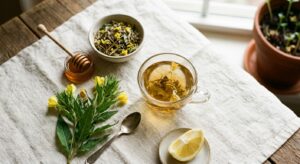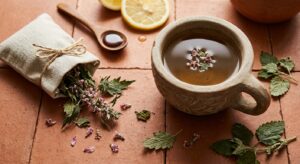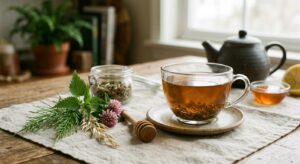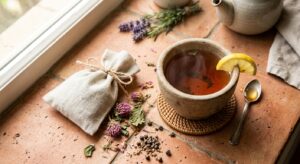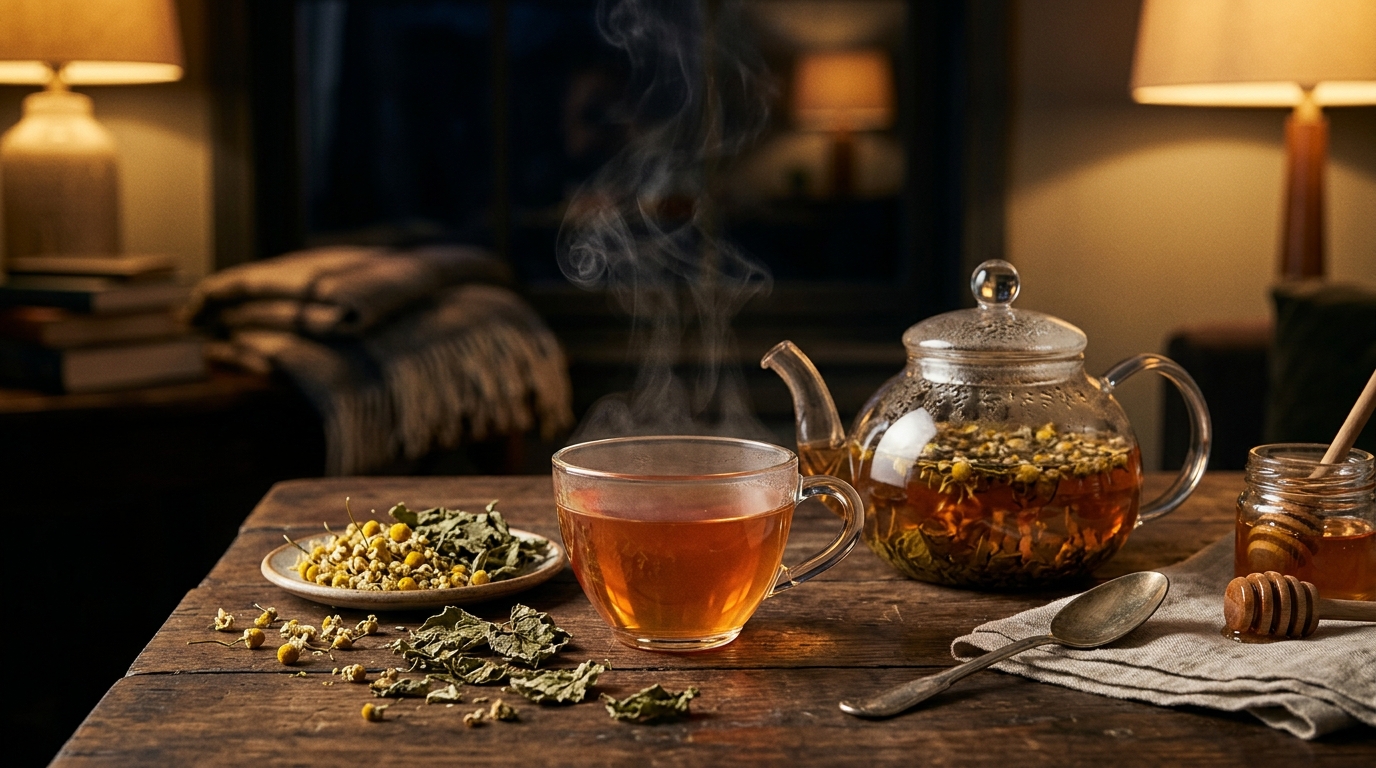
Red raspberry leaf (Rubus idaeus) has been a staple of women’s herbal medicine in Europe and North America for centuries. Midwives and village herbalists brewed it as a tonic for the womb, and the leaf appears in traditional herbals as a companion through menstruation, pregnancy, and recovery. Its reputation is so enduring that many herbalists still call it the woman’s herb. Unlike the fruit, the leaf is dry, tannic, and mineral-rich, with a flavor reminiscent of a mild black tea without the caffeine.
Chamomile (Matricaria chamomilla) needs little introduction. Ancient Egyptians dedicated it to their sun god, and Roman and Greek physicians prescribed it for fevers, digestive upset, and restless nights. Its apple-scented flowers have been steeped as a bedtime drink for generations, and it remains one of the most widely consumed herbal teas in the world.
Brewed together, these two herbs balance each other beautifully. The slightly astringent, earthy raspberry leaf is softened by chamomile’s honeyed, floral sweetness, while the combination speaks to two common evening needs: calming the nervous system and easing the tension that can gather in the pelvic region, especially in the days around menstruation. It is a quiet, grounding cup meant for the last hour of the day.
2
cups
Ingredients
- 2 tspdried red raspberry leaf
- 2 tspdried chamomile flowers
- 480 mlwater (95°C / 203°F)
- —raw honey to taste (optional)
- —a thin slice of lemon (optional)
How to Brew
Click on an item below to shop for the recommended items for this recipe on Amazon.
As an Amazon Associate, we earn from qualifying purchases.
- Bring fresh filtered water to a near boil, then let it rest for about 30 seconds so it settles around 95°C (203°F). Raspberry leaf is a sturdy leaf and tolerates hot water well, but a full rolling boil can push chamomile toward bitterness.
- Add the dried raspberry leaf and chamomile flowers to a teapot or large mug fitted with a tea infuser, using roughly 1 teaspoon of each herb per 240 ml of water. Give the herbs a gentle stir with your finger so they separate and settle loosely.
- Pour the hot water over the herbs, then immediately cover the vessel with a lid or saucer to keep the aromatic oils from escaping as steam.
- Steep for 8 to 10 minutes. Raspberry leaf needs the longer time to release its minerals and tannins, and chamomile holds up well at this duration. Shorter steeping gives a lighter, more floral cup.
- Remove the infuser and press the herbs lightly against the side to extract the last of the liquid. Sweeten with a little raw honey if you like, and sip slowly about an hour before bed.
- Combine 4 teaspoons of dried raspberry leaf and 4 teaspoons of dried chamomile flowers in a large glass jar. This ratio is slightly higher than the hot method because cold water extracts more slowly.
- Pour in 1 liter of cool filtered water and stir well until all the herbs are wet and submerged. Cap the jar tightly.
- Refrigerate for 8 to 12 hours, or overnight. Shake the jar gently once or twice if you pass by it, which helps even out the extraction.
- Strain through a fine mesh sieve or a cloth-lined strainer into a clean jar or pitcher, pressing the herbs gently to release the liquid.
- Serve chilled over ice or let it come to cool room temperature. It keeps in the refrigerator for up to 2 days. For a warm evening cup, you can gently heat a portion on the stove without boiling.
- Place 4 tablespoons of dried raspberry leaf and 2 tablespoons of dried chamomile flowers into a clean 1 liter heatproof glass jar. Using a higher herb-to-water ratio is what distinguishes a true nourishing infusion from an ordinary tea.
- Bring 1 liter of water to a full boil and pour it directly over the herbs, filling the jar to the top.
- Screw the lid on tightly to prevent the aromatic compounds from escaping, and leave the jar on the counter to cool and steep for 4 to 8 hours.
- Strain the dark, richly colored liquid through a fine sieve, squeezing the herbs to extract every drop.
- Drink 1 cup at a time, either warm or at room temperature, and store the rest in the refrigerator for up to 24 hours. Reheat gently on the stove if you prefer it warm.
Health Benefits
Raspberry leaf’s tannins and traditional use as a uterine tonic have made it a common choice for easing menstrual tension, while chamomile’s antispasmodic compounds may help relax smooth muscle. Direct clinical evidence for cramp relief is limited, but chamomile has shown benefit for menstrual discomfort in small trials.
Chamomile’s apigenin interacts with GABA receptors, and small studies have linked chamomile consumption with improved sleep quality and reduced night waking, particularly in people under stress or postpartum.
Clinical research on chamomile extract has shown modest reductions in generalized anxiety symptoms. The ritual of a warm, caffeine-free evening cup also encourages a calming wind-down routine.
Raspberry leaf contains small amounts of calcium, magnesium, potassium, iron, and B vitamins, along with polyphenols. A strong infusion delivers more of these than a quick steep, though it should be seen as a supportive drink rather than a primary nutrient source.
Chamomile has a long record of use for bloating, gas, and mild stomach upset, and its antispasmodic oils may help relax the gut, which can be especially welcome around menstruation.
🧪 Key Bioactive Compounds
The Science Behind Red Raspberry Leaf
The science behind this blend is a tale of two herbs with very different levels of research. Chamomile is relatively well studied. Its flavonoid apigenin has been shown to bind benzodiazepine sites on GABA-A receptors, which likely explains its mild sedative and anxiety-reducing effects. Randomized trials have reported improvements in sleep quality and modest reductions in anxiety scores, although results vary with dose and preparation, and tea is a gentler delivery than concentrated extracts. The essential oil constituents alpha-bisabolol and chamazulene contribute anti-inflammatory and antispasmodic actions that may help relax smooth muscle in the digestive tract.
Red raspberry leaf is traditionally valued, but its modern evidence base is thinner. The leaf is rich in ellagitannins, flavonoids such as kaempferol and quercetin, and minerals including calcium, magnesium, and potassium. Laboratory studies suggest the leaf can relax smooth muscle tissue, which fits with its traditional use for menstrual and uterine support, but human clinical trials are small and often focused on late pregnancy rather than general menstrual health. The alkaloid fragarine, often cited in herbal literature, has not been thoroughly characterized in modern research.
What the blend offers, then, is best understood as complementary support rather than a proven treatment. Chamomile brings the better-documented calming and antispasmodic effects, while raspberry leaf contributes polyphenols, minerals, and a long history of traditional use. Together they create a caffeine-free evening ritual that addresses both nervous system tension and the physical heaviness many women feel in the days around their cycle.
Brewing Tips
- Use whole dried leaf and whole chamomile flowers rather than powdery tea bag dust, which tends to taste harsher and more bitter.
- If you find raspberry leaf too astringent, shorten the steep to 5 minutes or use the cold brew method for a smoother cup.
- Store both herbs in airtight glass jars away from light and heat, and replace them after about a year for the best flavor and potency.
- Drink this tea about 45 to 60 minutes before bed so you have time to settle without needing to get up during the night.
- Let a strong infusion cool and keep it in the fridge to enjoy as a refreshing iced drink the following day.