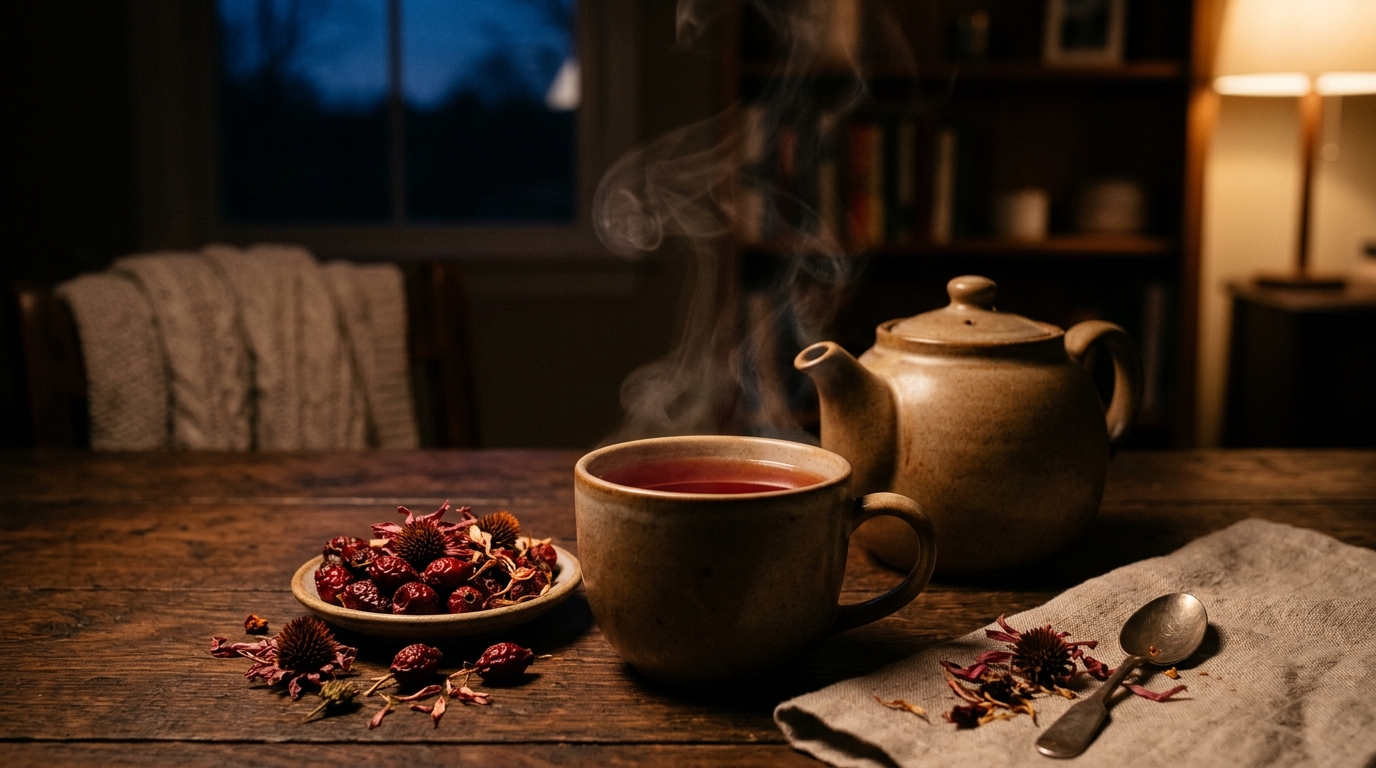
Long before it became a staple of pharmacy shelves, echinacea was one of the most valued medicinal plants of the Great Plains. The Lakota, Cheyenne, Comanche, and many other Indigenous nations used the roots and leaves of purple coneflower (Echinacea purpurea and relatives) for sore throats, infections, snakebites, and wounds. Chewing a fresh root to feel the characteristic numbing tingle on the tongue was a well-known sign of a good plant. European settlers adopted echinacea in the late 1800s, and by the early twentieth century it was among the best-selling herbal remedies in North America before antibiotics took over.
Rose hips tell a different but equally rich story. These are the round, brick-red fruits left behind when a rose blossom fades, and they are among the most concentrated plant sources of vitamin C. During World War II, British schoolchildren were sent into hedgerows to gather wild rose hips, which were turned into syrup to replace scarce citrus fruit. Their bright, tart flavor and generous supply of vitamin C, flavonoids, and carotenoids made them a trusted wintertime tonic across Scandinavia, Britain, and Eastern Europe.
Together, these two herbs make a beautiful pairing: echinacea brings its earthy, slightly peppery depth and traditional immune reputation, while rose hips add fruity tartness, a rosy color, and a boost of vitamin C. Both are naturally caffeine-free, so this blend works wonderfully as an evening ritual when you want to look after yourself without disturbing your sleep.
2
cups
Ingredients
- 2 tspdried echinacea purpurea aerial parts (leaf, flower, and stem), cut and sifted
- 2 tbspdried rose hips, cut and seeded
- 1 tspdried orange peel (optional, for brightness)
- 480 mlwater (95°C / 203°F)
- —raw honey to taste (optional)
- —fresh lemon wedge (optional)
How to Brew
Click on an item below to shop for the recommended items for this recipe on Amazon.
As an Amazon Associate, we earn from qualifying purchases.
- Measure 2 teaspoons of dried echinacea and 2 tablespoons of cut rose hips into a teapot or large mug. If your rose hips are whole rather than cut, gently crush them with the back of a spoon or a mortar and pestle first, so the water can reach the inner flesh.
- Add the orange peel now if you are using it.
- Bring fresh water to a full boil, then let it rest for about 30 seconds to reach roughly 95°C (203°F). Pour 480 ml over the herbs.
- Cover immediately with a lid or saucer and steep for 10 to 12 minutes. This longer time is intentional, since rose hips and echinacea are both sturdy plant materials that need time to release their compounds.
- Strain through a fine mesh strainer into two cups, pressing lightly on the rose hips to release their juice. If any tiny hairs from the rose hips slip through, strain a second time through a paper filter or muslin.
- Stir in honey while the tea is still hot and add a squeeze of lemon if you like. Sip slowly about an hour before bed.
- Combine 2 teaspoons of echinacea and 2 tablespoons of rose hips in a clean glass jar. Crush whole rose hips lightly first so more surface area is exposed.
- Pour in 480 ml of cold, filtered water. Stir once to make sure all the herbs are submerged.
- Seal the jar and place it in the refrigerator for 8 to 12 hours, ideally overnight. Give the jar a gentle shake once or twice if you remember.
- Strain through a fine mesh strainer lined with a coffee filter or muslin cloth to catch the fine rose hip hairs.
- Serve over ice for a refreshing midday tonic, or pour into a saucepan and warm very gently over low heat for 2 to 3 minutes until just steaming. Do not boil.
- Store any leftovers in the refrigerator and drink within 48 hours.
- Place 2 tablespoons of lightly crushed rose hips and the optional orange peel in a small saucepan with 540 ml of cold water.
- Bring slowly to a gentle simmer over medium-low heat, then reduce the heat so only a few small bubbles rise. Partially cover and simmer for 15 minutes, which softens the rose hip skins and turns the liquid a deep red.
- Remove the pan from the heat and stir in 2 teaspoons of dried echinacea. Cover fully and let everything steep for 10 minutes.
- Strain through a fine mesh strainer lined with muslin, pressing gently on the rose hips with a spoon to extract every bit of liquid.
- Sweeten with honey, add a lemon wedge if desired, and serve warm. This version makes a rich, syrupy cup that is especially comforting when you feel a cold coming on.
Health Benefits
Several clinical trials and meta-analyses suggest echinacea preparations may modestly lower the risk of catching a cold and shorten its length, though results vary by product and study quality. Regular use during cold season rather than a single dose appears to matter.
Vitamin C contributes to the normal function of neutrophils and other immune cells. Rose hips supply it alongside flavonoids that may enhance its antioxidant effects, though brewing heat does degrade some of the vitamin.
Cichoric acid from echinacea and the carotenoids, polyphenols, and vitamin C from rose hips combine to neutralize free radicals, which supports overall cellular health during times of stress.
Rose hip powder has been studied in randomized trials for mild osteoarthritis, with some evidence of reduced pain, likely due to the galactolipid GOPO and anti-inflammatory polyphenols. A tea delivers lower amounts than concentrated extracts but may still contribute.
Sipping a warm, caffeine-free herbal infusion supports hydration and encourages relaxation before bed, while the sore-throat-soothing warmth is a time-honored comfort during illness.
🧪 Key Bioactive Compounds
The Science Behind Echinacea
Echinacea’s reputation rests largely on three groups of compounds: alkamides, caffeic acid derivatives such as cichoric acid, and polysaccharides. The alkamides are especially interesting. They are structurally similar to endocannabinoids and have been shown in laboratory studies to interact with CB2 receptors on immune cells, influencing the release of inflammatory messengers called cytokines. They also create the tongue-tingling sensation that herbalists use as a quality marker. Because alkamides are more soluble in alcohol than in water, a simple tea extracts them less efficiently than a tincture, which is one reason hot water infusions tend to taste milder and may be somewhat less potent.
Human trials on echinacea have produced mixed results, largely because products differ so much in species, plant part, extraction method, and dose. A widely cited Cochrane review found that some echinacea preparations may offer a modest benefit for preventing colds, while evidence for treating established colds is less consistent. The most promising results tend to come from products made from the aerial parts of Echinacea purpurea, which is why this blend uses the leaf, stem, and flower rather than the root alone.
Rose hips contribute a very different kind of support. Fresh rose hips can contain several hundred milligrams of vitamin C per 100 grams, though levels fall during drying and brewing because ascorbic acid is sensitive to heat and light. A cup of tea will not match a vitamin C supplement, but it still delivers some vitamin C along with carotenoids, flavonoids, and tannins that work together as antioxidants. Rose hip extracts have also been studied for joint comfort, with the galactolipid GOPO emerging as a compound of interest. Taken together, this blend is best thought of as a nourishing, supportive ritual rather than a cure.
Brewing Tips
- Choose echinacea labeled as the aerial parts of Echinacea purpurea if you want a mild, pleasant tea; root-heavy blends tend to be more bitter and numbing.
- Always buy cut and seeded rose hips for tea, and strain through muslin or a coffee filter to avoid the fine, itchy hairs found around the seeds.
- Keep your dried herbs in airtight, opaque jars away from light and heat, since both vitamin C and alkamides degrade over time.
- Steep covered and add lemon at the end, since a little acidity can help preserve and complement the flavor of the rose hips.
- Use this tea for short stretches when you feel run down, such as a week at a time, rather than daily all year.