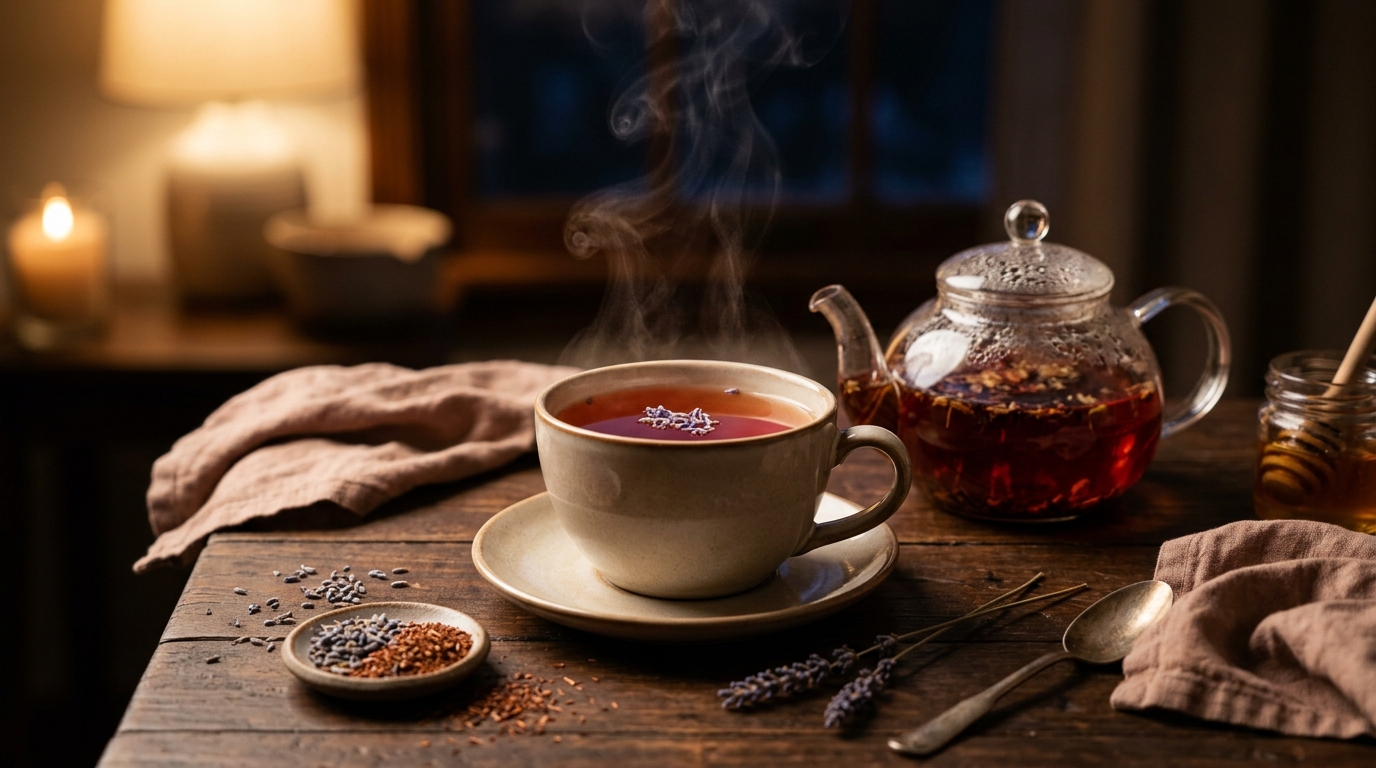
Lavender (Lavandula angustifolia) has been woven into evening rituals for well over two thousand years. The Romans scented their baths with it, and its name likely descends from the Latin lavare, to wash. Medieval herbalists tucked sprigs into pillows and strewing herbs to ease restless nights, and in the Provence region of France, lavender fields became inseparable from the idea of rest itself. Its flowers carry a clean, floral perfume that the body seems to recognize as a signal to slow down.
Rooibos (Aspalathus linearis), the red bush of South Africa’s Cederberg mountains, has a much younger story in the global tea cupboard but a long one at home. The Khoikhoi and San peoples harvested the needle-like leaves of this fynbos shrub for generations, and in the early twentieth century it became a staple across South Africa as an affordable, gentle alternative to black tea. Once the leaves are bruised and oxidized, they turn a deep russet and develop a naturally sweet, woody, almost caramel-like character. Rooibos contains no caffeine and very little tannin, so it never turns bitter or astringent, however long it steeps.
Together, the two herbs solve a common problem with bedtime blends. Lavender alone can taste soapy or perfumey if overdone, and many calming herbs are thin and grassy in the cup. Rooibos provides the body, sweetness, and warmth that carry lavender’s delicate florals, turning a medicinal-tasting remedy into a drink you actually look forward to. The result is a cozy, amber-red nightcap with a soft purple-floral lift on the finish.
2
cups
Ingredients
- 2 tspdried rooibos leaves
- 1 tspdried culinary lavender buds
- 480 mlwater (95°C / 203°F)
- —raw honey or a splash of oat milk to taste (optional)
- —a thin strip of orange peel (optional)
How to Brew
Click on an item below to shop for the recommended items for this recipe on Amazon.
As an Amazon Associate, we earn from qualifying purchases.
- Measure 2 teaspoons of rooibos and 1 teaspoon of culinary lavender buds into a teapot or a large infuser basket, giving the leaves room to expand.
- Heat fresh water until it just comes off the boil, then let it rest for 30 seconds so it settles near 95°C (203°F). Fully rolling boiling water can scorch the delicate lavender and push it toward a perfumey, soapy edge.
- Pour the water over the herbs and cover the pot or mug with a small saucer to hold in the aromatic volatile oils that give lavender its calming scent.
- Steep for 6 to 8 minutes. Rooibos needs this longer window to release its sweetness and color, while the lavender will have given up its best flavor by this point.
- Strain thoroughly so no buds remain in the cup, then sip slowly. Add a little honey or oat milk if you like, and enjoy it 30 to 60 minutes before bed.
- Combine 3 tablespoons of rooibos and 1 teaspoon of lavender buds in a large glass jar. The ratio is higher than hot brewing because cold water extracts more slowly.
- Add 1 liter of cold, filtered water and stir gently to wet all of the leaves and buds.
- Seal the jar and refrigerate for 8 to 12 hours, or overnight. Avoid leaving it on the counter, as the lavender can ferment slightly in warm rooms over this length of time.
- Strain through a fine mesh sieve or a coffee filter into a clean pitcher, pressing lightly on the herbs to release the remaining liquid.
- Serve over ice or straight from the fridge. The cold brew keeps for up to 3 days in a sealed container.
- Place 1/4 cup of rooibos and 2 tablespoons of lavender buds in a heatproof jar or pot.
- Pour over 500 ml of water at 95°C (203°F), cover tightly, and steep for 15 minutes. The longer infusion draws out a deep, syrupy, caramel-like base.
- Strain the concentrate through a fine sieve into a clean bottle or jar, pressing the herbs to extract as much liquid as possible.
- To serve hot, mix 1 part concentrate with 2 to 3 parts hot water, or warm it gently with steamed oat milk for a soothing rooibos lavender latte.
- Store the cooled concentrate in the refrigerator for up to 4 days and dilute individual portions as needed.
Health Benefits
Linalool and linalyl acetate from lavender interact with the nervous system in ways that reduce feelings of anxiety, and clinical trials of lavender oil preparations have shown measurable anxiolytic effects. Drinking the tea adds the benefit of a calming sensory ritual, though most strong evidence comes from standardized oil capsules rather than tea.
Lavender aroma and ingestion have been associated with improved sleep quality and a lighter, easier transition to rest in several small studies. Pairing it with a caffeine-free base like rooibos means nothing in the cup works against your wind-down.
Rooibos is rich in aspalathin, nothofagin, and quercetin, which have demonstrated antioxidant activity in laboratory and some human studies. These compounds help neutralize oxidative stress, though tea is best viewed as one small part of a broader healthy diet.
Both herbs have traditional use as mild digestive soothers, and rooibos is naturally low in tannins, making it easier on sensitive stomachs than black or green tea. Lavender has long been used to calm nervous digestion and reduce bloating after meals.
Because neither herb contains caffeine, this tea can be enjoyed late in the day without disrupting sleep. The warming, deliberate act of preparing and sipping a cup also helps signal to the body that the day is winding down.
🧪 Key Bioactive Compounds
The Science Behind Lavender
The calming reputation of lavender rests largely on two aromatic compounds, linalool and linalyl acetate, which together make up a large share of its essential oil. Linalool has been shown in animal and human research to influence GABAergic and glutamatergic signaling, the same broad neurochemical systems targeted by many anti-anxiety medications, though at much gentler levels. Clinical trials of an oral lavender oil preparation (Silexan) have found reductions in anxiety scores comparable to some conventional treatments, while studies on sleep show modest but consistent improvements in perceived sleep quality. It is worth noting that much of this evidence involves standardized oil rather than brewed tea, so the cup is best understood as a supportive, ritual-based aid rather than a clinical dose.
Rooibos brings a different kind of chemistry. Its flavor and color come from a family of polyphenols, including the dihydrochalcones aspalathin and nothofagin, which are found in meaningful amounts almost nowhere else in the plant kingdom. Laboratory and small human studies suggest these compounds act as antioxidants and may support healthy glucose metabolism and vascular function. Fermented (red) rooibos loses some aspalathin during oxidation but gains its characteristic sweet, woody flavor, while unfermented green rooibos retains more of the original antioxidant content with a grassier taste.
Equally important is what rooibos leaves out. It contains no caffeine and is very low in tannins, the astringent compounds that make black tea bitter and can interfere with iron absorption. That combination is what allows it to serve as a full-bodied, forgiving base for delicate botanicals like lavender, creating a blend where flavor, comfort, and function support one another.
Brewing Tips
- Use culinary-grade lavender and measure carefully. Too many buds is the most common reason lavender tea tastes soapy, so start with 1 teaspoon per 480 ml and adjust only after tasting.
- Cover your cup while it steeps. Lavender’s calming aromatics are volatile and escape quickly, so a saucer or lid captures more of the scent and flavor.
- Make the evening ritual part of the benefit. Dim the lights, put your phone away, and sip slowly. The routine itself reinforces the signal to your body that it is time to rest.
- Store both herbs in airtight, opaque containers away from heat and light, and aim to use lavender within a year for the best aroma.