Ashwagandha (Withania somnifera) has been a cornerstone of Ayurvedic medicine for more than 3,000 years. Its Sanskrit name translates roughly to “smell of the horse,” a nod to the root’s distinctive musky aroma and to the traditional belief that it imparts the strength and vitality of a stallion. In Ayurveda it is classed as a rasayana, a rejuvenating tonic taken to build resilience, support healthy aging, and calm an overworked nervous system.
Modern herbalists place ashwagandha in the adaptogen category, a group of botanicals thought to help the body adapt to physical and mental stress. Its Latin species name, somnifera, means “sleep-inducing,” and while the root is not a sedative in the way valerian is, it has long been taken in the evening to quiet racing thoughts and soften the wired-but-tired feeling that follows a demanding day. Traditionally, the dried root powder was simmered in warm milk with a little ghee and honey as a bedtime restorative.
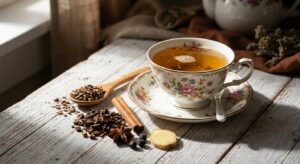
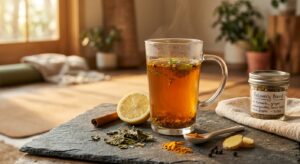
As a tea, ashwagandha is an acquired but deeply comforting pleasure. The flavor is earthy, slightly bitter, and faintly sweet, a bit like a mild root vegetable crossed with warm hay. Paired with soothing spices like cinnamon and cardamom, it becomes a grounding evening ritual that signals to your body that the day is done.
2
cups
Ingredients
- 1 tspdried ashwagandha root pieces or coarse powder
- 480 mlfiltered water
- 1 small stickcinnamon (optional)
- 2 podsgreen cardamom, lightly crushed (optional)
- —raw honey or maple syrup to taste (optional)
- —splash of warm milk or oat milk (optional)
How to Brew
Click on an item below to shop for the recommended items for this recipe on Amazon.
As an Amazon Associate, we earn from qualifying purchases.
- Bring filtered water to a full boil, then let it rest for about 30 seconds so it sits just off the boil.
- Place the ashwagandha root pieces, cinnamon stick, and crushed cardamom pods into a teapot or a large mug fitted with a fine-mesh infuser.
- Pour the hot water over the herbs, cover the vessel with a lid or saucer to trap the aromatic steam, and set a timer for 12 minutes.
- While it steeps, swirl the pot gently once or twice to keep the powdery particles circulating.
- Strain thoroughly through a fine-mesh strainer or a coffee filter to remove fine sediment, since ashwagandha powder can leave a gritty texture.
- Stir in honey and a splash of warm milk if desired, and sip slowly about 30 to 60 minutes before bed.
- Combine the ashwagandha root pieces and 480 ml of water (or half water and half milk of your choice) in a small saucepan.
- Add the cinnamon stick and cardamom, then bring the mixture to a boil over medium heat.
- As soon as it boils, reduce the heat to low so the liquid barely bubbles, partially cover the pan, and simmer for 15 to 20 minutes until the liquid has reduced by about a quarter and turned a deeper golden tan.
- Remove from the heat and let the decoction rest, covered, for 5 minutes so the flavors settle and the particles sink.
- Strain through a fine-mesh sieve into your mug, pressing the root pieces lightly to release the last of the liquid.
- Sweeten with honey or maple syrup and add a tiny pinch of ground nutmeg if you like, then drink warm.
- Add 1 tablespoon of ashwagandha root pieces and the crushed cardamom pods to a clean glass jar, using a slightly higher herb ratio than the hot method to compensate for the cooler extraction.
- Pour in 480 ml of cool filtered water, stir well, and seal the jar with a tight lid.
- Leave the jar on the counter for 1 hour to let the root begin hydrating, then transfer it to the refrigerator.
- Steep in the fridge for 8 to 12 hours, giving the jar a gentle shake once or twice if you remember.
- Strain the liquid through a fine-mesh sieve lined with a coffee filter or muslin to catch the fine sediment.
- Serve over ice with a thin slice of orange or a drizzle of honey, and finish the batch within 48 hours.
Health Benefits
Several randomized controlled trials have found that standardized ashwagandha root extract significantly reduced serum cortisol in chronically stressed adults compared with placebo. It is thought to modulate the hypothalamic-pituitary-adrenal (HPA) axis, the body’s central stress-response system.
Clinical studies in adults with sleep difficulties have reported improvements in sleep onset, sleep efficiency, and overall sleep quality after several weeks of ashwagandha supplementation. The effect appears strongest in people whose poor sleep is driven by stress.
Multiple trials using validated stress and anxiety scales found reduced scores in participants taking ashwagandha over 6 to 8 weeks. Results are encouraging, though most studies used concentrated extracts rather than tea.
Early research suggests ashwagandha may support attention, memory, and reaction time in stressed or mildly impaired adults, likely through its antioxidant and neuroprotective withanolides.
As a traditional rasayana, ashwagandha is used to help the body recover from physical and mental strain. Some studies note improved perceived energy and reduced fatigue with consistent use.
🧪 Key Bioactive Compounds
The Science Behind Ashwagandha
The pharmacological interest in ashwagandha centers on a family of steroidal lactones called withanolides, with withaferin A and withanolide A the most studied. These compounds appear to influence the HPA axis, the hormonal feedback loop that governs cortisol release. In chronic stress, this axis can become overactive, keeping cortisol elevated into the evening when it should be falling. By helping to dampen that overactivity, ashwagandha may allow cortisol to decline more naturally ahead of sleep.
A second proposed mechanism involves the brain’s inhibitory signaling. Research suggests certain ashwagandha constituents may interact with GABA pathways, the same calming neurotransmitter system targeted by many sleep aids, though far more gently. Triethylene glycol, isolated from the leaf, has been linked to sleep induction in animal models, and the root’s alkaloids and withanolides may add to its nervine, settling effect.
It is worth being honest about the evidence. Most high-quality human trials used standardized root extracts delivered in capsules, often providing 300 to 600 mg of extract daily for 6 to 12 weeks. A cup of tea made from raw root delivers a smaller and more variable dose, so tea is best seen as a gentle, ritual-based way to enjoy the herb rather than a clinical-strength intervention. Decoction and hot brewing extract more of the heat-stable compounds than cold brewing, which is one reason the traditional simmered preparation remains popular.
Brewing Tips
- Use a fine-mesh strainer or a paper coffee filter, since ashwagandha powder can make the tea gritty if left unfiltered.
- Start with a half-teaspoon of root for the first few evenings to see how your body responds, then increase to a full teaspoon.
- Drink it 30 to 60 minutes before bed and pair it with a screen-free wind-down routine to amplify the calming effect.
- Consistency matters more than quantity, since the studied benefits appeared after several weeks of regular use rather than a single cup.
- Soften the earthy bitterness with warming spices like cinnamon, cardamom, or a pinch of ginger, plus a little honey or warm milk.