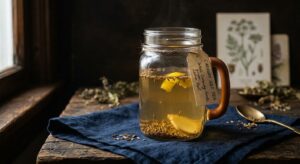
Dandelion (Taraxacum officinale) has been valued as medicine for well over a thousand years. Arab physicians of the 10th and 11th centuries wrote of its use for liver and spleen complaints, and European herbalists later gave it names like pissenlit in French for its diuretic reputation. While the leaves and flowers each have their culinary place, the root has long been the herbalist’s choice for digestion. It was roasted and brewed as a coffee substitute in times of scarcity, and its deep, toasty bitterness was recognized as a signal that wakes up the digestive system.
Licorice root (Glycyrrhiza glabra) is among the oldest sweeteners and remedies in the world. Sealed jars of it were found in the tomb of Tutankhamun, and it holds a central place in Traditional Chinese Medicine, where it is called gan cao, the ‘sweet herb,’ and is often added to formulas to harmonize other ingredients. Its main sweet compound, glycyrrhizin, is roughly 30 to 50 times sweeter than sugar, which means a small piece of root can sweeten an entire pot of tea.
Together, these two roots make a brilliant after-dinner pairing. The dandelion brings earthy, slightly bitter, roasted notes, while the licorice rounds them off with a lingering, anise-like sweetness. The result tastes a bit like a mellow, caffeine-free coffee alternative, making it a deeply satisfying ritual for the end of the day when you want something warm, grounding, and gentle on a full stomach.
2
cups
Ingredients
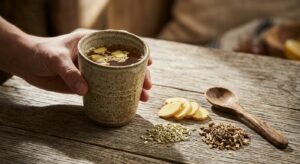
- 2 tsproasted dandelion root, chopped or granulated
- 1 tspdried licorice root, cut and sifted
- 480 mlwater (just off the boil, 95°C / 203°F)
- —a thin slice of fresh ginger (optional)
- —a splash of oat milk or a pinch of cinnamon to finish (optional)
How to Brew
Click on an item below to shop for the recommended items for this recipe on Amazon.
As an Amazon Associate, we earn from qualifying purchases.
- Measure 2 teaspoons of roasted dandelion root and 1 teaspoon of licorice root into a large teapot or two infuser mugs. Roasted dandelion root has a darker, richer flavor than raw, so choose roasted if you want that coffee-like depth.
- Bring fresh water to a boil, then let it rest for about 30 seconds so it sits near 95°C (203°F). Roots handle hotter water well because their flavor compounds are locked inside tough plant tissue.
- Pour 480 ml of water over the roots, cover the pot or cup with a saucer or lid, and steep for 10 to 12 minutes. Covering traps the sweet, aromatic licorice compounds.
- Strain through a fine mesh sieve or lift out the infuser. Taste the tea before adding anything, as licorice often provides all the sweetness you need.
- Finish with a splash of oat milk, a pinch of cinnamon, or a thin slice of ginger if desired, and sip slowly about 20 to 30 minutes after your meal.
- Add 3 tablespoons of roasted dandelion root and 1 tablespoon of licorice root to a clean 1-liter glass jar. Use a slightly higher ratio than hot brew because cold water extracts more slowly.
- Pour in 1 liter of cold, filtered water and stir gently with a long spoon to wet all the root pieces.
- Seal the jar and refrigerate for 10 to 12 hours, or overnight. Give the jar a gentle swirl once if you remember.
- Strain through a fine mesh sieve or a cloth-lined funnel into a clean bottle or pitcher, pressing lightly on the roots to release remaining liquid.
- Serve over ice with a slice of orange peel or a sprig of mint. Store in the refrigerator and drink within 2 to 3 days.
- Combine 2 tablespoons of roasted dandelion root and 1 tablespoon of licorice root in a small stainless steel or enameled saucepan. Add 600 ml of cold water so the roots heat up gradually with the water.
- Bring the pot slowly to a gentle boil over medium heat, then immediately reduce to a low simmer. You should see small lazy bubbles, not a vigorous boil.
- Partially cover the pan and simmer for 15 to 20 minutes, until the liquid reduces by about one quarter and turns a deep mahogany color. Add a coin of fresh ginger in the last 5 minutes for extra warmth if you like.
- Remove from the heat and let the decoction rest, covered, for 5 minutes so the flavors settle and the roots sink.
- Strain through a fine mesh sieve into a warmed mug. Dilute with a little hot water if the flavor is too concentrated, and enjoy slowly. Leftover decoction keeps in the fridge for up to 2 days and can be gently rewarmed.
Health Benefits
The bitter compounds in dandelion root activate bitter taste receptors, which traditionally are understood to prompt the release of digestive juices and bile. This is why bitter herbs are classic after-dinner remedies for heaviness and bloating.
Dandelion root is high in inulin, a prebiotic fiber that selectively feeds beneficial gut microbes. Human trials on inulin more broadly show improvements in stool regularity and microbiome balance.
Licorice root has a long history as a demulcent for heartburn and upset stomach, and deglycyrrhizinated licorice (DGL) has been studied for gastric comfort. Whole licorice root tea provides mucilage-like soothing, though its glycyrrhizin content calls for moderation.
Dandelion root is classified in herbal medicine as a cholagogue, meaning it encourages bile flow. While robust human evidence is limited, its traditional use for liver support is long-standing and supported by preliminary animal research.
With no caffeine and a naturally sweet, roasted flavor, this tea satisfies the craving for a warm coffee-like drink without interfering with sleep, making it ideal for winding down.
🧪 Key Bioactive Compounds
The Science Behind Dandelion Root
The digestive reputation of dandelion root rests largely on its bitter constituents and its fiber. Sesquiterpene lactones give the root its characteristic bitterness, and bitter taste receptors are found not only on the tongue but along the digestive tract. Activating them is thought to promote gastric secretions and bile release, which is the physiological logic behind the age-old habit of taking bitters before or after meals. Dandelion root is also one of the richest plant sources of inulin, a fructan that passes undigested to the colon where it ferments and nourishes beneficial bacteria, producing short-chain fatty acids that support the health of the gut lining.
Licorice contributes a very different but complementary set of actions. Glycyrrhizin and related flavonoids such as liquiritin and isoliquiritigenin have demonstrated anti-inflammatory and antioxidant properties in laboratory and some clinical research. Licorice is also rich in mucilaginous and saponin-like compounds that form a soothing film over irritated tissue, which helps explain its traditional use for heartburn and gastritis. This is also why licorice is called a harmonizing herb in Traditional Chinese Medicine: it softens the harshness of bitter or strong herbs in a blend.
It is worth being honest about the state of the evidence. Much of the research on dandelion root comes from animal and cell studies, and well-designed human trials are still limited, so its benefits are best described as supported by long traditional use and plausible mechanisms rather than conclusively proven. Licorice has stronger pharmacological data, but the same glycyrrhizin that gives it its sweetness and activity is also responsible for its side effects at high intake, which is why moderation is key. Enjoyed occasionally and mindfully, this tea is a pleasant way to support after-dinner comfort.
Brewing Tips
- Choose roasted dandelion root over raw for a richer, coffee-like flavor, or buy raw root and dry-roast it in a pan for a few minutes until fragrant.
- Because licorice is so naturally sweet, taste the tea before adding any sweetener, and keep licorice to about a teaspoon per pot to stay on the moderate side.
- Make a double batch of the decoction in the evening, refrigerate it, and gently rewarm a cup the next night for a quick ritual.
- Sip the tea slowly 20 to 30 minutes after eating, when the digestive system is most receptive to a gentle bitter prompt.