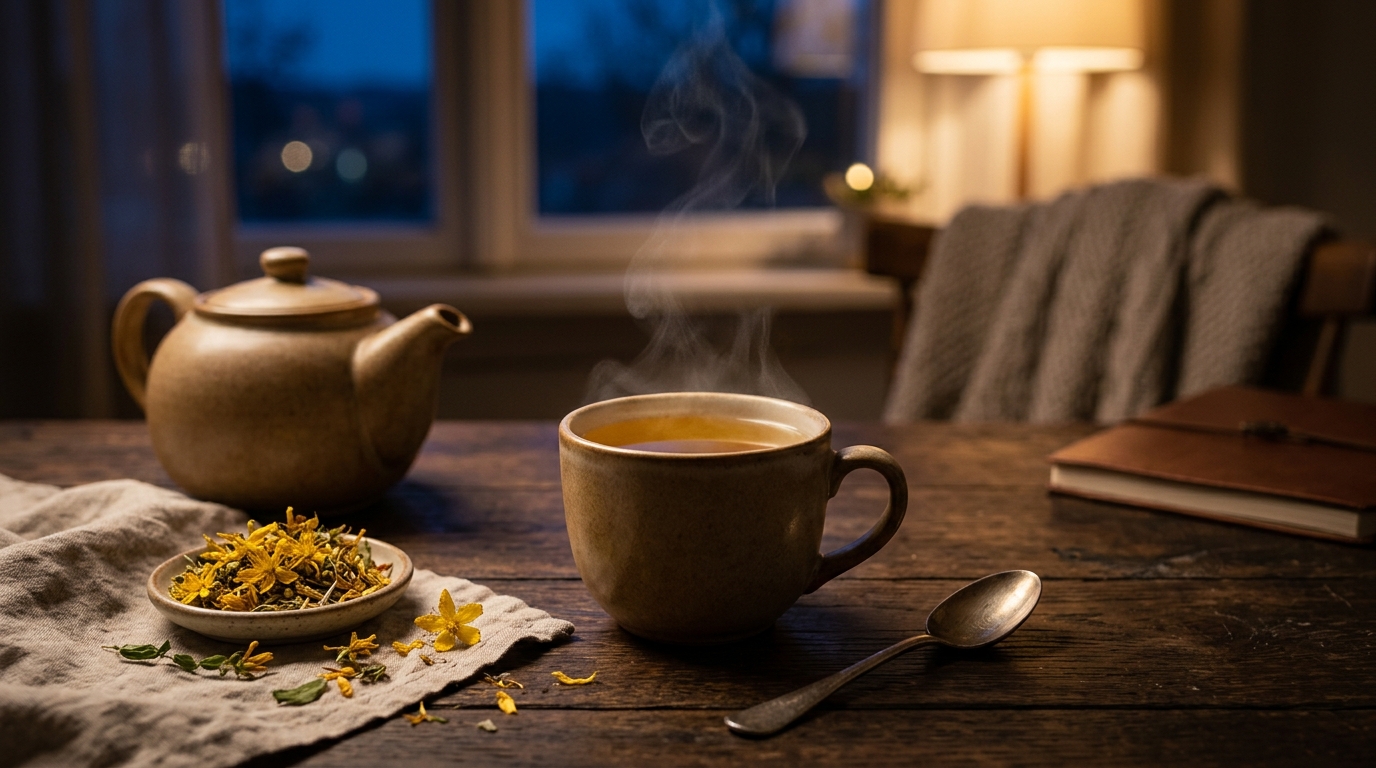
St. John’s Wort has been woven into European folk medicine for well over two thousand years. Its name is tied to the feast of St. John the Baptist on June 24th, when the bright yellow flowers burst into bloom around the summer solstice. Greek physicians including Hippocrates and Dioscorides wrote of the plant, and medieval herbalists hung it above doorways to ward off evil spirits and melancholy alike. Crush a fresh flower between your fingers and it stains them a deep reddish purple, a vivid sign of the pigments that give the plant its character.
In traditional herbalism, St. John’s Wort was prized as a remedy for what older texts called a heavy heart, restlessness, and nervous tension. Today it remains one of the most widely studied botanicals for mild low mood. As an evening tea, it fits into a quiet routine: the warm cup, the soft floral aroma, and the unhurried act of steeping all signal the day is winding down.
The tea itself is delicate and surprisingly pleasant. Where capsules deliver concentrated extracts, a cup of tea offers a gentler dose of the plant’s water-soluble compounds, along with a flavor that is lightly bitter, resinous, and honeyed. It pairs beautifully with other calming herbs, and it rewards patience, since a covered steep helps hold in the aromatic oils. Before you brew, though, read the cautions below carefully. St. John’s Wort interacts with a long list of medications, which makes it an herb to respect.
2
cups
Ingredients
- 2 tspdried St. John’s Wort flowering tops (cut and sifted)
- 480 mlfiltered water (95°C / 203°F)
- —raw honey to taste (optional)
- —thin slice of lemon or a pinch of dried lemon balm (optional)
How to Brew
Click on an item below to shop for the recommended items for this recipe on Amazon.
As an Amazon Associate, we earn from qualifying purchases.
- Measure 2 teaspoons of dried St. John’s Wort into a tea infuser or directly into a warmed teapot. Warming the pot first with a splash of hot water helps keep the temperature steady during steeping.
- Heat filtered water to just below a full boil, around 95°C (203°F). If you do not have a thermometer kettle, bring water to a boil and let it rest for about 30 seconds.
- Pour 480 ml of the hot water over the herbs, cover the pot or mug with a saucer or lid, and set a timer for 8 to 10 minutes. The longer end gives a deeper color and more pronounced flavor.
- Strain through a fine mesh or lift out the infuser, pressing the herbs lightly against the side to release the last of the liquid.
- Sweeten with a little raw honey if desired, then sip slowly about 45 to 60 minutes before bed, dimming the lights as you drink.
- Add 2 tablespoons of dried St. John’s Wort to a clean glass jar. Cold extraction is gentler, so the ratio is increased slightly compared to the hot brew.
- Pour in 1 liter of cold filtered water and stir once to wet all of the herbs.
- Seal the jar and refrigerate for 8 to 12 hours, or overnight. Avoid leaving it on the counter for the full time, since low-acid herbal infusions can spoil at room temperature.
- Strain the tea through a fine mesh sieve or a coffee filter into a clean pitcher to remove all plant fragments.
- Serve over ice or straight from the fridge in the early evening, with a slice of lemon if you like. Drink within 48 hours and keep refrigerated.
- Combine 1 teaspoon of dried St. John’s Wort, 1 teaspoon of dried lemon balm, and a few strips of dried orange peel in a small teapot.
- Heat 480 ml of water to 90°C (194°F), which is slightly cooler than the standard brew to protect the delicate lemon balm oils.
- Pour the water over the blend, cover tightly, and let the pot sit undisturbed for 12 to 15 minutes. The extended covered rest allows the mixed herbs to meld.
- Strain into a mug, discarding the plant material. Stir in a small spoonful of honey if you want to round out the bitterness.
- Sip slowly, inhaling the citrus and herbal steam before each mouthful as part of a deliberate wind-down ritual.
Health Benefits
Multiple clinical trials and meta-analyses have found St. John’s Wort extracts effective for mild to moderate low mood, likely through effects on serotonin, dopamine, and norepinephrine signaling. Note that most of this evidence comes from standardized extracts, not tea, so the effect of a cup is gentler.
Traditionally used for restlessness and an agitated mind, the herb’s flavonoids and other constituents are thought to help settle nervous tension, making it a fitting companion to an evening routine.
The act of brewing and sipping a warm, aromatic tea is itself a proven relaxation cue. Combined with the herb’s traditional mood-lifting reputation, it can help the mind transition toward rest.
Rich in flavonoids such as quercetin, rutin, and hyperoside, St. John’s Wort offers antioxidant activity in laboratory studies, though human evidence for this effect from tea is limited.
🧪 Key Bioactive Compounds
The Science Behind St. John’S Wort
The research on St. John’s Wort centers on two groups of compounds: the phloroglucinol hyperforin and the naphthodianthrone hypericin, alongside a range of flavonoids. Hyperforin is believed to be the most important contributor to mood effects. Rather than blocking a single transporter, it appears to raise levels of several neurotransmitters, including serotonin, dopamine, and norepinephrine, by altering how neurons take them back up. Hypericin and the flavonoids likely play supporting roles.
A large body of clinical research, including Cochrane reviews, has found that standardized St. John’s Wort extracts can be as effective as some conventional antidepressants for mild to moderate low mood, with fewer side effects in many trials. However, these studies use concentrated, standardized extracts delivered in measured doses. A cup of tea contains lower and more variable amounts of these compounds, and hyperforin in particular is lipophilic, meaning it dissolves poorly in water. Tea is therefore best understood as a gentle, ritual-centered way to enjoy the herb, not a substitute for clinical treatment.
The same enzyme-inducing activity that makes the herb pharmacologically interesting is also the source of its medication interactions. Hyperforin activates the pregnane X receptor, which ramps up the liver’s production of metabolic enzymes that break down many drugs faster than intended. This is why even moderate, regular use can undermine other medications, and it is the central reason professional guidance matters before making this tea part of a nightly routine.
Brewing Tips
- Buy St. John’s Wort from a reputable supplier that sources flowering tops harvested at peak bloom, as the flowers and buds carry the highest concentration of active compounds.
- Store the dried herb in an airtight, opaque container away from light and heat, since both degrade its pigments and aromatic oils over time.
- Drink the tea in the early evening rather than right at bedtime, and limit sun exposure the following day if you notice any skin sensitivity.
- Be patient and consistent: traditional use suggests the herb works gradually, not as an immediate sedative, and it is not a sleeping aid in the way valerian or chamomile can be.