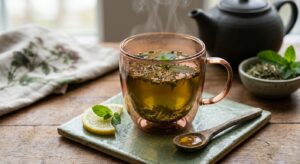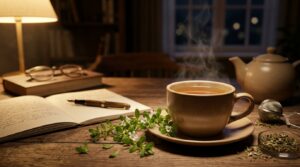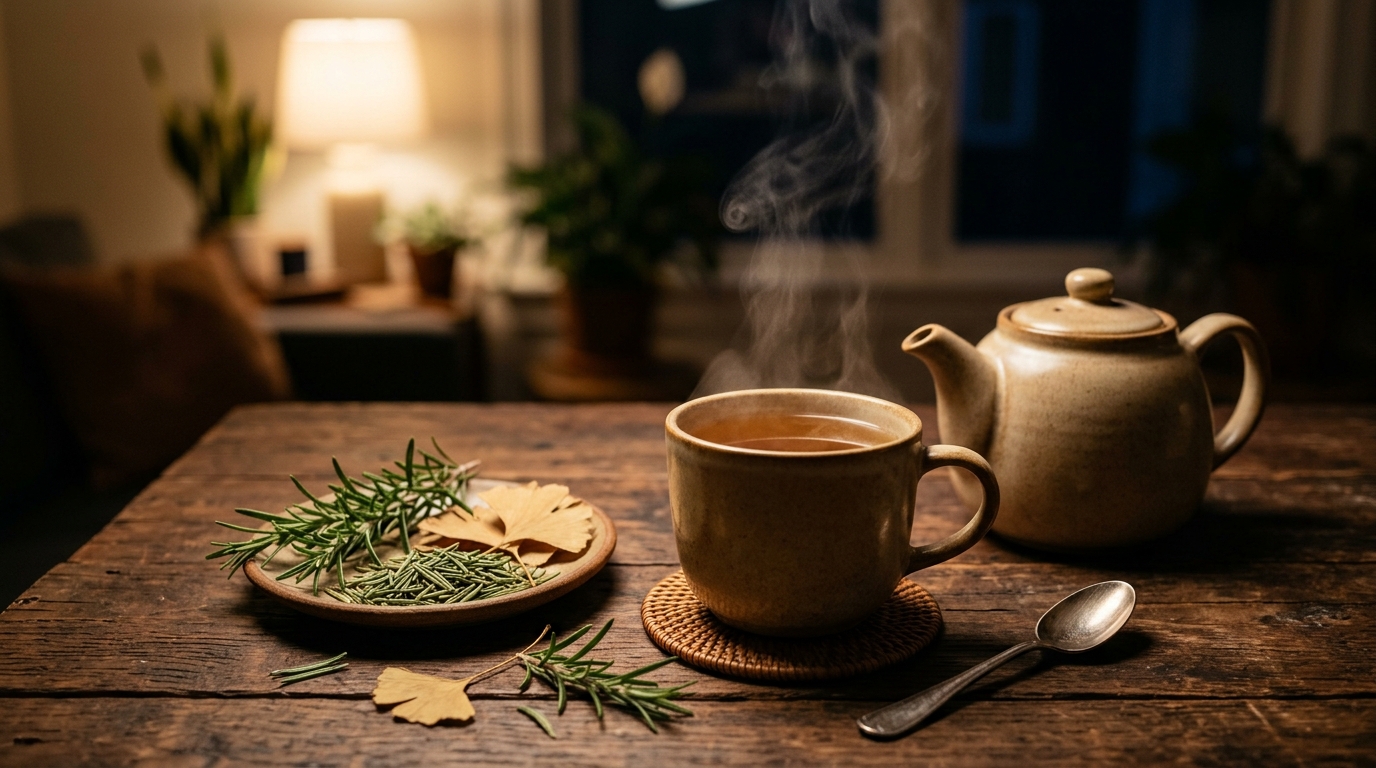
Rosemary has been tied to memory for thousands of years. Ancient Greek students reportedly wore rosemary garlands while studying for exams, and in Shakespeare’s Hamlet, Ophelia declares, ‘There’s rosemary, that’s for remembrance.’ Mediterranean herbalists brewed its needle-like leaves for headaches, sluggish digestion, and mental fatigue, and the plant’s resinous, pine-and-camphor aroma has long been considered a natural wake-up call for the mind.
Ginkgo biloba is among the oldest living tree species on Earth, a botanical survivor that has changed little in over 200 million years. Traditional Chinese medicine has used ginkgo seeds for centuries, while the leaves became the focus of modern research, particularly in Europe, where standardized leaf extracts are widely studied for circulation and cognitive support. As a tea, ginkgo leaf is mild, slightly bitter, and grassy, with a gentle woody sweetness.
Together, these two herbs make a fascinating evening pairing. Rosemary brings bright, aromatic, savory notes and a long folk reputation for alertness, while ginkgo adds a soft, earthy backbone and a traditional association with healthy blood flow to the brain. Because neither herb contains caffeine, this blend suits those late-evening hours when you want a clear head without risking a sleepless night.
2
cups
Ingredients
- 1 tspdried rosemary leaves
- 2 tspdried ginkgo leaf, cut and sifted
- 480 mlwater (95°C / 203°F)
- —a strip of lemon peel (optional)
- —raw honey to taste (optional)
How to Brew
Click on an item below to shop for the recommended items for this recipe on Amazon.
As an Amazon Associate, we earn from qualifying purchases.
- Bring fresh, filtered water to a near boil, then let it rest for about 30 seconds so it settles at roughly 95°C (203°F). Fully boiling water can push the ginkgo toward bitterness.
- Lightly crush the dried rosemary between your fingertips as you drop it into a teapot or large mug. This breaks the leaves slightly and helps release their oils.
- Add the ginkgo leaf and the optional strip of lemon peel to the same vessel.
- Pour the hot water over the herbs, cover immediately with a lid or saucer, and steep for 7 to 10 minutes. Closer to 7 minutes gives a lighter, floral-piney cup, while 10 minutes brings out deeper woody and resinous notes.
- Strain thoroughly through a fine mesh strainer to remove the needle-like rosemary pieces, which can be sharp to sip.
- Sweeten with a small drizzle of raw honey if desired, and sip slowly while you work or read.
- Combine 1 tablespoon of dried rosemary and 2 tablespoons of dried ginkgo leaf in a clean glass jar. This is a stronger ratio than hot brewing, since cold water extracts more slowly.
- Add 1 liter of cold filtered water and stir gently with a long spoon so every leaf is submerged.
- Seal the jar and refrigerate for 8 to 10 hours. Avoid going much beyond 12 hours, as the rosemary can turn harsh and medicinal.
- Strain through a fine mesh strainer lined with a piece of muslin or a paper coffee filter to catch every fine rosemary needle.
- Pour over a tall glass of ice and garnish with a fresh rosemary sprig and a lemon wheel.
- Store any leftover tea in a sealed container in the refrigerator and drink within 48 hours.
- Heat 500 ml of water until steaming but not boiling, around 90 to 95°C (194 to 203°F).
- Place 3 tablespoons of dried rosemary and 4 tablespoons of dried ginkgo leaf in a heatproof jar or small saucepan off the heat.
- Pour in the hot water, cover tightly, and steep for 15 minutes. This produces a deeply flavored, intensely aromatic liquid.
- Strain through a fine mesh strainer and press the herbs gently with the back of a spoon to extract every drop.
- To serve, dilute 1 part concentrate with 2 to 3 parts hot water for a warm cup, or with cold sparkling water over ice for a refreshing spritz.
- Store the undiluted concentrate in a sealed glass bottle in the refrigerator for up to 4 days.
Health Benefits
Small human studies have linked rosemary aroma and low-dose rosemary to improved speed and accuracy on memory tasks, while ginkgo extracts have been widely studied for age-related cognitive support, though results vary.
Ginkgolides and flavonoids in ginkgo leaf may improve blood flow in small vessels, which is the traditional rationale for its use in supporting mental clarity and cold extremities.
Rosmarinic acid, carnosic acid, and ginkgo flavonoids work together to scavenge free radicals, which may help protect brain tissue from oxidative stress over time.
Rosemary’s aromatic compounds and its stimulating folk reputation offer a gentle sense of alertness, making this blend a useful caffeine-free option for evening study or creative work.
Rosemary has a long tradition as a carminative, helping relieve bloating and heaviness, which makes this tea a sensible companion after a larger dinner.
🧪 Key Bioactive Compounds
The Science Behind Rosemary
Rosemary’s reputation as the herb of remembrance has surprisingly modern support. Its signature aroma compound, 1,8-cineole, has been detected in the bloodstream after inhalation, and a well-known 2012 study from Northumbria University found that higher blood levels of this compound correlated with improved speed and accuracy on cognitive tests. Rosemary’s phenolic compounds, especially rosmarinic acid and carnosic acid, are also strong antioxidants that appear to protect neurons from oxidative stress in laboratory research.
Ginkgo leaf is chemically unusual. It is the only known source of ginkgolides and bilobalide, a group of terpene lactones with distinctive ring structures. Ginkgolides may influence blood platelet behavior and vascular tone, while bilobalide has shown neuroprotective activity in cell studies. Ginkgo’s flavonoid glycosides, including quercetin and kaempferol derivatives, add further antioxidant capacity. Clinical trials of standardized ginkgo extract, such as EGb 761, have produced mixed results, with some showing modest benefits for memory and attention and others finding little effect.
It is worth noting that much of the research on ginkgo uses concentrated, standardized extracts rather than a simple tea, so a cup of herbal tea delivers a gentler and less predictable dose. Think of this blend as a pleasant, supportive ritual rather than a clinical intervention. The aromatic experience itself, the steam, the pine scent, and the deliberate pause, may contribute to the sense of focus as much as the compounds in the cup.
Brewing Tips
- Use cut and sifted ginkgo leaf rather than whole leaves, which are harder to measure and steep unevenly.
- Fresh rosemary works beautifully: use one 4-inch sprig in place of the teaspoon of dried, and bruise it gently before steeping.
- Drink this tea in the early evening, ideally between 6 and 9 p.m., to enjoy its alertness-supporting qualities without feeling over-stimulated near bedtime.
- Start with a smaller quantity of ginkgo and increase gradually to see how your body responds, especially if you are sensitive to herbs.
- Pair the tea with a small handful of walnuts or a square of dark chocolate for a brain-friendly study snack.