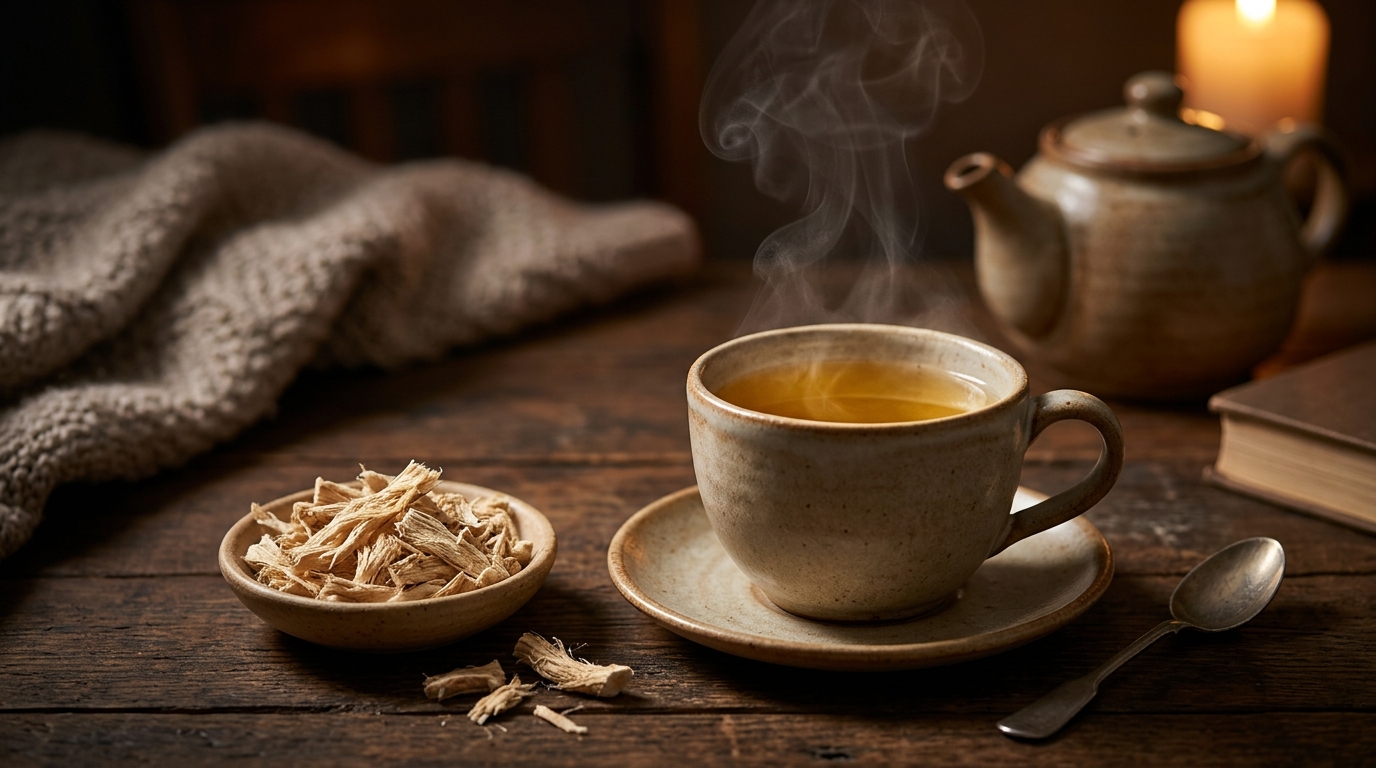
Long before the fluffy confection existed, marshmallow was a humble wetland plant. Althaea officinalis grows in damp meadows and salt marshes across Europe, western Asia, and North Africa, and its name hints at its character: the Greek althaia comes from althein, meaning ‘to heal.’ Ancient Egyptians, Greeks, and Romans all made use of the plant. Dioscorides and Pliny both recorded the root as a remedy for coughs, wounds, and inflamed tissues, and medieval European apothecaries kept it as a staple. The original marshmallow sweet was made by whipping the root’s sticky sap with sugar and egg whites, a far cry from today’s version.
What sets the root apart is its mucilage. When soaked in water, the dried root releases a thick, slippery gel made of long-chain polysaccharides. This gives the tea a naturally silky, almost velvety body unlike any other herbal infusion. Traditional herbalists classify marshmallow as a demulcent, meaning it forms a soothing film over irritated mucous membranes in the mouth, throat, and digestive tract. It has been used in European and Middle Eastern folk medicine for dry coughs, sore throats, and stomach discomfort.
As an evening tea, marshmallow root is a natural fit. It is caffeine-free, mild and faintly sweet, and its ritual is unhurried: the longer you let it steep, the more luxurious it becomes. A warm mug before bed offers a quiet moment of comfort for your throat and gut, which is why many people think of it as a nightcap for the digestive lining.
2
cups
Ingredients
- 2 tbspdried marshmallow root, cut and sifted
- 480 mlfiltered water
- —raw honey to taste (optional)
- —a small pinch of ground cinnamon (optional)
How to Brew
Click on an item below to shop for the recommended items for this recipe on Amazon.
As an Amazon Associate, we earn from qualifying purchases.
- Measure 1 tablespoon of cut and sifted marshmallow root per 240 ml of water into a teapot or mug with a lidded infuser. Use cut root rather than fine powder, which clumps and turns gluey.
- Heat filtered water until it just stops boiling, then let it rest for about 30 seconds to reach roughly 90 to 95°C.
- Pour the hot water over the root, cover the vessel to trap the volatile aromas, and steep for 10 to 15 minutes. The water will turn slightly cloudy and take on a gently viscous feel.
- Strain through a fine mesh sieve, pressing the root lightly with the back of a spoon to release extra mucilage.
- Stir in a little honey or a pinch of cinnamon if you like, and sip slowly while warm.
- Add 2 tablespoons of cut marshmallow root to a clean glass jar and pour in 480 ml of cool, filtered water. Stir once to wet all the root.
- Cover the jar and leave it on the counter for the first hour, giving it a gentle shake every 15 to 20 minutes to help the mucilage release evenly.
- Transfer the jar to the refrigerator and let it infuse for a total of 6 to 8 hours, or overnight. The liquid will thicken noticeably and develop a slightly gel-like texture.
- Strain through a fine mesh sieve or a layer of muslin, squeezing the root gently to capture the remaining mucilage.
- Drink chilled, or warm gently on the stove over low heat for a few minutes without letting it boil. Keep refrigerated and drink within 24 hours.
- Combine 2 tablespoons of cut marshmallow root with 480 ml of cold filtered water in a small saucepan. Starting with cold water allows the root to hydrate slowly and release mucilage gradually.
- Bring the pot slowly to a gentle simmer over medium-low heat, stirring occasionally so the root does not stick or clump.
- Reduce the heat to low and simmer uncovered for about 10 minutes. Avoid a hard boil, which can break down the mucilage and cloud the flavor.
- Remove from the heat, cover the pan, and let the decoction rest for 20 minutes so it thickens and cools to a comfortable drinking temperature.
- Strain through a fine mesh sieve into a mug, pressing the root to extract the last of the gel. Sweeten lightly if desired and drink warm.
Health Benefits
The mucilage coats the throat lining, and studies on marshmallow root preparations suggest relief for dry, irritating coughs. This is among the best-supported traditional uses.
Marshmallow’s demulcent action is traditionally used to comfort an irritated stomach and gut. Direct human evidence for the gut lining is limited, so it is best viewed as a gentle supportive remedy rather than a treatment.
The protective film may offer a temporary buffer against acid irritation, and marshmallow is a long-standing folk remedy for reflux-type discomfort. Evidence is largely traditional and preliminary.
Lab studies show marshmallow root extracts have antioxidant and anti-inflammatory activity thanks to their flavonoids and phenolic acids. More human research is needed.
Though not sedating, the warm, comforting, caffeine-free nature of the tea makes it an easy habit for winding down, which indirectly supports restful sleep.
🧪 Key Bioactive Compounds
The Science Behind Marshmallow Root
The defining feature of marshmallow root is its mucilage, a complex mixture of high-molecular-weight polysaccharides that can make up around 10 to 20 percent of the dried root. When these molecules meet water they swell and form a viscous gel. In the mouth and throat, this gel coats the mucosal surface, forming a physical barrier that reduces irritation and may dampen the cough reflex. This mechanical, protective action is the core of what is meant by demulcent.
Research has also looked at how these polysaccharides interact with tissue. In vitro studies suggest that marshmallow root extracts may stimulate the migration and growth of epithelial cells and show anti-inflammatory effects, which hints at a possible role in supporting tissue repair. Clinical evidence is strongest for marshmallow preparations used for dry cough and throat irritation, where some trials and regulatory assessments, including the European Medicines Agency’s monograph, support its traditional use. Evidence for effects on the gut lining specifically comes mostly from traditional use and laboratory work rather than large human trials.
The root also contains flavonoids and phenolic acids with measurable antioxidant activity, along with pectin and starch that contribute to its soothing texture and mild sweetness. Because mucilage is more efficiently extracted in cool or lukewarm water and can be partly degraded by prolonged high heat, the choice of brewing method genuinely changes the character of the tea. Cold infusion tends to yield the most mucilage-rich, silky result, while a short decoction produces a thicker, warmer cup.
Brewing Tips
- Choose cut and sifted root over fine powder. Powder clumps into a gluey mass and is difficult to strain, while cut root infuses cleanly.
- Be patient with the steep. Marshmallow tea improves with time, and a 10 to 15 minute hot steep or an overnight cold infusion gives a noticeably silkier cup than a quick 5 minute brew.
- Store dried root in an airtight container away from light and moisture, and use it within about a year for the best mucilage yield.
- Take the tea at least one to two hours apart from medications or supplements so the mucilage does not interfere with their absorption.
- If the texture feels too thick or slippery for your taste, simply use less root or dilute the finished tea with a splash of warm water.