For more than 3,000 years, Bacopa monnieri has held a place of honor in Ayurvedic medicine. Called Brahmi in Sanskrit (a name linked to Brahma, the creator in Hindu tradition) and sometimes confused with gotu kola, this small, succulent-leaved herb grows in marshy wetlands across India, Southeast Asia, and parts of the southern United States. Ancient scholars and young students of the Vedas were said to take it before memorizing long sacred texts, and it remains one of the classic Medhya Rasayana herbs, a category of plants traditionally used to nourish the mind.
Modern research has taken a real interest in this old reputation. Clinical trials, most of them using standardized extracts taken daily for 8 to 12 weeks, suggest that Bacopa may support certain aspects of memory retention and information processing. It is not a stimulant like coffee or yerba mate. Instead, its effects are subtle, cumulative, and slow to build, which makes a nightly tea ritual a natural fit: steady, unhurried, and rooted in routine.
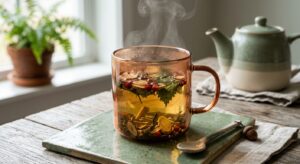
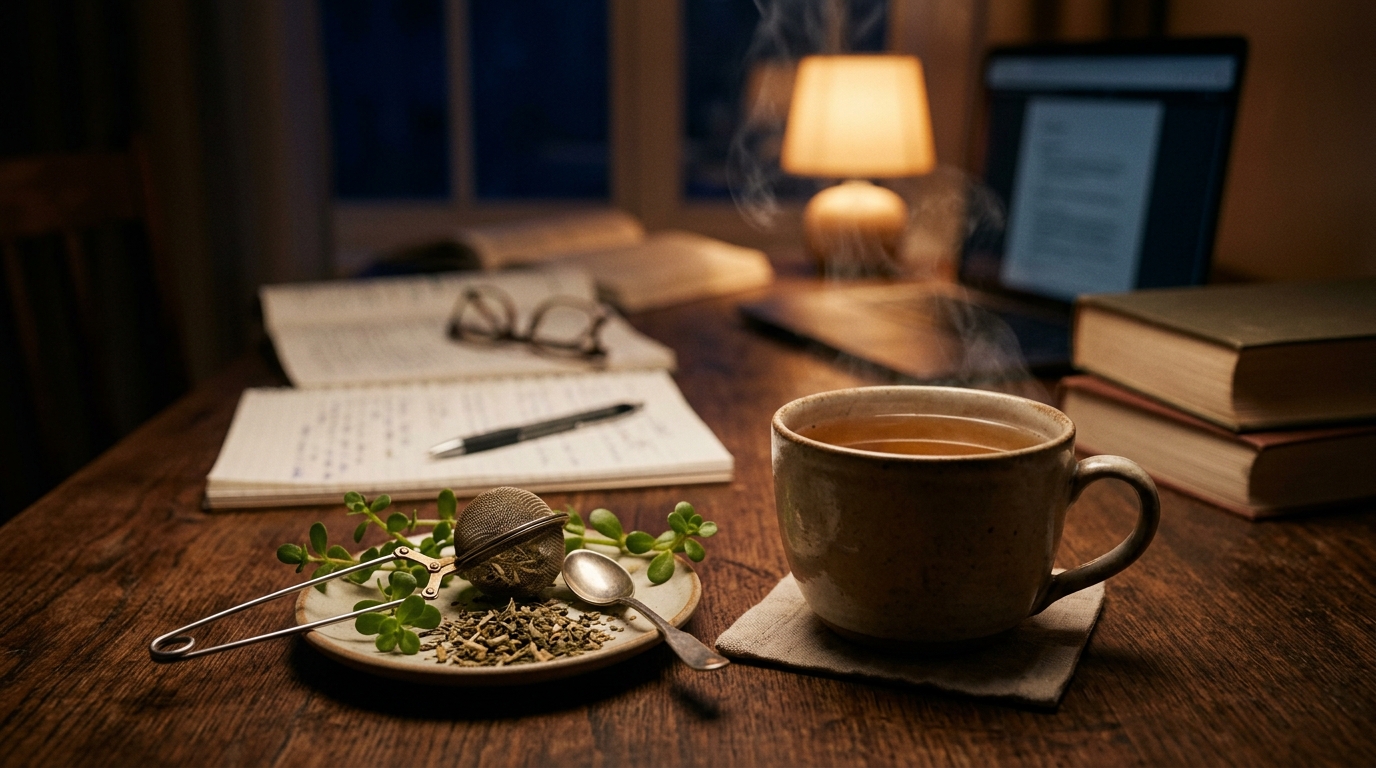
In the cup, Bacopa is distinctly herbal. The flavor is earthy and noticeably bitter, with a grassy, slightly woody backbone, and it rewards thoughtful pairing. Many evening learners find the preparation itself becomes a cue for focus, a few quiet minutes of steam and aroma that signal the mind to settle in before opening the books.
2
cups
Ingredients
- 2 tspdried bacopa monnieri leaves and stems
- 480 mlfiltered water (95°C / 203°F for hot brew)
- 1 tspfresh ginger slices or dried ginger (optional, to temper bitterness)
- —raw honey or jaggery to taste (optional)
- —a small splash of warm milk or oat milk (optional, traditional pairing)
How to Brew
Click on an item below to shop for the recommended items for this recipe on Amazon.
As an Amazon Associate, we earn from qualifying purchases.
- Measure 2 teaspoons of dried bacopa into a teapot or large mug. Gently crush the leaves between your fingers first to break up the stems and expose more surface area.
- Bring filtered water to a full boil, then let it rest for about 30 seconds so it settles near 95°C (203°F).
- Pour the hot water over the herb and cover the vessel with a saucer or lid to hold in the steam and aromatic compounds.
- Steep for 7 to 10 minutes. Start at 7 if you are new to the flavor, and go longer once you are used to its bitterness.
- Strain through a fine mesh strainer, pressing lightly on the herb to release the last of the liquid.
- Sweeten with a little honey or jaggery if desired, and sip slowly about 30 to 45 minutes before your study session or as you begin it.
- Add 2 tablespoons of dried bacopa to a clean glass jar. This is a higher ratio than the hot brew because cold water extracts more gently.
- Pour in 500 ml of cool filtered water, stir once, and seal the jar with a lid.
- Leave the jar on the counter for 1 hour, then transfer to the refrigerator to steep for 8 to 12 hours.
- Give the jar a gentle shake once or twice during the steep to keep the herb moving through the water.
- Strain through a fine mesh strainer or a piece of muslin into a clean glass, squeezing the herb lightly.
- Serve over a few ice cubes or at straight fridge temperature, with a thin slice of lemon or a pinch of cardamom if you like. Drink within 24 hours.
- Combine 2 teaspoons of dried bacopa, 3 thin slices of fresh ginger, and 1 crushed green cardamom pod in a small saucepan.
- Add 240 ml of water and 240 ml of milk (dairy, oat, or almond all work). The fat in the milk helps carry bacopa’s fat-soluble constituents.
- Bring slowly to a gentle simmer over medium-low heat, stirring occasionally. Do not let it reach a rolling boil or the milk may scorch.
- Simmer gently for 10 to 12 minutes until the liquid reduces slightly and turns a soft, creamy green-gold.
- Remove from heat, cover, and rest for 5 minutes to let the flavors settle.
- Strain into a warm mug, stir in a teaspoon of honey or jaggery, and drink while warm as a calming wind-down ritual.
Health Benefits
Several randomized trials using standardized Bacopa extract over 8 to 12 weeks found improvements in verbal learning and delayed word recall. Effects tend to build gradually rather than appearing after a single cup.
Bacopa has been studied for reducing stress-related markers and anxiety symptoms, and it is classified as an adaptogen in traditional systems. It tends to calm rather than stimulate.
Bacosides and flavonoids in Bacopa have shown antioxidant activity in laboratory and animal studies, which may help protect brain cells from oxidative stress.
Some trials report improved speed of visual information processing and reaction time in healthy adults after sustained use, though results vary between studies.
In Ayurveda, Brahmi is used to settle a scattered, overworked mind, which makes it a fitting companion for long evening study sessions.
🧪 Key Bioactive Compounds
The Science Behind Bacopa Monnieri
The cognitive reputation of Bacopa monnieri rests mainly on a group of compounds called bacosides, which are triterpenoid saponins. In laboratory and animal studies, bacosides appear to support the repair and growth of nerve cell branches (dendrites), modulate neurotransmitters such as acetylcholine and serotonin, and reduce oxidative stress in the hippocampus, a brain region central to forming new memories.
Human evidence is more modest but encouraging. A number of randomized, placebo-controlled trials and at least one meta-analysis have found that standardized Bacopa extracts taken daily for 12 weeks can improve measures such as free recall and attention in healthy adults. Importantly, the benefits do not appear immediately; most studies show effects emerging only after several weeks of consistent use, which fits the herb’s traditional description as a slow, nourishing tonic.
A practical note: most clinical research uses concentrated, standardized extracts rather than tea. A cup of brewed Bacopa delivers a gentler, more variable dose of saponins, and because these compounds are better absorbed with fat, preparing the tea with a splash of milk may help. Think of the tea as a supportive daily ritual rather than a substitute for clinical-strength extracts, and give it at least a few weeks before judging its effect.
Brewing Tips
- Be patient and consistent: drink Bacopa tea nightly for at least 8 to 12 weeks before judging its effects, since benefits build gradually.
- Take it with a small snack or a splash of milk to reduce stomach upset and improve absorption of its fat-soluble compounds.
- Buy dried herb from a reputable source that tests for purity, as Bacopa grown in polluted waters can accumulate heavy metals.
- If the bitterness is too strong, shorten the steep, try the cold brew, or add ginger, cardamom, or a little honey rather than over-sweetening.