Amla, known botanically as Phyllanthus emblica and revered across South Asia as the Indian gooseberry, holds a place of extraordinary esteem in Ayurvedic medicine. For more than three millennia, healers across India, Nepal, and Sri Lanka have regarded this small, pale-green fruit as a rasayana, a class of rejuvenating herbs believed to promote longevity, strengthen the immune system, and restore vitality to the body. Amla is one of the three fruits that form the celebrated Ayurvedic formula Triphala, and it appears in ancient Sanskrit texts including the Charaka Samhita as a remedy for everything from fevers and digestive sluggishness to premature aging. Its name in Sanskrit, amalaki, translates to “the sustainer,” a fitting tribute to a fruit that continues to earn scientific validation for properties long celebrated by traditional practitioners.
What sets amla apart from virtually every other fruit used in herbal medicine is the remarkable stability of its vitamin C content. Most botanical sources of ascorbic acid degrade rapidly with heat and oxidation, but amla’s vitamin C is bound within a matrix of tannins and polyphenols that shields it through drying, storage, and even gentle cooking. This means the dried powder and fruit pieces used to brew amla tea retain a genuinely significant portion of their original nutrient density, making a warm cup far more than a pleasant ritual. The berries are harvested in late autumn across the Indian subcontinent, then sun-dried or powdered for year-round use, preserving the tart, astringent brightness that makes the tea so distinctive on the palate.
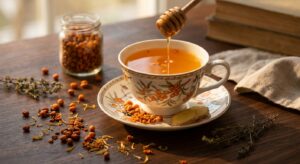
Brewed into a tea, amla delivers a flavor experience that is bracingly tart, faintly bitter, and subtly sweet on the finish, reminiscent of a cross between cranberry and green apple. It has an energizing quality that feels almost citrusy, and its deep golden-amber liquor looks as nourishing as it truly is. Whether you reach for amla tea at the first sign of a cold, as a morning ritual to sharpen mental clarity, or simply as a daily antioxidant boost, you are participating in one of humanity’s oldest and most carefully observed wellness traditions. This guide will walk you through three distinct brewing methods, the science behind the herb’s key compounds, and everything you need to know to make the most of this remarkable botanical.
2
cups
Ingredients
- 2 tspdried amla pieces or amla powder
- 480 mlwater (95°C / 203°F)
- 1 tspraw honey or jaggery (optional)
- —a thin slice of fresh ginger (optional)
- —a pinch of black pepper (optional, enhances absorption)
How to Brew
Click on an item below to shop for the recommended items for this recipe on Amazon.
As an Amazon Associate, we earn from qualifying purchases.
- Bring 480 ml of fresh, filtered water to 90 to 95°C (194 to 203°F). Avoid a full rolling boil, as slightly sub-boiling water better preserves the heat-sensitive vitamin C content and tannin balance.
- Place 2 teaspoons of dried amla pieces (or 1 teaspoon of amla powder) into a tea infuser or small saucepan. If using a saucepan, add the amla directly to the water just off the boil.
- Pour the hot water over the amla and steep for 7 to 10 minutes. A shorter steep yields a lighter, more citrusy flavor. A full 10-minute steep produces a deeper, more tannic cup with greater astringency.
- If you added a slice of fresh ginger, muddle it gently against the side of the mug before straining to release its volatile oils.
- Strain the tea into your mug using a fine mesh strainer. Allow it to cool for 1 to 2 minutes before sweetening with raw honey or jaggery, as heat destroys honey’s beneficial enzymes.
- Stir in a small pinch of black pepper if desired. The piperine in black pepper enhances the bioavailability of several of amla’s key polyphenols, a practice rooted in Ayurvedic formulation.
- Measure 2 to 3 teaspoons of dried amla pieces into a clean glass jar. Cold brewing benefits from a slightly higher herb-to-water ratio to compensate for the slower extraction that occurs without heat.
- Pour 480 ml of room-temperature filtered water over the amla pieces. Do not use warm or hot water for this method, as the goal is a slow, cold extraction that minimizes tannin release and preserves a gentler flavor profile.
- Stir briefly to ensure all the amla is submerged, then seal the jar with a lid or cover it with a small plate. Place it in the refrigerator and allow it to steep for 10 to 14 hours. Overnight is ideal for convenience.
- In the morning, strain the cold brew through a fine mesh strainer into a glass, pressing the amla pieces gently to extract the remaining liquid.
- Serve over ice for a refreshing cold drink, or drink straight from the refrigerator. Sweeten with a light honey syrup (honey dissolved in a small amount of warm water) so it blends easily into the cold liquid.
- The cold brew keeps well in the refrigerator for up to 48 hours in a sealed jar, making it easy to prepare a two-day supply in a single batch.
- Combine 2 teaspoons of dried amla pieces with 600 ml of fresh filtered water in a small saucepan. Using more water than a standard brew allows for evaporation during simmering without the decoction becoming overly concentrated.
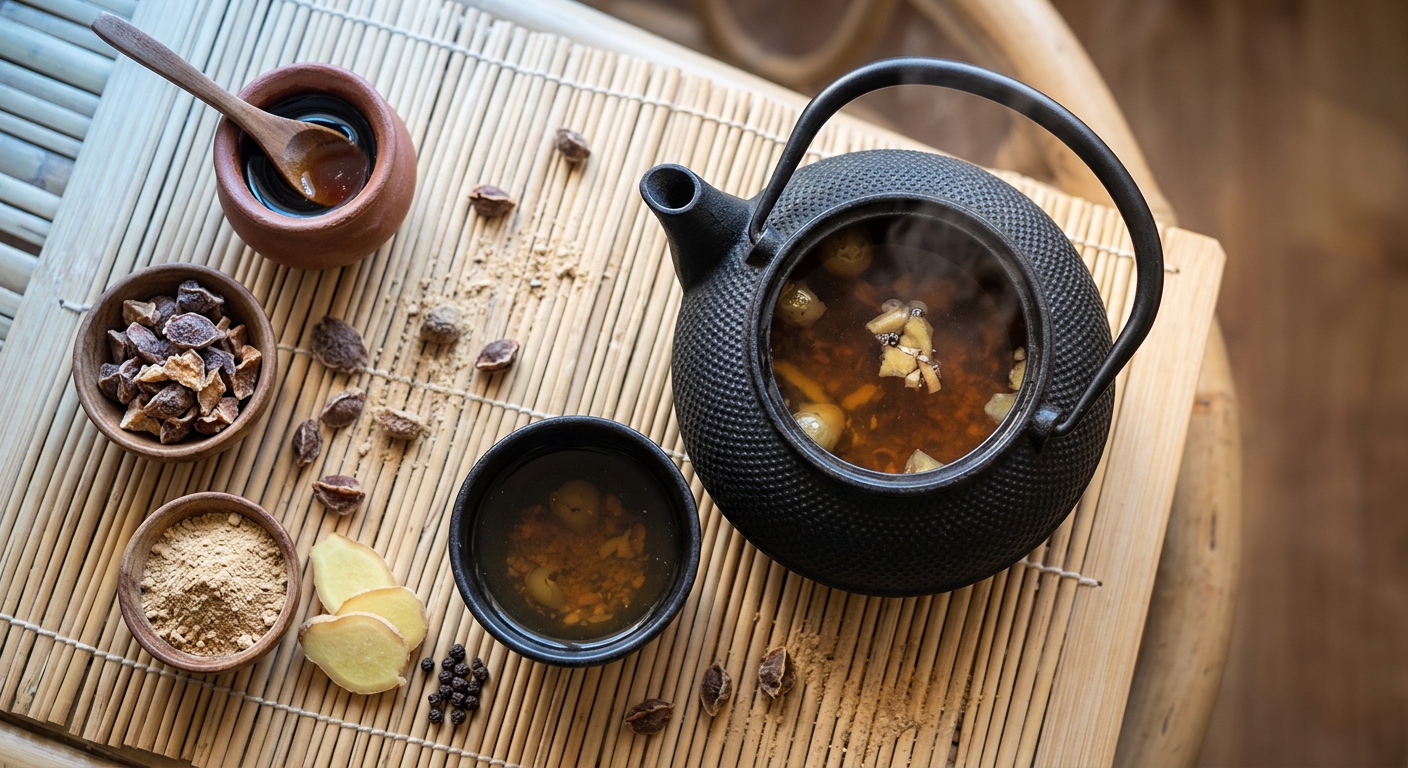
- Add optional Ayurvedic companions directly to the pot: a thin slice of fresh ginger, a small cinnamon stick, and 2 to 3 black peppercorns. These additions are traditional in kashayam preparations and complement amla’s tart profile beautifully.
- Bring the water to a full boil over medium-high heat, then immediately reduce to a gentle but steady simmer. Maintain this simmer uncovered for 15 to 20 minutes, until the liquid has reduced by roughly one quarter.
- Watch the pot to ensure it does not reduce too aggressively. The finished decoction should be a rich, deep amber color with a notably more intense aroma than a standard hot brew infusion.
- Remove from heat and allow to cool for 3 to 5 minutes. Strain through a fine mesh strainer, pressing the amla pieces firmly to extract every drop of the concentrated liquid.
- Sweeten lightly with jaggery or raw honey added after straining. Sip slowly in small amounts, as the decoction is significantly stronger than a standard cup. One small cup of 150 to 200 ml is a traditional serving size for this preparation.
Health Benefits
Amla’s extraordinarily high and stable vitamin C content directly supports the proliferation and function of lymphocytes, neutrophils, and natural killer cells. Clinical research published in the Journal of Ethnopharmacology has highlighted amla’s immunomodulatory effects, noting improvements in both innate and adaptive immune responses with regular use.
The combination of vitamin C, emblicanins, gallic acid, and ellagic acid gives amla one of the highest ORAC (Oxygen Radical Absorbance Capacity) scores of any food or botanical tested. This antioxidant density helps neutralize oxidative stress that damages cells and accelerates aging, making amla tea a genuinely functional daily drink rather than merely a pleasant one.
Gallic acid and quercetin in amla have demonstrated antiviral activity against respiratory pathogens, while vitamin C reduces the duration and severity of upper respiratory infections according to a well-cited Cochrane review meta-analysis. Traditional Ayurvedic practitioners have long prescribed amla preparations specifically at the onset of colds, fever, and coughs.
Amla’s tannins and chebulagic acid have a mild astringent effect on the gastrointestinal mucosa, soothing inflammation and supporting the integrity of the gut lining. Because roughly 70 percent of immune tissue resides in the gut, a healthy digestive tract is directly linked to stronger immune resilience, a relationship Ayurvedic medicine recognized long before modern gastroimmunology.
Several human studies have found that amla supplementation modestly but consistently reduces fasting blood glucose and post-meal glucose spikes, likely through the inhibition of alpha-glucosidase enzymes that slow carbohydrate digestion. While amla tea is less concentrated than amla supplements, regular consumption contributes to this metabolic benefit as part of a balanced diet.
🧪 Key Bioactive Compounds
The Science Behind Amla
The science behind amla’s reputation as one of the world’s premier immunity herbs begins with its vitamin C content, which is remarkable not just for its quantity but for its chemical stability. Unlike most plant-derived vitamin C, which degrades quickly with heat and oxygen exposure, amla’s ascorbic acid is tightly bound within a matrix of hydrolyzable tannins, particularly the unique compounds emblicanin A and emblicanin B, which are found almost exclusively in Phyllanthus emblica. These tannins act as a protective scaffold, significantly slowing oxidative degradation. Research published in the European Journal of Clinical Nutrition has confirmed that amla retains substantially more bioavailable vitamin C after drying and mild heating than comparative botanical sources, explaining why traditional Ayurvedic preparations using dried amla remain therapeutically active long after harvest.
Beyond vitamin C, amla’s polyphenol profile is exceptionally diverse. Gallic acid and ellagic acid are among its most studied constituents, and both have demonstrated direct antiviral activity in laboratory models, inhibiting viral replication by interfering with pathogen surface proteins and cellular entry mechanisms. Quercetin, another key flavonoid in amla, modulates the NF-kB inflammatory signaling pathway, effectively reducing the cytokine-driven inflammation that causes many of the symptoms associated with colds and upper respiratory infections. A 2011 study in the Journal of Medicinal Food found that amla extract significantly increased natural killer cell activity and lymphocyte proliferation in human subjects, providing direct mechanistic support for its traditional use as an immune tonic rather than simply attributing its effects to vitamin C alone.
Amla’s effects on the gut-immune axis represent an important and often overlooked dimension of its immune-supportive action. Chebulagic acid, a hydrolyzable tannin abundant in amla, demonstrates potent prebiotic-like activity by selectively modulating gut microbiota composition, favoring populations of beneficial Lactobacillus and Bifidobacterium species. Since the gut-associated lymphoid tissue (GALT) accounts for approximately 70 percent of the body’s total immune activity, the ability of amla’s compounds to support mucosal integrity and microbiome diversity represents a systemic immune benefit that complements its direct antioxidant and antiviral actions. This multidimensional pharmacology, affecting vitamin C status, antioxidant capacity, antiviral signaling, and gut immunity simultaneously, explains why Ayurvedic physicians considered amla a foundational herb rather than a single-purpose remedy.
Brewing Tips
- If using amla powder rather than dried pieces, start with half the amount you would use for dried pieces, as powder has a much greater surface area and extracts very rapidly, making it easy to over-steep and produce an excessively bitter or astringent brew.
- Pair amla tea with a small amount of healthy fat, such as a few almonds or a drizzle of ghee stirred into the warm cup. Several of amla’s fat-soluble polyphenols, including ellagic acid derivatives, show improved absorption when consumed alongside lipids, a practice supported by traditional Ayurvedic nutrition principles.
- For the best flavor balance in hot brew, add your sweetener only after the tea has cooled slightly below 60°C (140°F). This preserves the enzymes and beneficial compounds in raw honey, and also allows amla’s natural sweet finish to emerge once the initial sharp tartness fades on the palate.