The liver is one of the body’s most industrious organs, filtering over 1.5 liters of blood every minute, metabolizing nutrients, neutralizing toxins, and producing the bile that keeps digestion running smoothly. Long before modern hepatology, traditional healers across Europe, Asia, and the Americas identified specific plants that seemed to revive sluggish digestion, brighten the skin, and restore energy after illness or overindulgence. Milk thistle, dandelion root, and turmeric were cornerstones of those traditions, and today they remain among the most thoroughly studied herbs in phytomedicine.
Milk thistle has been used since at least the first century CE, when the Roman naturalist Pliny the Elder wrote of its value for carrying off bile. Dandelion root has deep roots in Ayurvedic, Traditional Chinese Medicine, and European folk herbalism, prized as a bitter tonic that stimulates the liver and gallbladder. Turmeric, the golden spice of South Asian cooking and Ayurveda, has been revered for over four thousand years as a warming herb that supports digestion, reduces inflammation, and protects the liver from oxidative damage. Together, these three herbs form a synergistic blend that addresses liver health from multiple angles.
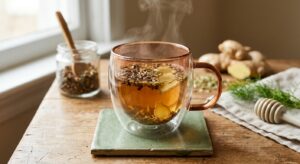
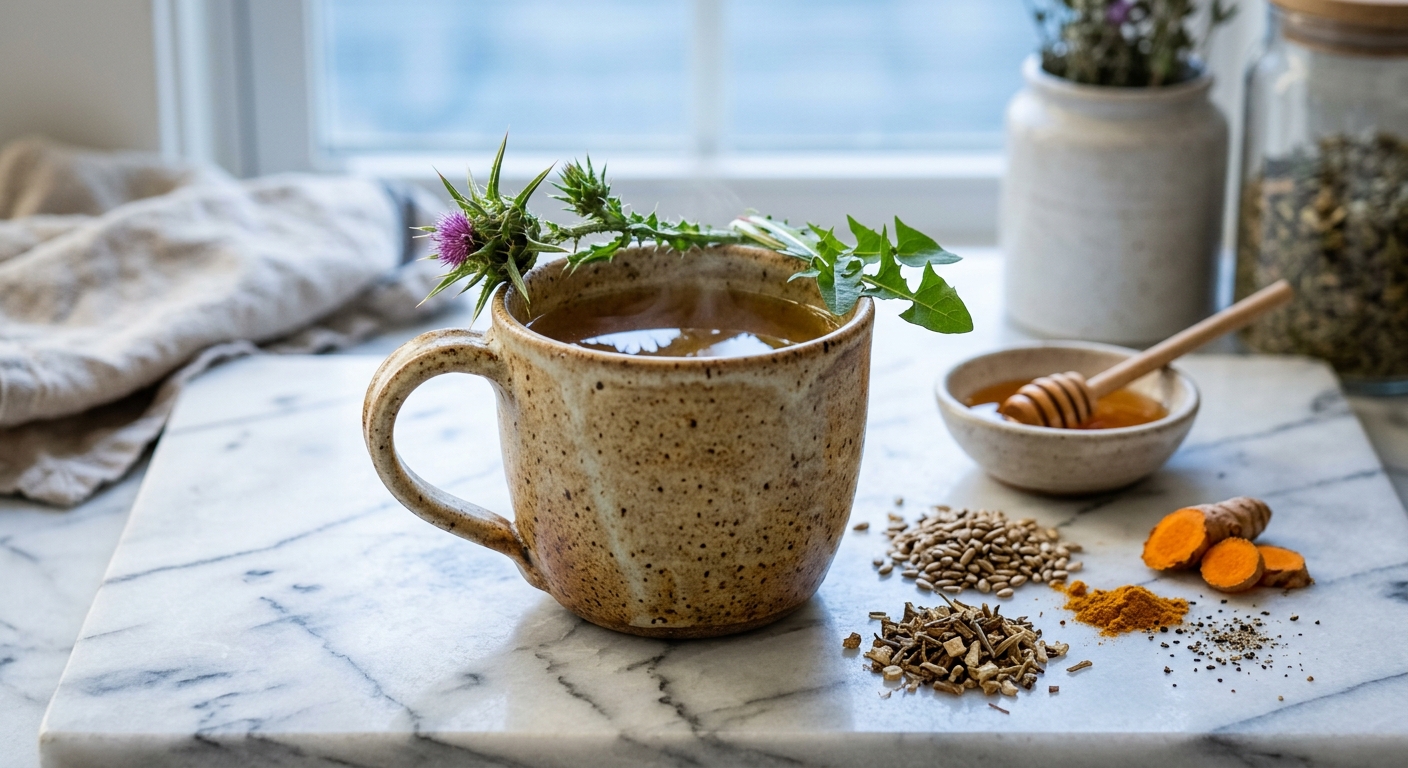
This liver detox herbal tea is best understood not as a dramatic cleanse but as a gentle, daily ritual of support. Its deep amber color, earthy bitterness softened by turmeric’s warmth, and subtle peppery finish make it a satisfying cup that signals to the body it is time to rest and restore. Whether you brew it hot on a quiet morning or cold-steep it overnight for a smoother, less bitter sip, this blend offers a practical and pleasurable way to incorporate liver-supportive herbs into everyday life.
2
cups
Ingredients
- 1 tspmilk thistle seeds (lightly crushed)
- 1 tspdried dandelion root (chopped)
- 0.5 tspground turmeric or 2 thin slices of fresh turmeric root
- 0.25 tspfreshly cracked black pepper
- 480 mlwater (100°C / 212°F)
- —raw honey or maple syrup to taste (optional)
- —a squeeze of lemon juice (optional, brightens flavor and adds vitamin C)
How to Brew
Click on an item below to shop for the recommended items for this recipe on Amazon.
As an Amazon Associate, we earn from qualifying purchases.
- Add the crushed milk thistle seeds and chopped dandelion root to a small saucepan with 480 ml of cold filtered water. Do not add the turmeric or black pepper yet.
- Bring the water to a full rolling boil over medium-high heat, then reduce to a gentle simmer. Cover the saucepan partially with a lid to minimize evaporation and allow the roots and seeds to decoct for 15 minutes.
- After 15 minutes, add the ground turmeric (or fresh turmeric slices) and cracked black pepper directly to the simmering liquid. Stir well and continue simmering, uncovered, for a further 3 to 5 minutes. Adding turmeric at this stage protects its more delicate volatile aromatics while still activating curcumin.
- Remove from heat and allow the blend to rest for 2 minutes. Pour through a fine-mesh strainer or cheesecloth into your mugs, pressing the spent herbs gently to extract all liquid.
- Add honey or maple syrup to taste, and a squeeze of fresh lemon if desired. Drink warm, ideally in the morning before eating to maximize the bitter tonic effect on bile production.
- Lightly crush the milk thistle seeds using a mortar and pestle or the flat of a knife to crack the outer hull and maximize surface area for cold extraction. Combine the crushed seeds, chopped dandelion root, turmeric, and black pepper in a clean glass jar.
- Pour 600 ml of cold filtered water over the herbs (a slightly higher water ratio compensates for lower extraction efficiency at cold temperatures). Stir briefly to ensure all herbs are submerged.
- Cover the jar with a lid or a small plate and leave it at room temperature for 2 hours to begin the initial extraction phase, then transfer it to the refrigerator.
- Allow the blend to cold-steep for a minimum of 12 hours and up to 16 hours. The longer steep draws out more bitter compounds and increases the golden color from turmeric.
- Strain through a fine-mesh strainer lined with cheesecloth into glasses filled with ice. Add a slice of fresh lemon and a drizzle of honey if desired. This cold brew is excellent served over a large ice cube with a sprig of fresh mint for an herbal wellness drink on warm days.
- Combine 3 tbsp of crushed milk thistle seeds, 3 tbsp of chopped dandelion root, 1.5 tsp of ground turmeric, and 0.5 tsp of cracked black pepper in a medium saucepan. Add 750 ml of cold filtered water.
- Bring to a full boil over medium-high heat, then reduce to a vigorous simmer. Cook uncovered, stirring occasionally, for 30 to 40 minutes. You are aiming to reduce the liquid by roughly one third, finishing with approximately 480 to 500 ml of concentrate.
- Watch the saucepan during the final 10 minutes to ensure the liquid does not reduce too far. If it drops below 400 ml, add a small splash of hot water and remove from heat promptly.
- Strain the hot concentrate through a fine-mesh strainer lined with cheesecloth into a clean glass jar or heatproof pitcher. Press the spent herbs firmly to extract every drop.
- Allow the concentrate to cool to room temperature before sealing and refrigerating. To serve, dilute one part concentrate with two parts hot water (for a warming cup) or two parts cold sparkling water (for a refreshing effervescent drink). Add honey, lemon, or a pinch of cinnamon to taste.
Health Benefits
Silymarin from milk thistle has been shown in multiple clinical trials to reduce liver enzyme markers (ALT and AST) in patients with liver damage, non-alcoholic fatty liver disease, and hepatitis. It works by stabilizing hepatocyte membranes and stimulating the synthesis of structural proteins that allow damaged liver cells to repair themselves.
The bitter sesquiterpene lactones in dandelion root act as cholagogues, substances that promote bile production in the liver and bile flow from the gallbladder into the small intestine. Improved bile flow aids fat digestion, reduces bloating after fatty meals, and helps the liver eliminate fat-soluble waste products more efficiently.
Curcumin’s well-documented anti-inflammatory action in the liver involves suppression of key inflammatory pathways including NF-kB and COX-2. Studies in patients with non-alcoholic fatty liver disease found that curcumin supplementation significantly reduced inflammatory markers and liver fat accumulation compared to placebo.
All three primary herbs in this blend contribute antioxidant activity. Silibinin scavenges free radicals produced during the liver’s detoxification processes, curcumin upregulates the body’s own antioxidant enzymes (superoxide dismutase and glutathione), and dandelion root provides beta-carotene and polyphenols that neutralize reactive oxygen species in liver tissue.
The inulin content of dandelion root acts as a prebiotic fiber, selectively feeding Bifidobacterium and Lactobacillus species in the colon. A balanced gut microbiome produces fewer harmful metabolites (such as lipopolysaccharides) that would otherwise reach the liver via the portal vein and trigger inflammation, creating a meaningful indirect benefit for liver health.
🧪 Key Bioactive Compounds
The Science Behind Milk Thistle
The liver detox concept in herbal medicine centers on a practical biological reality: the liver processes every compound absorbed from the digestive tract, and its capacity to do so is influenced by the health of its individual cells (hepatocytes), the efficiency of its enzyme systems, and the quality of bile it produces. Milk thistle’s silymarin complex, particularly its most bioactive constituent silibinin, supports hepatocyte integrity by embedding in cell membrane phospholipids and physically blocking the entry of hepatotoxic substances. This membrane-stabilizing effect has been demonstrated in studies on alcohol-induced liver damage, pharmaceutical hepatotoxicity, and even Amanita phalloides (death cap mushroom) poisoning, in which intravenous silibinin is used as a clinical antidote in European hospitals.
Turmeric’s curcumin operates through several complementary mechanisms. It reduces the transcription of inflammatory genes by inhibiting NF-kB, a master regulator of inflammatory signaling that is chronically activated in fatty liver disease. It also upregulates the Nrf2 pathway, the body’s primary cellular defense system against oxidative stress, leading to increased production of glutathione, superoxide dismutase, and other endogenous antioxidants within liver tissue. The challenge with curcumin has historically been its poor bioavailability: it is rapidly metabolized and poorly absorbed from the gut. This is precisely where black pepper’s piperine plays a critical role. By inhibiting glucuronidation in the gut wall and slowing hepatic metabolism, piperine raises plasma curcumin levels by up to 2000 percent, transforming turmeric from a mildly effective cooking spice into a clinically meaningful herbal compound.
Dandelion root’s bitter sesquiterpene lactones, taraxacin and taraxacerin, stimulate the vagus nerve receptors in the upper digestive tract, triggering a reflexive increase in bile production and secretion. This choleretic and cholagogue action accelerates the clearance of fat-soluble waste products and environmental toxins that the liver packages into bile for excretion via the digestive system. Dandelion root’s prebiotic inulin further supports this process indirectly: by feeding beneficial microbiota in the colon, it reduces the production of microbial endotoxins (particularly lipopolysaccharides) that travel through the portal circulation to the liver, where they activate Kupffer cells and drive hepatic inflammation. Together, the three herbs in this blend target liver wellness through membrane protection, anti-inflammatory signaling, antioxidant enzyme induction, bile stimulation, and microbiome support, representing a genuinely multi-mechanistic botanical strategy.
Brewing Tips
- Always crack or lightly grind milk thistle seeds before brewing. The hard outer seed coat significantly limits water extraction if the seeds are left whole, and cracking them releases the silymarin-rich internal oils into the brew.
- Source dandelion root that is roasted rather than raw if you prefer a milder, slightly nutty flavor reminiscent of chicory coffee. Raw dandelion root has a sharper, more intensely bitter profile that is more potent as a bile stimulant but can be an acquired taste.
- Drink this tea consistently rather than sporadically. Silymarin and curcumin both demonstrate their most meaningful liver-protective effects when maintained at steady levels through daily or near-daily consumption, rather than in short intensive bursts.