Anyone who has spent time traveling knows the uncomfortable reality of a disrupted digestive system. Long flights, unfamiliar foods, irregular meal times, and heightened stress all conspire to leave your gut feeling unsettled. For centuries, herbalists across cultures have turned to a core set of digestive herbs, ginger in South and East Asian traditions, peppermint across European folk medicine, and fennel throughout Mediterranean and Ayurvedic practice, to bring relief on journeys near and far. Together, these three herbs form one of the most effective and time-honored digestive blends in plant medicine.
What makes this blend particularly well suited to travel is the complementary way each herb addresses a different dimension of digestive discomfort. Ginger works on nausea and gastric motility, peppermint relaxes the smooth muscle of the intestinal wall to relieve cramping and gas, and fennel seeds provide gentle carminative action that eases bloating from the inside out. The result is a tea that feels both warming and settling, grounding you in your body no matter where in the world you happen to be.
Beyond its functional benefits, this tea is a pleasure to drink. The sharpness of ginger gives way to a cool, bright peppermint finish, while fennel lends a subtle sweetness that rounds out any bitterness. Brewed hot before a meal, chilled for a long flight, or made as a concentrate for travel convenience, this blend adapts to your journey as readily as it soothes your stomach.
2
cups
Ingredients
- 1 tspfresh ginger, thinly sliced (or 0.5 tsp dried ground ginger)
- 1 tspdried peppermint leaves
- 1 tspfennel seeds, lightly crushed
- 480 mlwater (95°C / 203°F)
- —raw honey or fresh lemon juice to taste (optional)
How to Brew
Click on an item below to shop for the recommended items for this recipe on Amazon.
As an Amazon Associate, we earn from qualifying purchases.
- Bring 480 ml of filtered water to just below a boil, around 90 to 95°C (194 to 203°F). Avoid a rolling boil, which can drive off the volatile aromatic oils in peppermint and fennel.
- Add the sliced fresh ginger and lightly crushed fennel seeds to your infuser or teapot. Pour the hot water over them and steep for 4 to 5 minutes to allow their more robust compounds to begin extracting.
- After 4 to 5 minutes, add the dried peppermint leaves to the same infuser or teapot. Continue steeping for a further 3 to 5 minutes, keeping the vessel covered with a lid or saucer to trap the volatile menthol oils.
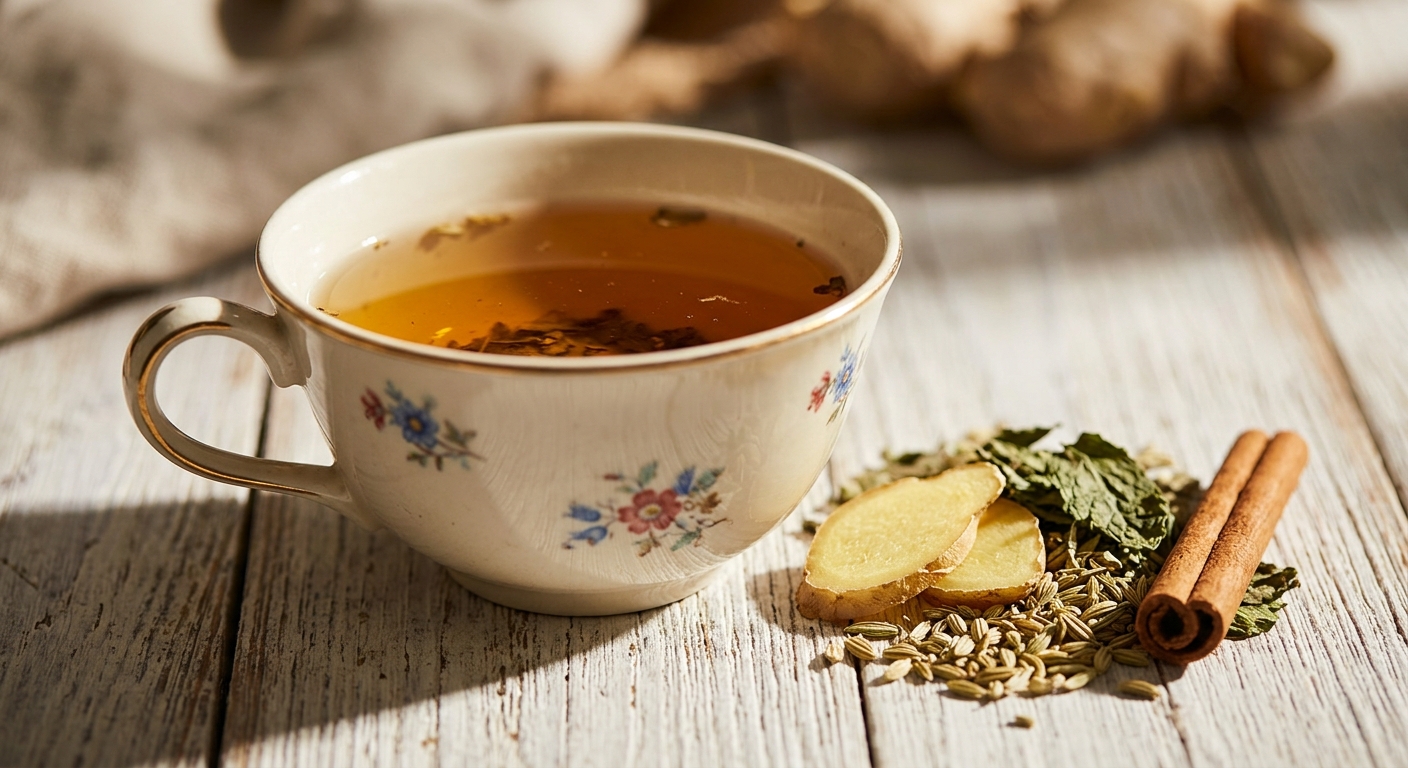
- Remove the infuser or strain the tea into two mugs. The liquor should be a warm amber-gold with a greenish hue.
- Taste before sweetening. If using fresh ginger the tea will have a pleasant heat; add raw honey or a squeeze of lemon to balance if desired. Drink warm, ideally 20 to 30 minutes before or after a meal.
- Combine the sliced fresh ginger, crushed fennel seeds, and dried peppermint leaves in a clean glass jar. Use slightly heaped amounts since cold water extracts more slowly and less aggressively than hot.
- Pour 480 ml of cold filtered water over the herbs. Do not use hot water at any stage; the entire extraction happens cold to preserve the delicate aromatic oils and produce a milder flavor.
- Stir gently to ensure all herbs are submerged, then seal the jar with a lid. Leave at room temperature for 30 minutes so the herbs begin to hydrate, then transfer to the refrigerator.
- Cold brew for 10 to 12 hours, or overnight. The longer steep compensates for the lack of heat and draws out the full spectrum of carminative compounds from fennel and ginger.
- Strain through a fine mesh strainer into a travel bottle or pitcher. The finished cold brew will be noticeably smoother and more subtly sweet than a hot brew. Sweeten with a small drizzle of honey if desired, stirring well to dissolve. Keeps refrigerated for up to 3 days.
- Triple the standard herb quantities: use 3 tsp fresh sliced ginger, 3 tsp dried peppermint, and 3 tsp lightly crushed fennel seeds. Combine them in a small saucepan.
- Add 480 ml of filtered water (the same volume as a standard two-cup batch). Bring to a gentle boil over medium heat, then reduce to a low simmer.
- Simmer uncovered for 15 to 20 minutes. This extended heat exposure is intentional here since it concentrates the ginger and fennel compounds significantly. The peppermint will lose some volatile menthol during simmering, which is acceptable given the tripled quantity of herb.
- Remove from heat and steep covered for an additional 5 minutes to allow the peppermint oils to reinfuse slightly into the cooling liquid.
- Strain through a fine mesh strainer into a clean glass bottle, pressing the herbs firmly to extract as much liquid as possible. You will end up with roughly 300 to 350 ml of deep amber concentrate.
- To serve, dilute 1 part concentrate with 2 to 3 parts hot or cold water, adjusting to taste. Sweeten the finished cup if desired. Store the concentrate in the refrigerator for up to 5 days, or freeze in an ice cube tray for up to one month and pack individual cubes in a small cooler for travel.
Health Benefits
Ginger’s gingerols and shogaols interact with serotonin (5-HT3) receptors in the gut and central nervous system to reduce nausea signals. Multiple randomized controlled trials have confirmed ginger’s efficacy for motion sickness, morning sickness, and post-operative nausea, making it the backbone of any travel-ready digestive blend.
Fennel seed’s anethole and peppermint’s menthol work together as powerful carminatives, compounds that relax the muscular walls of the digestive tract and allow trapped gas to disperse. This dual action makes the blend particularly effective against the bloating that often follows long periods of sitting during travel.
Peppermint’s menthol is a well-documented antispasmodic agent that relaxes smooth muscle in the gut by blocking calcium ion channels. Clinical trials have shown peppermint oil capsules significantly reduce abdominal pain in IBS patients, and the brewed leaf delivers meaningful amounts of these same compounds.
Ginger has been shown in clinical studies to accelerate gastric emptying, the rate at which food moves from the stomach into the small intestine. This property is particularly relevant for travelers whose digestive rhythm is disrupted by time zone changes, irregular eating schedules, or unfamiliar cuisine.
The combined aromatherapeutic effect of inhaling the steam from this blend, rich in menthol and anethole, activates the parasympathetic nervous system response. Travel-related anxiety is a known trigger for gut dysfunction, and the ritual of brewing and mindfully drinking this tea may help activate the rest-and-digest state.
🧪 Key Bioactive Compounds
The Science Behind Ginger, Peppermint, And Fennel Seed
The digestive effectiveness of this three-herb blend is rooted in complementary biochemical mechanisms that address nausea, motility, spasm, and gas through distinct but overlapping pathways. Ginger’s primary active phenolics, specifically 6-gingerol in fresh root and the more potent shogaols in dried or heated preparations, interact with 5-HT3 and NK1 receptors in the enteric nervous system. These are the same receptor targets used by pharmaceutical antiemetics, which explains why ginger has performed favorably against placebo in multiple clinical trials for motion sickness and postoperative nausea. Ginger also promotes prokinetic activity, stimulating the migrating motor complex that sweeps the gut between meals and is often suppressed during travel stress.
Peppermint’s mechanism is primarily muscular. Menthol, which can constitute up to 40 to 55 percent of peppermint leaf’s essential oil, acts as a natural calcium channel antagonist in smooth muscle cells lining the gastrointestinal tract. By reducing the influx of calcium ions into these cells, menthol prevents the sustained muscle contractions that cause cramping and spasm. A landmark meta-analysis published in the Journal of Clinical Gastroenterology found peppermint oil significantly superior to placebo for reducing abdominal pain in irritable bowel syndrome, with the brewed leaf delivering pharmacologically relevant quantities of menthol when steeped covered to prevent volatile loss.
Fennel seed’s anethole works at the level of the intestinal mucosa, reducing the surface tension of gas bubbles trapped in the gut so they merge and disperse more easily, a direct carminative action. Anethole also modulates the gut’s smooth muscle tone through interaction with dopaminergic pathways, and emerging research suggests it may have prebiotic-like effects that support a balanced gut microbiome. When these three compounds are consumed together, they address the full spectrum of travel-related gut disruption from the stomach to the colon, making this blend considerably more comprehensive than any single-herb tea.
Brewing Tips
- Pack a small tin or zip-lock bag with pre-measured portions of this blend before you travel. Most airport cafes and hotel rooms have hot water available, and having your herbs ready means you can brew a cup without weighing out ingredients mid-journey.
- Always cover your mug or teapot while steeping, especially when using peppermint. Menthol and other volatile aromatic oils evaporate quickly in open hot water, and a simple saucer placed over your mug can preserve up to 30 percent more of the active compounds.
- Use fresh ginger whenever possible rather than ground dried ginger. Fresh root contains higher concentrations of gingerols and a brighter, more complex flavor. A 2 cm knob of fresh ginger is roughly equivalent to 0.5 tsp of ground, but the fresh version will produce a noticeably more aromatic and effective tea.