For generations, women have turned to plant medicine to navigate the ebbs and flows of their hormonal cycles. Long before synthetic hormones existed, herbalists across Europe, Asia, and the Americas relied on a handful of key botanicals to ease irregular cycles, relieve premenstrual tension, and support the luteal phase of the menstrual cycle, the phase in which progesterone plays its most vital role. Today, a growing body of research is beginning to validate what traditional healers knew intuitively: certain herbs contain compounds that interact meaningfully with the body’s endocrine system.
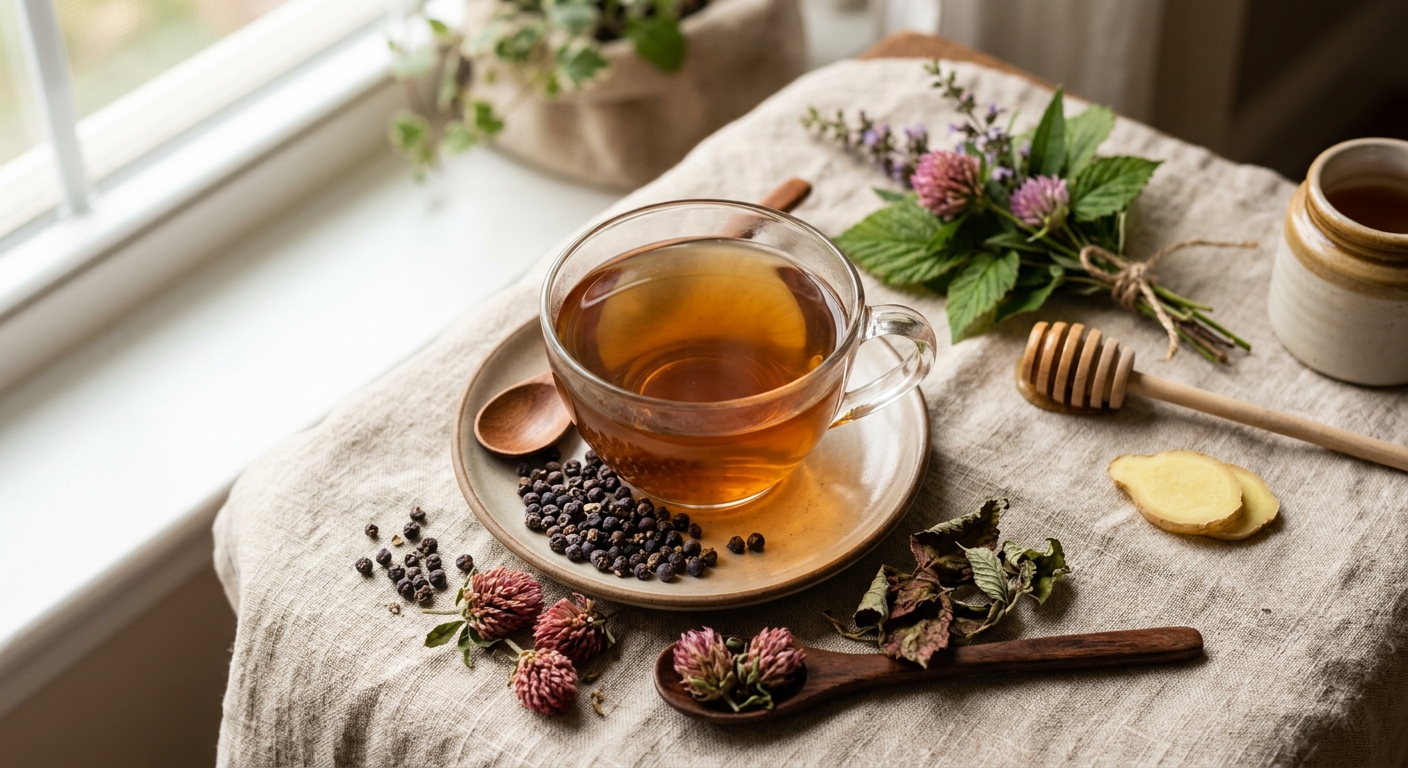
Low progesterone is a surprisingly common concern, often presenting as shortened luteal phases, spotting before menstruation, mood swings in the second half of the cycle, difficulty conceiving, or simply a feeling of hormonal unease. Rather than a single magic herb, the most effective herbal approach tends to be a thoughtfully assembled blend. This recipe centers on vitex (chaste tree berry), one of the most rigorously studied herbs for female hormone balance, supported by red clover for its phytoestrogenic and progesterogenic signaling properties, and red raspberry leaf for its affinity with the uterus and reproductive system.
What makes this tea special is both its depth of tradition and its sensory warmth. Vitex carries a faintly peppery, aromatic quality reminiscent of allspice. Red clover lends a gentle, grassy sweetness, and raspberry leaf rounds everything out with a clean, slightly astringent finish not unlike a mild green tea. Sipped daily during the luteal phase or throughout the cycle, this blend is a small, intentional ritual of self-care rooted in centuries of women’s wisdom.
2
cups
Ingredients
- 1 tspdried vitex berries (chaste tree berry), lightly crushed
- 1 tspdried red clover blossoms
- 1 tspdried red raspberry leaf
- 480 mlwater (95°C / 203°F)
- —raw honey or a few drops of liquid stevia to taste (optional)
- —a thin slice of fresh ginger (optional, for warmth and circulation support)
How to Brew
Click on an item below to shop for the recommended items for this recipe on Amazon.
As an Amazon Associate, we earn from qualifying purchases.
- Lightly crush the dried vitex berries using a mortar and pestle or the back of a spoon before measuring. This breaks the hard outer shell and dramatically improves extraction of the active iridoid glycosides.
- Combine the crushed vitex berries, red clover blossoms, and red raspberry leaf in a tea infuser, muslin bag, or a small teapot with an integrated strainer. If using a teapot, allow the herbs room to expand.
- Heat water to approximately 95°C (203°F), just below a rolling boil. If you do not have a temperature-controlled kettle, bring water to a full boil and allow it to rest for 30 to 45 seconds before pouring.
- Pour the hot water directly over the herb blend and cover your mug or teapot with a lid or small saucer. Covering is important, as it traps the volatile aromatic compounds that contribute to the tea’s therapeutic effect.
- Steep for 10 to 15 minutes. Vitex in particular benefits from a longer infusion. Taste at 10 minutes and continue if you prefer a stronger, more medicinal cup.
- Remove the infuser, sweeten lightly with raw honey if desired, and sip slowly. For hormonal support, consistency matters: aim to drink one to two cups daily, ideally starting after ovulation through the onset of menstruation.
- Lightly crush the vitex berries as described in the hot brew method. This step is especially important for cold brewing, since lower temperatures require maximum surface area contact to extract the berries’ active compounds over the long steep.
- Combine the crushed vitex berries, red clover blossoms, and raspberry leaf in a clean glass jar. Use 1.5 times the standard herb quantity (approximately 1.5 tsp of each herb per 480 ml water) to compensate for the slower, cooler extraction.
- Pour room-temperature filtered water over the herbs, ensuring all plant material is fully submerged. Stir gently with a long spoon to make sure no dry herb clumps remain at the surface.
- Seal the jar with a lid or cover it tightly with plastic wrap. Allow the jar to sit at room temperature for one hour, then transfer it to the refrigerator.
- Steep in the refrigerator for a minimum of 8 hours and up to 12 hours. Overnight cold brewing is the most convenient approach: prepare before bed and strain in the morning.
- Strain the herbs using a fine mesh strainer or cheesecloth, pressing gently to extract all liquid. Pour over ice if desired. The cold brew will keep refrigerated for up to 36 hours. Add a squeeze of fresh lemon and a drizzle of honey before serving for a bright, refreshing finish.
- Measure 1.5 tsp of vitex berries and lightly crush them with a mortar and pestle. For a decoction, you do not need to crush as finely as for a cold brew, but cracking the outer shell is still essential.
- Place the crushed vitex berries into a small saucepan and add 600 ml of cold filtered water. Do not add the red clover blossoms or raspberry leaf yet, as these more delicate herbs cannot withstand prolonged simmering without losing their beneficial volatile compounds.
- Bring the water to a gentle simmer over medium heat, then reduce to low. Allow the vitex berries to simmer uncovered for 20 to 25 minutes. The liquid will reduce by roughly 20 percent and deepen in color to a rich amber.
- Remove the saucepan from the heat. Add the red clover blossoms and red raspberry leaf directly to the hot decoction liquid. Cover the saucepan immediately with a lid to trap the volatile aromatics from these delicate herbs.
- Allow the blend to steep covered and off the heat for an additional 10 minutes. This two-stage approach honors the different natures of each herb: vigorous heat for the hard berry, gentle residual heat for the leaves and flowers.
- Strain through a fine mesh strainer into a mug or heat-safe carafe, pressing the herbs gently. Sweeten with raw honey and sip while warm. A decoction can also be divided into two portions, refrigerated, and gently rewarmed throughout the day.
Health Benefits
Vitex does not contain progesterone itself but works on the pituitary gland to lower excess prolactin, a hormone that, when elevated, suppresses progesterone synthesis. Several randomized controlled trials, including a notable 2012 study published in Phytomedicine, found that vitex extract significantly improved luteal phase deficiency and raised progesterone levels in women with cycle irregularities.
The combination of vitex and the anti-inflammatory compounds in red clover has been associated with meaningful reduction in PMS symptoms including breast tenderness, bloating, irritability, and mood changes. A Cochrane-reviewed meta-analysis found vitex preparations to be statistically superior to placebo for overall PMS symptom reduction.
Red raspberry leaf has been used by midwives and herbalists for centuries to tone the uterus and support healthy menstrual regularity. The alkaloid fragarine is believed to strengthen and regulate smooth muscle tissue in the uterus, contributing to more regular and less crampy menstruation.
Red clover isoflavones such as formononetin and biochanin A interact with estrogen receptors in a selective, modulating way. In cases of estrogen dominance (a common companion to low progesterone), these phytoestrogens may compete with stronger endogenous estrogens at receptor sites, effectively reducing the relative estrogen load and supporting a more balanced hormonal environment.
Progesterone metabolizes into allopregnanolone, a neurosteroid with calming, GABA-modulating effects. By supporting healthier progesterone levels during the luteal phase, this tea blend may indirectly ease the anxiety, irritability, and low mood that many women experience in the days before menstruation.
🧪 Key Bioactive Compounds
The Science Behind Vitex (Chaste Tree Berry)
The hormonal effects of this tea blend operate through several distinct but complementary mechanisms. Vitex chaste tree berry’s primary bioactive compounds, the iridoid glycosides led by agnuside and the flavonoid casticin, act on the hypothalamic-pituitary axis rather than directly on the ovaries. Specifically, they bind to dopamine D2 receptors in the anterior pituitary gland, reducing the secretion of prolactin. Prolactin, when chronically elevated (a condition called hyperprolactinemia, which can occur even in subclinical ranges), inhibits the release of luteinizing hormone (LH) during the second half of the cycle, thereby suppressing progesterone output from the corpus luteum. By lowering prolactin, vitex creates a biochemical environment more favorable to robust progesterone synthesis. This mechanism has been confirmed in multiple clinical trials and is now well accepted in integrative gynecology.
Red clover contributes a distinct layer of hormonal support through its rich isoflavone content, particularly formononetin and biochanin A. These phytoestrogens are selective estrogen receptor modulators (SERMs) in the natural sense: they bind to estrogen receptor alpha and beta with far lower affinity than endogenous estrogens like estradiol, effectively occupying receptor sites without triggering the same magnitude of estrogenic signaling. In a state of estrogen dominance, where estradiol is high relative to progesterone, this competitive binding can moderate the overall estrogenic stimulus on target tissues, helping to restore a more favorable estrogen-to-progesterone ratio. Additionally, emerging research suggests biochanin A may support granulosa cell function in the ovary, potentially improving the quality of ovulation and the subsequent progesterone-producing corpus luteum.
Red raspberry leaf rounds out the scientific picture with its contribution to uterine and reproductive tissue health. The alkaloid fragarine has a well-documented spasmolytic and tonifying action on smooth muscle in the uterus, which helps explain its centuries-long use in supporting regular, comfortable menstruation. Beyond fragarine, raspberry leaf is notably rich in ellagic acid, a polyphenol with antioxidant and anti-inflammatory properties relevant to reproductive health. Oxidative stress in ovarian and uterine tissue has been linked to poor egg quality, luteal insufficiency, and irregular cycles, making antioxidant support from dietary and botanical sources a meaningful part of a comprehensive hormonal wellness strategy.
Brewing Tips
- Consistency is everything with vitex: unlike chamomile or peppermint, which work acutely, vitex requires daily use over 3 to 6 full menstrual cycles before its effects on prolactin and progesterone become clinically meaningful. Commit to the ritual and track your cycle alongside your tea habit.
- The best time to drink this tea for progesterone support is during the luteal phase, the roughly 14 days between ovulation and menstruation. If you track your cycle, begin on the day after ovulation confirmation (via basal body temperature rise or LH testing) and continue until your period arrives.
- Store your herb blend in an airtight, dark glass jar away from heat and light. Vitex berries are particularly prone to losing their volatile aromatic compounds when stored improperly. Pre-mixing a two-week supply in advance keeps your morning routine simple and ensures you stay consistent.