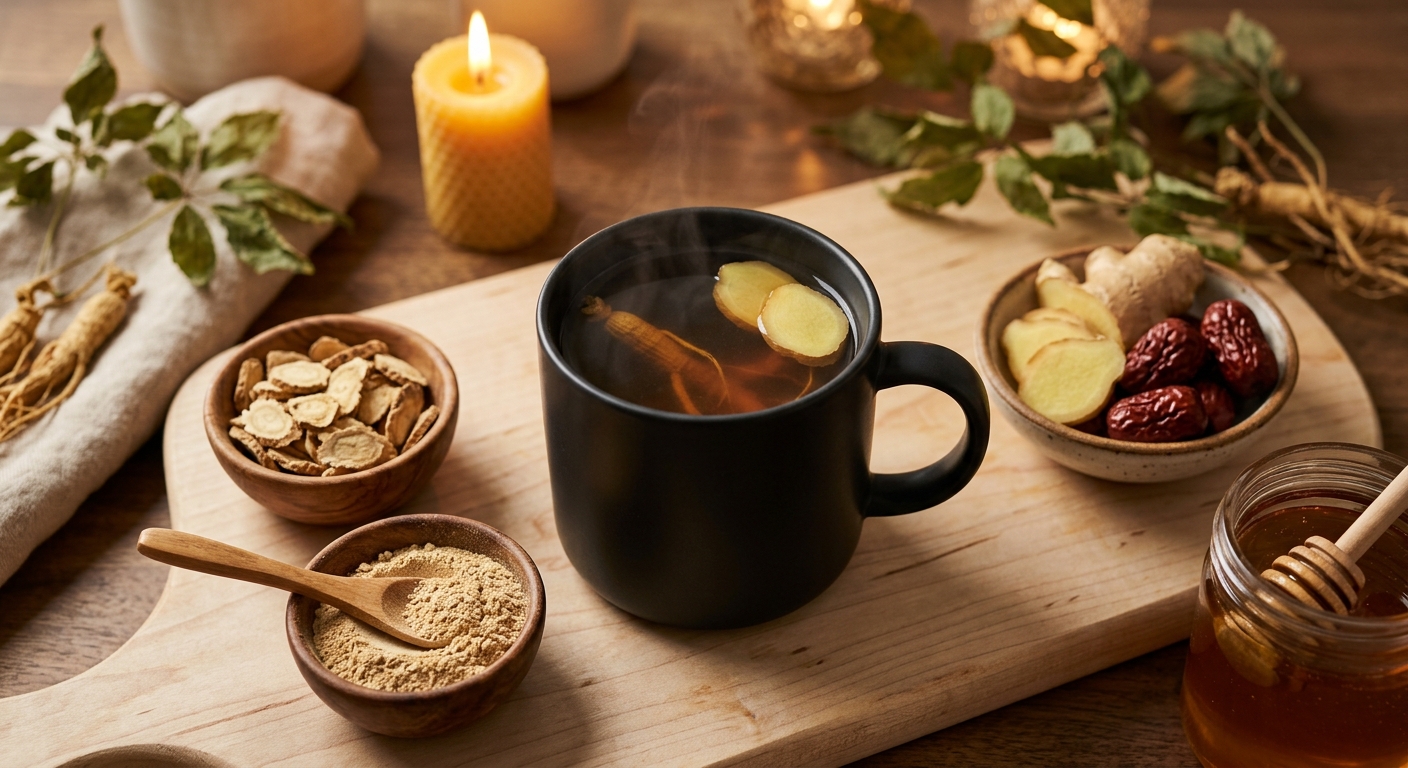
Few plants in the entire history of herbal medicine carry the legendary status of ginseng. For more than 2,000 years, the gnarled, man-shaped root of Panax ginseng has been treasured across China, Korea, and Japan as the ultimate tonic for vitality, longevity, and mental sharpness. Its very name reflects this reverence: Panax derives from the Greek word for “all-healing,” and the Chinese character for ginseng translates roughly as “man root,” a nod to its humanlike forked form. Emperors hoarded it, warriors carried it into battle, and scholars brewed it before long nights of study. That tradition has never really stopped.
What sets ginseng apart from stimulants like coffee or guarana is the nature of its energy. Rather than forcing a spike in alertness through adenosine blockade or adrenaline, ginseng works as an adaptogen, a class of botanicals that help the body resist physical and psychological stress while maintaining homeostasis. The active compounds responsible, a family of steroidal saponins called ginsenosides, modulate the hypothalamic-pituitary-adrenal axis and influence neurotransmitter systems in ways that promote calm, focused energy rather than nervous stimulation. The result is a tea that sharpens without jangling, energizes without depleting.
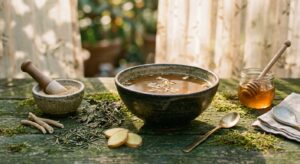
The sensory experience of ginseng tea is every bit as distinctive as its reputation. The brew is mildly bitter and deeply earthy, with a warm, woody undertone and a characteristic lingering sweetness on the back of the palate that herbalists call “kou gan,” or mouth-sweetness. A touch of honey and a slice of fresh ginger transform it into a complex, invigorating cup that feels genuinely nourishing. Whether you are brewing it as a morning ritual, a pre-workout tonic, or an afternoon focus aid, ginseng tea invites you to slow down and participate in one of humanity’s oldest wellness traditions.
2
cups
Ingredients
- 2 tspdried sliced ginseng root (or 1 tsp ginseng powder)
- 480 mlwater (90°C / 194°F)
- 2 thin slicesfresh ginger root (optional)
- —raw honey or jujube dates to taste (optional)
How to Brew
Click on an item below to shop for the recommended items for this recipe on Amazon.
As an Amazon Associate, we earn from qualifying purchases.
- Heat filtered water to 90 to 95°C (194 to 203°F). If you do not have a temperature-controlled kettle, bring water to a full boil and let it rest uncovered for 2 minutes before using.
- Place 2 teaspoons of dried sliced ginseng root into a tea infuser or small teapot. If using ginseng powder, use 1 teaspoon and plan to strain through a fine-mesh sieve.
- Add 2 thin slices of fresh ginger root to the infuser alongside the ginseng if desired for added warmth and digestive support.
- Pour 480 ml of hot water over the root, cover the teapot or mug with a lid or small plate to trap volatile aromatic compounds, and steep for 5 to 10 minutes. Shorter steeps yield a milder, sweeter cup; longer steeps intensify the bitterness and potency.
- Remove the infuser or strain the tea through a fine-mesh sieve into two warmed mugs. Sweeten with raw honey or add a couple of dried jujube dates to the cup for a traditional Korean-style pairing.
- Note that quality dried ginseng root can be re-steeped two to three times. Each subsequent infusion will be slightly milder but still flavorful and beneficial.
- Add 1 tablespoon of dried sliced ginseng root to a clean glass jar or pitcher. The higher herb-to-water ratio compared to hot brew compensates for the slower cold extraction.
- Pour 600 ml of cold, filtered water over the root. Do not use hot water at any stage, as the goal is a slow, low-temperature extraction.
- Stir gently to submerge all the root slices, then seal the jar with a lid or cover the pitcher tightly with plastic wrap.
- Let the jar rest at room temperature for 1 hour to begin the extraction, then transfer it to the refrigerator and steep for a further 9 to 13 hours, for a total of 10 to 14 hours.
- Remove from the refrigerator and strain the liquid through a fine-mesh sieve into a clean pitcher, pressing gently on the root to release remaining liquid.
- Serve over ice in tall glasses. The cold brew will keep refrigerated for up to 3 days. Add a slice of lemon or a few fresh mint leaves just before serving for a refreshing lift.
- Place 1 tablespoon of dried whole or sliced ginseng root into a small ceramic or stainless steel saucepan. Avoid aluminum cookware, which can react with bitter plant compounds.
- Add 600 ml of cold, filtered water and bring the mixture slowly to a gentle boil over medium heat, which should take about 5 to 7 minutes. Allow it to boil for 2 minutes, then immediately reduce the heat to a low simmer.
- Simmer uncovered or partially covered for 20 to 30 minutes, or until the liquid has reduced to approximately 400 ml. The brew will deepen in color to a rich amber and the aroma will become noticeably more concentrated and woody.
- Remove from heat and allow to cool for 3 to 5 minutes. Strain the decoction through a fine-mesh sieve into a warmed teapot or directly into mugs, pressing firmly on the softened root pieces.
- The decoction will be significantly stronger and more bitter than a standard steep. Start with a small cup of approximately 100 ml and sweeten with honey, or dilute to taste with hot water. Traditionally, jujube dates or licorice root slices are added during simmering to naturally balance the bitterness.
- The softened root pieces can be eaten after brewing or re-simmered once more with fresh water for a lighter second brew.
Health Benefits
Multiple randomized controlled trials have found that Panax ginseng supplementation significantly improves working memory, reaction time, and mental arithmetic in both healthy adults and those experiencing cognitive fatigue. Ginsenosides Rg1 and Rb1 appear to modulate cholinergic neurotransmission and promote brain-derived neurotrophic factor (BDNF) production, supporting neuronal health and communication.
Ginseng is one of the most studied adaptogens for fatigue reduction. Clinical trials, including a notable 2013 study published in the Journal of the National Cancer Institute, showed significant reductions in cancer-related fatigue with standardized ginseng supplementation. Its polysaccharides and ginsenosides support mitochondrial energy production and reduce the buildup of stress hormones like cortisol.
Panax ginseng has demonstrated immunomodulatory effects in multiple studies, increasing the activity of natural killer cells, macrophages, and T-lymphocytes. Regular consumption may reduce the incidence and duration of upper respiratory infections, a benefit supported by a 2004 randomized controlled trial published in the Canadian Medical Association Journal.
Several clinical studies suggest ginseng can modestly lower fasting blood glucose and improve insulin sensitivity in people with type 2 diabetes or metabolic syndrome. The ginsenosides appear to enhance GLUT4 translocation in muscle cells, improving glucose uptake independent of insulin signaling.
As a true adaptogen, ginseng helps normalize the hypothalamic-pituitary-adrenal (HPA) axis response to stress, reducing exaggerated cortisol release during demanding periods. User-reported outcomes in clinical trials consistently note improved mood, reduced feelings of anxiety, and greater psychological resilience after regular ginseng use.
🧪 Key Bioactive Compounds
The Science Behind Ginseng
The pharmacological activity of Panax ginseng centers on a diverse family of triterpene saponins known as ginsenosides, of which more than 150 distinct forms have been identified to date. These compounds are classified into two primary groups based on their chemical backbones: protopanaxadiols (PPD), such as Rb1, Rc, and Rd, which exert sedative, neuroprotective, and anti-anxiety effects, and protopanaxatriols (PPT), such as Rg1, Re, and Rf, which tend toward stimulating and memory-enhancing actions. This dual nature is precisely what gives ginseng its balanced adaptogenic character: the two groups work in opposition and in concert to produce an effect that neither purely stimulates nor purely sedates, but rather normalizes physiological function under stress.
At the neurological level, ginsenosides influence several key neurotransmitter systems simultaneously. Rg1 has been shown to upregulate acetylcholine synthesis and inhibit acetylcholinesterase activity, effectively increasing cholinergic tone in regions of the brain critical for memory and attention such as the hippocampus and prefrontal cortex. Separately, both Rb1 and Rg3 demonstrate neuroprotective activity by reducing beta-amyloid toxicity, suppressing neuroinflammatory pathways via NF-kB inhibition, and stimulating BDNF expression. At the cellular energy level, ginseng polysaccharides and ginsenosides enhance mitochondrial ATP production and reduce oxidative stress by upregulating superoxide dismutase and catalase activity, which explains the well-documented anti-fatigue effects observed in both animal models and human clinical trials.
One particularly important pharmacological nuance involves the gut microbiome. Many ginsenosides, particularly the PPD group, are not absorbed intact in the small intestine. Instead, they are transformed by colonic bacteria into more bioavailable metabolites called compound K (20-O-beta-D-glucopyranosyl-20(S)-protopanaxadiol) and other deglycosylated forms. This means that the efficacy of ginseng tea can vary significantly between individuals depending on their gut microbiome composition, and that traditional long-term daily use of ginseng, which cultivates the necessary bacterial populations, may actually be more effective than short-term supplementation. This insight also helps explain why fermented or “red” ginseng, processed through steaming and drying, tends to show stronger biological activity: the processing pre-converts some ginsenosides into these more readily absorbed forms before they even reach the gut.
Brewing Tips
- Source matters enormously with ginseng. Korean red ginseng (Panax ginseng that has been steamed and dried) is generally considered more potent than white ginseng (unprocessed dried root) and is distinctly different from American ginseng (Panax quinquefolius), which has a cooler, more calming energy profile in Traditional Chinese Medicine terms. Make sure the label clearly states the species and origin.
- Brew ginseng tea in the morning or early afternoon. Due to its mildly stimulating ginsenoside fractions, drinking ginseng tea in the evening can interfere with sleep for some individuals, particularly those who are sensitive to adaptogens or caffeine.
- Preserve the volatile aromatic compounds and prevent heat loss during steeping by covering your mug or teapot with a small lid or plate. This simple step keeps the temperature stable and ensures you capture the full spectrum of beneficial compounds, especially for short hot-brew steeps.