For centuries, athletes and warriors across cultures reached for plants to soothe aching bodies and restore vitality after physical exertion. Ancient Ayurvedic practitioners prescribed turmeric and ginger pastes to warriors after battle. Traditional Chinese herbalists brewed anti-inflammatory decoctions for those who labored with their bodies. What modern sports science is now confirming, these traditions understood intuitively: certain plant compounds can meaningfully accelerate recovery, reduce soreness, and protect muscle tissue from the cellular damage that intense exercise inflicts.
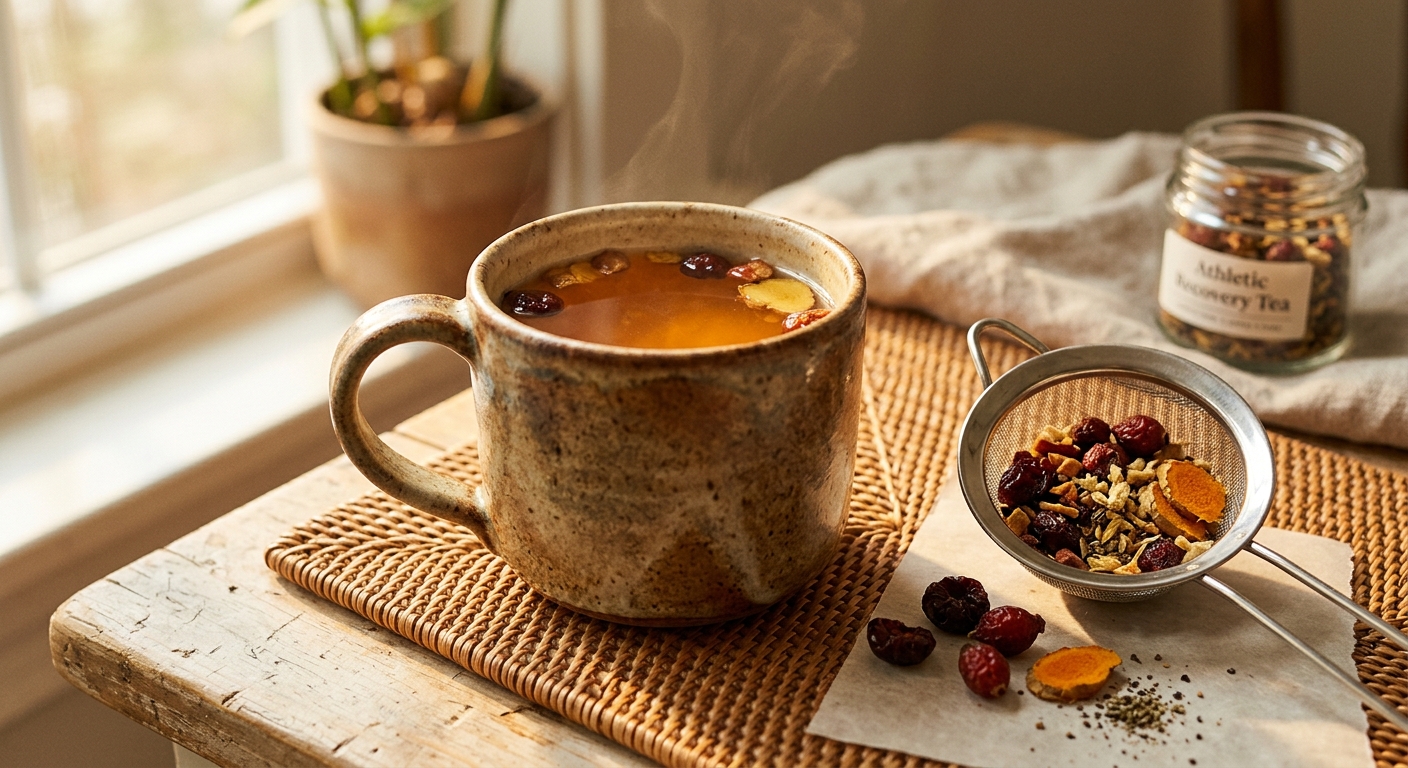
This Athletic Recovery Tea blends four synergistic herbs that work together across different physiological pathways. Tart cherry, long used in folk medicine for joint pain, brings a bold fruity tartness and delivers some of the most studied natural anti-inflammatory compounds available. Ginger and turmeric, the twin pillars of traditional anti-inflammatory herbalism, contribute warming heat and a golden hue. Rosehip rounds out the blend with a bright, tangy note and an extraordinary concentration of vitamin C, a critical antioxidant for collagen repair and immune resilience. Together they create a tea that is as delicious as it is therapeutic.
Whether you sip it warm after a long run, pour it chilled over ice after a gym session, or prepare a concentrate to keep in the fridge through a hard training week, this blend fits seamlessly into a recovery routine. It is not a replacement for sleep, nutrition, or proper training load management, but as a daily ritual it provides real, bioactive support for a body that works hard and needs to rebuild.
2
cups
Ingredients
- 2 tbspdried tart cherry pieces (or unsweetened tart cherry powder)
- 1 tbspdried rosehip pieces (seeds removed)
- 1 tspfreshly grated or dried ginger root
- 0.5 tspground turmeric or dried turmeric root slices
- 0.25 tspfreshly cracked black pepper (enhances curcumin absorption)
- 500 mlwater (90 to 95°C / 194 to 203°F)
- —raw honey or maple syrup to taste (optional)
- —a small splash of coconut milk or oat milk (optional, further aids curcumin absorption)
How to Brew
Click on an item below to shop for the recommended items for this recipe on Amazon.
As an Amazon Associate, we earn from qualifying purchases.
- Heat water to 90 to 95°C (194 to 203°F). If you do not have a temperature-controlled kettle, bring water to a full boil and allow it to rest for 60 to 90 seconds before pouring.
- Combine the dried tart cherry pieces, rosehip, grated ginger, turmeric, and cracked black pepper in a large tea infuser, muslin bag, or small heatproof saucepan. If you are using a saucepan, a gentle simmer for the first 2 minutes will help extract more from the rosehip and cherry pieces.
- Pour the hot water over the herbs and cover the vessel with a lid or small plate. Covering keeps volatile aromatic compounds and beneficial oils from escaping with the steam.
- Steep for 10 to 12 minutes, tasting at the 10-minute mark. A longer steep intensifies the tartness and spice, which many athletes enjoy.
- Strain the tea through a fine mesh strainer into two mugs. Press gently on the solids to extract remaining liquid.
- Sweeten with raw honey or maple syrup if desired, and stir in a small splash of coconut milk or oat milk. The fat content aids curcumin absorption significantly. Drink while warm.
- Combine the dried tart cherry pieces, rosehip, dried ginger (fresh ginger is too sharp for cold brew and is best avoided here), turmeric, and cracked black pepper in a clean glass jar. For cold brew, increase the tart cherry and rosehip to 3 tablespoons each per 500 ml of water to compensate for the slower extraction.
- Pour 500 ml of cold, filtered water over the herbs. Stir gently with a long spoon to ensure all the dried fruit and herbs are fully submerged.
- Leave the jar uncovered at room temperature for 30 minutes to allow the herbs to begin hydrating and releasing their pigments. You will notice the water beginning to turn a deep ruby color quickly.
- Seal the jar tightly with a lid and transfer it to the refrigerator. Allow it to steep for 10 to 14 hours, or overnight. Do not exceed 16 hours as the rosehip seeds, if any remain, can impart a slightly astringent quality.
- Strain through a fine mesh strainer lined with a piece of cheesecloth to catch any turmeric particles and fine sediment. Pour into tall glasses filled with ice.
- Taste and sweeten with a small drizzle of maple syrup if desired. Add a slice of fresh lemon or a few fresh mint leaves for a brighter, more refreshing finish. Consume within 48 hours and keep refrigerated.
- Triple the full ingredient quantities to make a batch concentrate: 6 tablespoons tart cherry, 3 tablespoons rosehip, 3 teaspoons dried ginger, 1.5 teaspoons turmeric, and 0.75 teaspoon cracked black pepper. Combine in a medium saucepan with 750 ml of cold filtered water.
- Bring the mixture to a gentle boil over medium-high heat, then immediately reduce to a low simmer. Simmer uncovered for 20 to 25 minutes. The liquid will reduce by approximately one third, concentrating all the bioactive compounds.
- Remove from heat and allow the concentrate to cool in the saucepan for 10 minutes. This resting period allows the cherry anthocyanins to settle back into the liquid rather than evaporating.
- Strain through a fine mesh strainer, pressing firmly on the solids to extract every drop. Discard the spent herbs.
- Pour the concentrate into a clean glass jar or bottle and allow to cool fully before sealing and refrigerating.
- To serve, dilute approximately 80 to 100 ml of concentrate with 150 ml of hot water for a warming recovery drink, or pour over ice and top with cold sparkling water for a refreshing post-workout tonic. Add honey, a squeeze of lemon, or a splash of milk alternative as preferred.
Health Benefits
Multiple randomized controlled trials have demonstrated that tart cherry juice and supplementation significantly reduce delayed-onset muscle soreness (DOMS) and strength loss following eccentric exercise. A 2010 study in the Scandinavian Journal of Medicine and Science in Sports found marathon runners consuming tart cherry experienced less muscle damage and faster strength recovery than placebo groups.
The combined action of curcumin from turmeric and anthocyanins from tart cherry provides a multi-pathway anti-inflammatory effect, suppressing both COX enzyme pathways and NF-kB signaling. This dual mechanism is more comprehensive than targeting a single inflammatory pathway, making this blend particularly effective for athletes with high training loads.
Tart cherry is one of the richest dietary sources of naturally occurring melatonin. Studies published in the European Journal of Nutrition found that tart cherry concentrate increased total sleep time and sleep efficiency in older adults. Since the majority of muscle protein synthesis and growth hormone secretion occurs during deep sleep, improving sleep quality directly accelerates physical recovery.
Rosehip provides a concentrated dose of vitamin C, which is a required cofactor in the enzymatic hydroxylation steps of collagen synthesis. Athletes who train heavily are at elevated risk for tendon and ligament stress; adequate vitamin C intake supports structural repair of these tissues and reduces oxidative damage to joint cartilage.
Intense physical exertion generates a significant surge of reactive oxygen species (ROS) that can damage muscle cell membranes, proteins, and DNA if not neutralized. The combined antioxidant capacity of vitamin C from rosehip, anthocyanins from tart cherry, and curcumin from turmeric helps quench this oxidative load, supporting faster cellular recovery and adaptation.
🧪 Key Bioactive Compounds
The Science Behind Tart Cherry
The science behind this recovery blend converges on two major post-exercise challenges: inflammation and oxidative stress. When muscle fibers sustain micro-tears during intense exercise, the body initiates an inflammatory cascade involving prostaglandins, leukotrienes, and cytokines such as interleukin-6 (IL-6) and tumor necrosis factor-alpha (TNF-a). This response is biologically necessary for adaptation, but when excessive or prolonged, it extends soreness, impairs subsequent training, and increases injury risk. The anthocyanins in tart cherry and the 6-gingerol in ginger both inhibit the COX-1 and COX-2 enzymes responsible for prostaglandin synthesis, while curcumin operates upstream by suppressing NF-kB, the transcription factor that activates the genes encoding most pro-inflammatory mediators. This means the three herbs together address inflammation at multiple points in the signaling cascade.
Bioavailability is a central concern with curcumin, which is notoriously poorly absorbed in its native form due to rapid hepatic metabolism. The inclusion of piperine from black pepper is not optional decoration in this recipe; it is a pharmacologically deliberate choice. Piperine inhibits the CYP3A4 enzyme in the liver and P-glycoprotein in the intestinal wall, both of which would otherwise rapidly clear curcumin from the bloodstream. Studies have demonstrated that co-administration of piperine increases peak plasma curcumin concentration by up to 2000 percent. The fat content from optional coconut or oat milk provides further assistance by making curcumin, which is fat-soluble, more readily absorbed through the lymphatic system rather than the hepatic portal route.
The melatonin content in tart cherry adds a dimension that purely anti-inflammatory herbs cannot match: support for sleep architecture. During slow-wave and REM sleep phases, the pituitary gland releases the largest pulses of growth hormone, which directly stimulates muscle protein synthesis and tissue repair. Studies using tart cherry concentrate have demonstrated measurable improvements in sleep efficiency and reductions in inflammatory markers simultaneously, suggesting the melatonin and anthocyanin content work in complementary ways. Meanwhile, rosehip’s vitamin C acts as both a structural substrate for collagen repair, supporting tendons, cartilage, and fascia, and as a water-soluble antioxidant that directly neutralizes hydrogen peroxide and superoxide radicals in the aqueous compartments of muscle cells, precisely where exercise-generated ROS are most destructive.
Brewing Tips
- Prepare a weekly batch of the concentrate on Sunday evening so you have ready-to-dilute recovery tea throughout the entire training week without any morning effort.
- If using fresh turmeric root instead of ground powder, grate approximately 1 cm of fresh root per serving and add it at the very start of brewing. Fresh turmeric has a slightly brighter, less bitter flavor profile than dried ground turmeric.
- For maximum anti-inflammatory effect, drink this tea both within 30 minutes before a hard training session and again within 60 minutes after finishing, as the pre-loading of curcumin and cherry anthocyanins has been shown in clinical studies to provide superior results compared to post-exercise supplementation alone.
- Store any unused dried herb blend in an airtight glass jar away from light and heat. A well-sealed blend of these dried herbs retains potency for 6 to 12 months.
- If the tartness of the rosehip is too pronounced for your palate, reduce the rosehip and add a small strip of dried orange peel to maintain brightness while softening the sour edge.