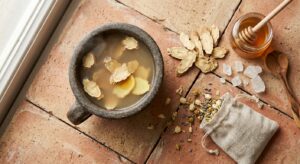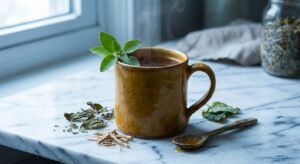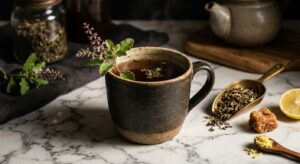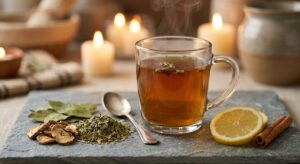
Long before modern science coined the term ‘adaptogen,’ healers in the Himalayan highlands and the river plains of India were reaching for the same two plants when life became overwhelming. Rhodiola rosea, sometimes called ‘golden root’ or ‘arctic root,’ flourished in the cold, rocky altitudes of Siberia, Scandinavia, and Central Asia, where it was treasured by Viking warriors for stamina, by Russian cosmonauts for mental sharpness, and by Tibetan monks who brewed it at altitude to ease the physical toll of mountain life. Holy basil, known in Ayurvedic tradition as Tulsi and considered the ‘Queen of Herbs,’ has been cultivated in Indian households for over three thousand years, revered as a sacred plant, a daily tonic, and a first-line remedy for the weight of worry and fatigue.
What makes this blend so compelling is the way these two herbs complement each other in both flavor and function. Rhodiola brings an earthy, slightly bitter, rose-tinged quality along with its well-documented ability to lower cortisol and sharpen cognition under pressure. Holy basil counters with its warm, clove-like spice and nervine qualities, softening anxiety at the edges while supporting the immune and digestive systems that chronic stress tends to compromise. The result is a tea that feels grounding and uplifting at once, not sedating, not stimulating, but genuinely balancing.
This blend is particularly suited to people navigating sustained stress: long work seasons, emotional burnout, or periods of mental overload where focus is needed but the nervous system is running on empty. Brewed hot, it delivers a full extraction of rhodiola’s rosavins and salidroside alongside holy basil’s eugenol and rosmarinic acid. Cold brewed, it becomes a smoother, subtler wellness drink that works beautifully prepared ahead and sipped throughout a demanding day.
2
cups
Ingredients
- 1 tspdried rhodiola root (sliced or cut-and-sifted)
- 2 tspdried holy basil (tulsi) leaf
- 480 mlwater (95°C / 203°F)
- —raw honey or coconut sugar to taste (optional)
- —a thin slice of fresh ginger (optional, for warmth)
How to Brew
Click on an item below to shop for the recommended items for this recipe on Amazon.
As an Amazon Associate, we earn from qualifying purchases.
- Bring filtered water to 93 to 96°C (200 to 205°F). If you do not have a temperature-controlled kettle, bring water to a full boil and let it rest for 60 to 90 seconds before using.
- Add 1 teaspoon of dried rhodiola root slices and 2 teaspoons of dried holy basil leaf per 240 ml of water directly into a saucepan or heatproof teapot. For two servings, use 480 ml of water and double the herb quantities.
- Pour the hot water over the herbs. Cover the vessel immediately with a lid or small plate to trap the volatile aromatic compounds in holy basil, which are sensitive to heat loss.
- Steep for 10 to 15 minutes. For a lighter, more floral cup with less bitterness, steep for 10 minutes. For a fuller, more medicinal extraction with stronger adaptogenic potency, allow the full 15 minutes.
- Strain the tea through a fine mesh strainer into your mug. Press the herbs gently with a spoon to extract the last of the liquor from the holy basil leaves.
- Taste before sweetening. If bitterness from the rhodiola is prominent, stir in a small amount of raw honey while the tea is still hot. Add a slice of fresh ginger to the mug before steeping if you enjoy a warming spice note.
- Measure 1.5 teaspoons of dried rhodiola root and 3 teaspoons of dried holy basil leaf into a clean glass jar. This slightly increased ratio compensates for the reduced extraction efficiency of cold water.
- Pour 480 ml of cold, filtered water over the herbs at room temperature. Do not use hot water at any point in this method, as you are aiming for a gentle, low-temperature extraction that retains the herb’s subtle sweetness.
- Stir gently to ensure all the dried herb is fully submerged. Secure the lid on the jar and allow it to rest at room temperature for one hour so the initial infusion can begin, then transfer the jar to the refrigerator.
- Refrigerate for 8 to 12 hours. Overnight steeping is ideal, producing a smooth, slightly earthy brew with a clean holy basil finish and minimal bitterness from the rhodiola.
- Remove the jar from the refrigerator and strain the tea through a fine mesh strainer or cheesecloth into a serving glass filled with ice. The cold brew will keep refrigerated in a sealed container for up to 48 hours.
- Serve over ice with a sprig of fresh tulsi or lemon balm if available, or stir in a small amount of honey diluted in a splash of warm water, as cold honey can be difficult to dissolve evenly.
- Place 1.5 teaspoons of dried rhodiola root slices into a small saucepan with 600 ml of cold filtered water. Starting from cold water allows the root to hydrate gradually and improves overall extraction before heat is applied.
- Bring the water to a gentle simmer over medium heat, then reduce the heat to maintain a steady simmer at approximately 85 to 90°C (185 to 194°F). Do not allow it to reach a rolling boil, as excessive heat can degrade some of rhodiola’s bioactive compounds.
- Simmer the rhodiola root uncovered for 20 to 25 minutes. The liquid will reduce slightly and deepen in color to a warm amber. You should notice a faintly rose-like, earthy aroma developing as the rosavins extract into the water.
- Remove the saucepan from heat. Add 2 teaspoons of dried holy basil leaf directly to the hot decoction. Cover the saucepan immediately and allow the holy basil to infuse into the hot rhodiola liquid for 5 minutes. This two-stage approach ensures the root gets a long, hot extraction while the leaf is treated as a gentler infusion to preserve its volatile aromatic oils.
- Strain through a fine mesh strainer, pressing the spent herbs gently. You should have approximately 400 ml of concentrated, richly colored tea after reduction. If needed, add a small splash of hot water to reach your preferred strength.
- Pour into warmed mugs and serve immediately. This method produces the most potent and full-spectrum extraction of both herbs and is especially recommended during periods of intense, sustained stress or at the onset of physical fatigue.
Health Benefits
Both rhodiola’s rosavins and holy basil’s ursolic acid have demonstrated the ability to modulate the hypothalamic-pituitary-adrenal (HPA) axis, reducing the magnitude of the cortisol stress response. A 2012 double-blind trial found rhodiola extract significantly reduced self-reported stress scores compared to placebo over 28 days.
Salidroside in rhodiola has been shown to improve accuracy and speed on cognitive tasks during conditions of sleep deprivation and fatigue. Holy basil also contributes by protecting neurons from oxidative stress and supporting acetylcholine availability, which underlies attention and memory.
Rosmarinic acid in holy basil inhibits the enzyme GABA transaminase, effectively increasing GABA availability in the brain and producing a calming effect. Rhodiola’s salidroside simultaneously helps regulate serotonin and dopamine metabolism, contributing to mood stability without sedation.
Rhodiola is one of the most studied herbs for fatigue reduction, with multiple clinical trials showing improvements in physical endurance and mental stamina among stressed or fatigued adults. Holy basil supports this effect by helping regulate blood glucose during stress, preventing the energy crashes that accompany cortisol spikes.
Chronic psychological stress elevates inflammatory markers including IL-6 and TNF-alpha. Both herbs in this blend contain compounds, including eugenol, rosmarinic acid, ursolic acid, and tyrosol, that have demonstrated the ability to reduce these inflammatory signals and quench the free radicals generated by chronic stress responses.
🧪 Key Bioactive Compounds
The Science Behind Rhodiola And Holy Basil
The adaptogenic concept, defined as a substance that helps organisms non-specifically resist physical, chemical, and biological stressors, was first formalized by Soviet pharmacologist Nikolai Lazarev in 1947. Both rhodiola and holy basil meet the criteria with impressive specificity. Rhodiola’s primary active compounds, the rosavins (rosavin, rosarin, and rosin) and the phenylpropanoid glycoside salidroside, work primarily by normalizing the activity of the hypothalamic-pituitary-adrenal (HPA) axis, the cascade of hormonal signaling that governs the body’s stress response. When the HPA axis is chronically overactivated, cortisol remains elevated, depleting energy reserves, impairing memory formation, and increasing systemic inflammation. Salidroside appears to blunt this overactivation by influencing corticotropin-releasing factor (CRF) signaling, effectively telling the brain’s stress response to stand down without completely suppressing it.
Holy basil operates through complementary but distinct mechanisms. Its dominant phenylpropanoid eugenol is a potent COX-2 inhibitor, reducing the inflammatory prostaglandins that chronic stress promotes at the cellular level. Rosmarinic acid, another key polyphenol in the leaf, inhibits GABA transaminase, the enzyme responsible for breaking down gamma-aminobutyric acid in the brain. By slowing GABA breakdown, holy basil gently increases inhibitory neurotransmitter tone, producing measurable anxiolytic effects that have been documented in both animal models and small human trials. Ursolic acid, a pentacyclic triterpene, adds a layer of systemic stress protection by modulating NF-kB, one of the central regulators of inflammatory gene expression.
When rhodiola and holy basil are combined, their mechanisms create a complementary adaptogenic profile that addresses stress from multiple physiological angles simultaneously. Rhodiola sharpens the mind and reduces cortisol output while holy basil calms the nervous system and dampens downstream inflammation. The antioxidant compounds present in both herbs, including tyrosol, rosmarinic acid, and various flavonoids, provide a further layer of cellular protection against the oxidative damage that sustained stress inflicts on the brain and body. This multi-target approach is precisely why traditional herbal systems often favored blended formulas over single-herb preparations, and it is why modern adaptogenic research increasingly examines synergistic herb combinations alongside individual plant extracts.
Brewing Tips
- Source your rhodiola from a reputable supplier that standardizes for a minimum of 3 percent rosavins and 1 percent salidroside, as wild-harvested or poorly processed rhodiola products vary enormously in potency and can be adulterated with related Rhodiola species that lack the same clinical evidence.
- Holy basil (Ocimum tenuiflorum) and common sweet basil (Ocimum basilicum) are not interchangeable. Check that your supplier specifies Ocimum tenuiflorum or ‘Tulsi’ on the label, as sweet basil lacks the adaptogenic triterpenes and does not offer the same therapeutic profile.
- This blend is best consumed in the morning or early afternoon. Rhodiola’s mild stimulating quality makes late-evening consumption inadvisable for those who are sensitive to stimulants or have difficulty falling asleep. For evening stress relief, consider pairing holy basil alone with lemon balm or passionflower instead.