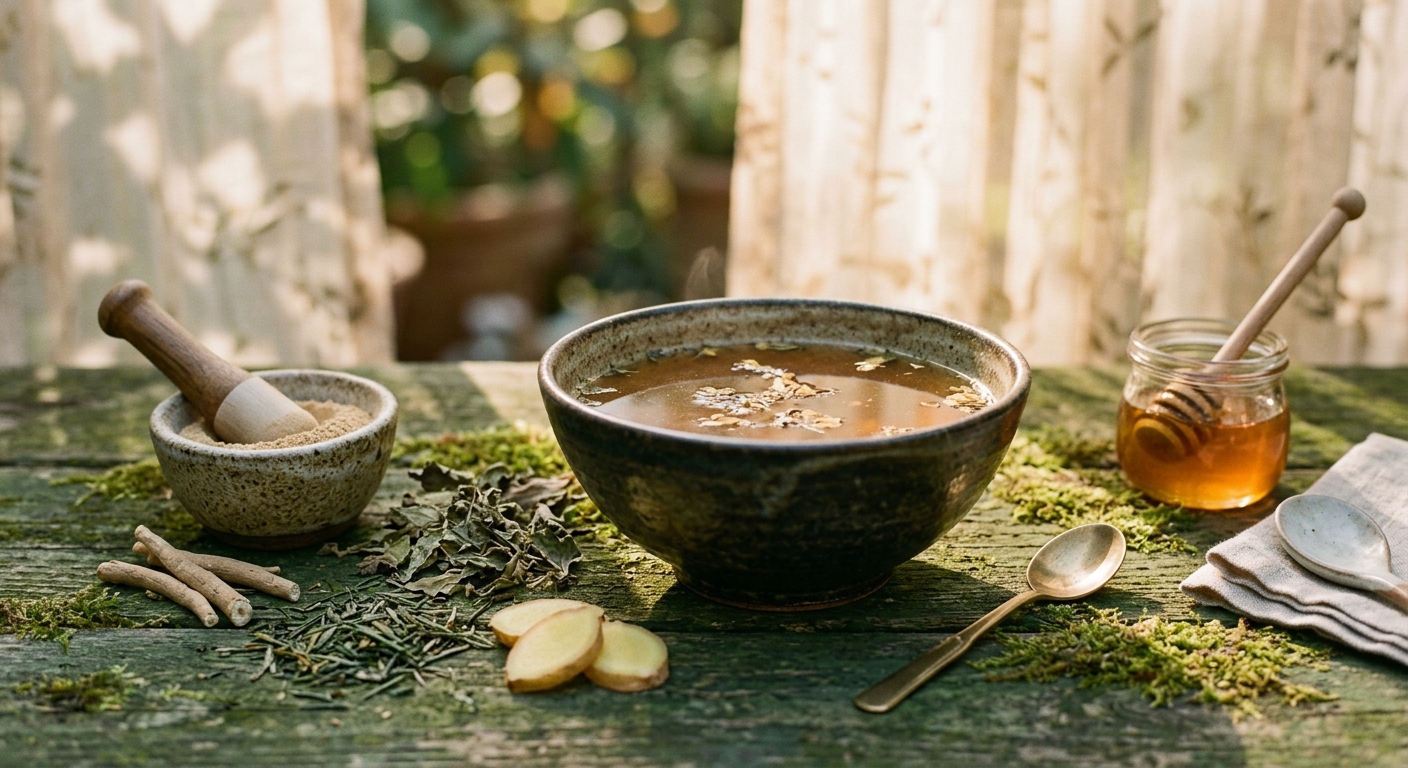
Long before the modern yoga studio existed, the plants in this blend were considered sacred allies in the pursuit of mental clarity and physical vitality. Tulsi, known as Holy Basil in Ayurvedic tradition, was revered as the queen of herbs, grown in temple courtyards and offered to deities as a symbol of purity and devotion. Ashwagandha, another pillar of Ayurveda, was prescribed to warriors and sages alike for its ability to restore strength without agitation. Together with the gentle stimulation of green tea and the warming fire of ginger, these four herbs form a blend that mirrors the spirit of yoga itself: energized yet grounded, alert yet calm.
Yoga Energy Tea is not a pre-workout jolt. It is a slow, intentional rise, the kind that allows you to hold a pose with steady breath rather than a racing heart. The L-theanine in green tea works in concert with ashwagandha’s withanolides to modulate cortisol and support a state of alert relaxation, precisely the mental space that makes a yoga or meditation practice sing. Ginger adds digestive fire, improving circulation and reducing the inflammation that can accumulate in joints and muscles after vigorous movement. Tulsi ties the blend together with its adaptogenic, mood-brightening qualities, helping the body respond to stress with grace rather than reactivity.
This blend is deeply rooted in tradition yet surprisingly practical for modern life. Whether you are rolling out your mat at dawn, heading into a long workday that demands creative focus, or winding down from an intense flow session, Yoga Energy Tea adapts to the moment. Its flavor is complex and inviting: grassy and slightly astringent from the green tea, warmly spiced from ginger, floral and herbaceous from tulsi, and gently earthy from ashwagandha. It is a tea that rewards slow sipping and conscious breath, which is perhaps the most yoga thing about it.
2
cups
Ingredients
- 1 tsploose-leaf green tea (sencha or gunpowder)
- 1 tspdried tulsi (holy basil) leaves
- 0.5 tspashwagandha root powder
- 3 slicesfresh ginger root (or 0.5 tsp dried ginger)
- 480 mlwater (80°C / 176°F)
- —raw honey or coconut sugar to taste (optional)
- —a pinch of black pepper (enhances ashwagandha absorption, optional)
How to Brew
Click on an item below to shop for the recommended items for this recipe on Amazon.
As an Amazon Associate, we earn from qualifying purchases.
- Heat water to exactly 80°C (176°F). If you do not have a temperature-controlled kettle, bring water to a full boil then let it cool for 4 to 5 minutes uncovered before pouring.
- Add the ashwagandha root powder and fresh ginger slices to your teapot or infuser first. These denser ingredients benefit from a slightly longer contact with hot water.
- Add the dried tulsi leaves and loose-leaf green tea into the infuser on top of the ashwagandha and ginger.
- Pour the 80°C water slowly over the herbs, ensuring all plant material is fully submerged. Place a lid or small saucer on top of the mug or teapot to trap the volatile aromatic compounds from the tulsi.
- Steep for 4 to 6 minutes. Check at 4 minutes for a lighter, grassier cup. Extend to 6 minutes for a stronger, spicier brew with more pronounced ashwagandha earthiness.
- Remove the infuser, stir gently to distribute the ashwagandha powder, and sweeten with raw honey or coconut sugar if desired. Add a pinch of black pepper to boost withanolide absorption. Sip slowly 20 to 30 minutes before or after your yoga practice.
- Use filtered cold water at room temperature (not warm or hot). Combine the green tea, tulsi, and dried ginger into a glass jar or pitcher. For cold brew, omit loose ashwagandha powder as it does not dissolve well in cold water. Instead, use ashwagandha in cut-and-sifted root form if available, or add the powder only when serving.
- Pour 600 ml of cold filtered water over the herbs (use a slightly higher water ratio than hot brew to account for the slower, less efficient cold extraction).
- Stir briefly to ensure all herbs are saturated. Seal the jar or cover the pitcher with a lid or plastic wrap to prevent the tulsi’s volatile oils from evaporating.
- Place the jar in the refrigerator and allow to steep for 8 to 12 hours, ideally overnight. Do not steep longer than 14 hours as the green tea may develop off-flavors.
- Strain the cold brew through a fine mesh strainer or cheesecloth into a clean pitcher or individual glasses. If using ashwagandha powder, whisk in 0.5 tsp per serving at this stage along with a pinch of black pepper.
- Serve over ice. Sweeten with a small amount of honey dissolved in a teaspoon of warm water (to help it blend), or use liquid sweetener such as agave. Garnish with a fresh tulsi leaf or a slice of ginger for an elegant finish.
- Place 1 tsp of ashwagandha root powder (or 1 tbsp of cut ashwagandha root pieces) and 4 to 5 slices of fresh ginger into a small saucepan with 600 ml of cold filtered water.
- Bring the saucepan to a gentle simmer over medium heat, not a rolling boil. Maintain the simmer for 15 to 20 minutes, stirring occasionally. The liquid will reduce slightly and take on a warm tan color with a distinctly earthy, warming aroma. This is your adaptogenic base.
- Remove the saucepan from the heat and allow the decoction to cool for 2 to 3 minutes until the temperature drops to approximately 80°C (176°F). This cooling step is critical before adding the green tea.
- Add the green tea and dried tulsi directly into the saucepan or transfer the decoction liquid to a teapot containing the green tea and tulsi. Steep for 3 to 4 minutes only. Do not return to heat during this step.
- Strain the entire preparation through a fine mesh strainer into two warmed mugs, pressing gently on the herbs to extract the last of the liquid.
- Sweeten with raw honey and add a pinch of black pepper to each mug. This method produces the most potent, deeply earthy, and warming version of the blend, best enjoyed on cold mornings or during high-stress periods when maximum adaptogenic support is needed.
Health Benefits
The combination of L-theanine and low-to-moderate caffeine in green tea produces a well-documented state of alert relaxation, with studies showing this pairing improves attention, accuracy, and reaction time without the anxiety associated with caffeine alone. Ashwagandha’s cortisol-modulating effects further steady the energy curve over several hours.
6-Gingerol in ginger and ursolic acid in tulsi both inhibit key inflammatory pathways, including COX-2 and lipoxygenase enzymes. Clinical trials have shown ginger supplementation significantly reduces delayed-onset muscle soreness (DOMS), making this blend particularly valuable as a post-yoga recovery tea.
Ashwagandha is among the most clinically studied adaptogens in the world. Multiple double-blind trials, including a landmark 2019 study in Medicine, have shown that daily ashwagandha supplementation significantly reduces serum cortisol, perceived stress scores, and anxiety levels compared to placebo. Tulsi adds complementary adaptogenic action through a different biochemical pathway.
Tulsi has demonstrated anxiolytic and antidepressant effects in both animal and human studies, with improvements in cognitive flexibility, attention, and working memory. EGCG from green tea supports neuroplasticity and may protect dopaminergic neurons, contributing to mood stability and mental clarity.
Ginger stimulates digestive enzyme activity and bile secretion, improving the breakdown and absorption of nutrients consumed around your yoga practice. The piperine in black pepper, used optionally in this blend, enhances the bioavailability of ashwagandha’s withanolides by up to 20 percent by inhibiting hepatic metabolism.
🧪 Key Bioactive Compounds
The Science Behind Tulsi (Holy Basil)
The synergy at the heart of Yoga Energy Tea is the relationship between green tea’s L-theanine and its caffeine. On their own, caffeine is stimulating but can trigger cortisol spikes and anxious energy in sensitive individuals. L-theanine, a non-protein amino acid almost unique to the tea plant, increases alpha brain wave activity, associated with a wakeful, relaxed mental state. Research published in the journal Nutritional Neuroscience has consistently shown that this pairing improves sustained attention, visual processing speed, and accuracy on cognitively demanding tasks more effectively than either compound alone. For yoga practitioners, this translates to a mind that is sharp and present without being scattered or overactivated.
Ashwagandha’s withanolides work through a fundamentally different mechanism: they regulate the hypothalamic-pituitary-adrenal (HPA) axis, the control system governing cortisol release. Under chronic stress, this axis becomes dysregulated, leading to fatigue, brain fog, and poor exercise recovery. Withanolides appear to act as adaptogenic buffers, normalizing HPA axis output without suppressing it entirely. A randomized, double-blind, placebo-controlled trial published in Medicine (2019) found that participants taking ashwagandha extract for 8 weeks experienced a 27 percent reduction in serum cortisol levels and significantly improved scores on validated stress and anxiety questionnaires. Crucially, this effect accumulates over time, making Yoga Energy Tea most powerful when consumed consistently as part of a daily ritual.
Tulsi contributes through its rich content of eugenol, rosmarinic acid, and ursolic acid, compounds that collectively inhibit both COX-1 and COX-2 inflammatory enzymes, reduce reactive oxygen species, and modulate monoamine neurotransmitters including dopamine and serotonin. A human clinical trial found that tulsi supplementation for 6 weeks improved cognitive flexibility, working memory, and reaction times compared to placebo. Ginger’s 6-gingerol and shogaol compounds complete the picture by reducing systemic inflammation and supporting gastrointestinal motility, ensuring that the body is both comfortable and efficient during and after physical practice. Together, these four plant allies offer a multi-pathway approach to energy that is as holistic as the discipline it was designed to support.
Brewing Tips
- Toast the ashwagandha powder in a dry pan for 60 seconds before brewing. This brief heat exposure mellows its raw, slightly bitter earthiness and brings out a nuttier, more pleasant flavor that blends seamlessly with the ginger and tulsi.
- Use fresh tulsi leaves from a home-grown plant if possible. Fresh tulsi contains higher concentrations of volatile eugenol compounds than most commercially dried tulsi, resulting in a noticeably more vibrant, clove-like aroma and a brighter adaptogenic effect.
- Brew this tea in a covered vessel whenever possible. Tulsi and ginger are both rich in volatile aromatic oils that begin evaporating the moment hot water is added. Placing a lid or saucer over your mug during steeping traps these oils and returns them to the cup when you remove the cover, ensuring you receive the full sensory and therapeutic benefit of the herbs.