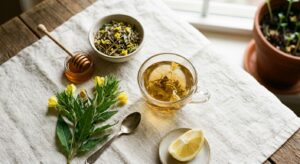
Few herbs carry as storied and intimate a history with women’s health as lady’s mantle (Alchemilla vulgaris). Named after the alchemists who once collected the sparkling dewdrops that gather in its pleated, cloak-shaped leaves, this low-growing perennial has graced European cottage gardens and apothecary shelves since at least the Middle Ages. Herbalists from Germany to the British Isles regarded it as a near-universal remedy for the rhythms and transitions of the female body, from adolescence through menopause. The great medieval abbess and herbalist Hildegard von Bingen praised it for its strengthening and consolidating properties, and it earned the folk name “a woman’s best friend” across much of central Europe.
The Latin genus name Alchemilla hints at the mystical reverence once accorded this plant. Alchemists believed the glistening water collected in the folds of its leaves possessed magical purifying powers, and they used it in their experiments. Beyond the legend, the plant is genuinely remarkable. Its soft, fan-shaped leaves are covered in fine hairs that trap moisture in perfect silver beads, and its clusters of tiny yellow-green flowers bloom through late spring and summer. Today, modern herbalists and integrative practitioners continue to use lady’s mantle for premenstrual tension, heavy or irregular periods, perimenopausal symptoms, and as a gentle digestive tonic. It is one of those herbs that bridges folk wisdom and emerging scientific evidence with quiet confidence.
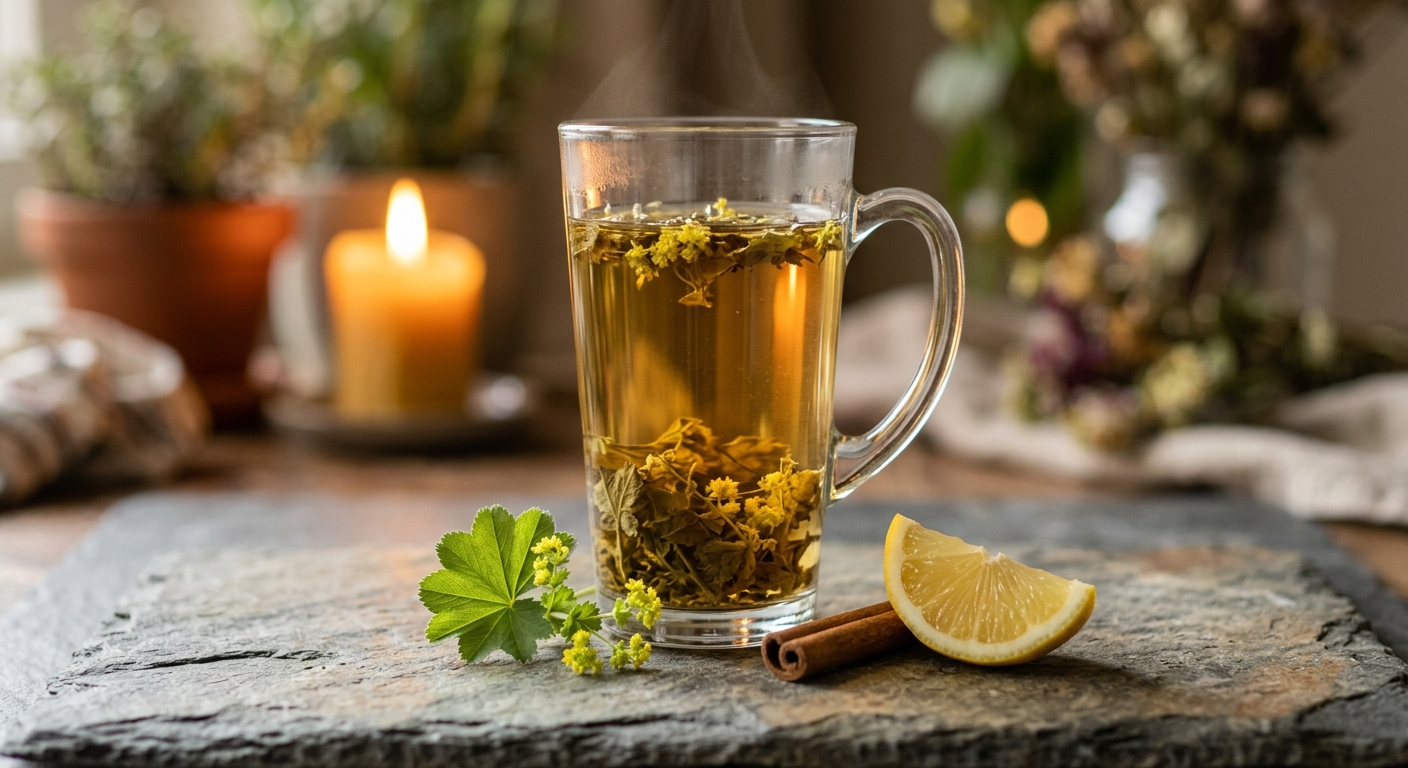
Brewed as a tea, lady’s mantle produces a mild, pleasantly astringent cup with faintly grassy and green notes, reminiscent of a delicate green tea but softer and more earthy. It is gentle enough for daily use during hormonal transitions, yet effective enough to have maintained its place in European phytotherapy for over a thousand years. Whether you are seeking relief from menstrual cramps, support during perimenopause, or simply a grounding, mineral-rich herbal tea to add to your wellness routine, lady’s mantle offers a time-tested and botanically fascinating option.
2
cups
Ingredients
- 2 tspdried lady’s mantle leaves and flowers (Alchemilla vulgaris)
- 480 mlwater (90°C / 194°F)
- —raw honey or a slice of lemon to taste (optional)
How to Brew
Click on an item below to shop for the recommended items for this recipe on Amazon.
As an Amazon Associate, we earn from qualifying purchases.
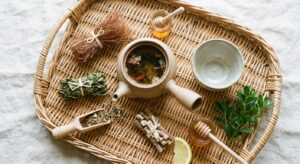
- Measure 2 teaspoons of dried lady’s mantle leaves and flowers per cup (240 ml) and place them in a tea infuser, strainer basket, or directly into a teapot.
- Heat fresh filtered water to approximately 90 to 95°C (194 to 203°F). Avoid a full rolling boil, as excessive heat can degrade some of the delicate flavonoid compounds. A kettle with temperature control works best.
- Pour the hot water over the herb and cover the vessel immediately with a lid or a small saucer. Covering traps volatile aromatic compounds and prevents the tea from cooling too quickly.
- Steep for 10 to 15 minutes. Lady’s mantle benefits from a longer infusion than most leaf herbs because its tannins and bitter glycosides require more time to fully release into the water.
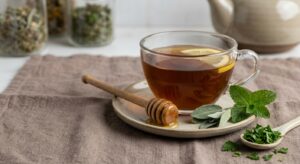
- Remove the infuser or strain the herb out completely. Taste the tea before adding anything – its gentle bitterness is part of its therapeutic character. Add raw honey or a squeeze of lemon if desired, then sip slowly while still warm.
- Add 3 teaspoons of dried lady’s mantle leaves and flowers per 480 ml of cold, filtered water to a clean glass jar or pitcher. Using a slightly higher herb-to-water ratio compensates for the slower, cooler extraction.
- Stir the herbs gently to ensure all plant material is submerged. You can use a spoon or small muddler to lightly press the leaves against the side of the jar to help release their compounds into the cold water.
- Cover the jar loosely with a lid or a piece of muslin cloth secured with a rubber band, and leave it at room temperature for 30 minutes to allow initial extraction to begin.
- Transfer the jar to the refrigerator and let it steep for a further 8 to 12 hours, or overnight. The cold environment slows extraction and produces a cleaner, mellower flavor with a subtler astringency.
- When ready, strain the liquid through a fine mesh strainer or cheesecloth into a clean glass or pitcher, pressing the spent herb gently to extract the last of the infusion. Serve chilled over ice or at cool room temperature. The cold brew keeps well in the refrigerator for up to 48 hours.
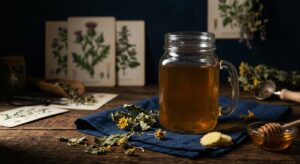
- Place 3 teaspoons of dried lady’s mantle leaves and flowers into a clear glass jar with a tight-fitting lid. Use filtered or spring water, as the mineral content of good water complements this herb beautifully.
- Fill the jar with 480 ml of cold or room-temperature filtered water and seal the lid. Hold the jar up to the light briefly to appreciate the pale green hue the herb imparts almost immediately.
- Set the sealed jar in a sunny outdoor spot or a south-facing windowsill that receives consistent direct sunlight. The gentle ambient warmth of sunlight, typically between 30 and 45°C, slowly draws out the herb’s flavonoids and tannins without the harshness of boiling.
- Allow the jar to sit in the sun for 4 to 6 hours, checking occasionally. The tea is ready when it has turned a soft golden-green and the aroma, when you open the jar briefly, is fresh and herbaceous with a faint floral quality.
- Strain the infusion through a fine mesh strainer into a clean glass or pitcher. Taste and add honey or lemon if desired. Serve at room temperature or over ice. Refrigerate any unused portion and consume within 24 hours.
Health Benefits
Lady’s mantle’s high tannin content, particularly agrimoniin and pedunculagin, exerts a pronounced astringent effect on mucous membranes and blood vessels, helping to reduce excessive uterine bleeding. European phytotherapy traditions have long recommended it for menorrhagia, and clinical herbalists continue to use it as a first-line botanical for heavy periods.
The phytosterols and flavonoids in lady’s mantle are thought to exert gentle hormone-modulating effects, potentially easing symptoms such as hot flashes, mood fluctuations, and irregular cycles during the perimenopausal transition. Traditional herbalists in Germany and Austria have prescribed it as a tonic during this life stage for generations.
The antispasmodic and anti-inflammatory properties of luteolin and other flavonoids in lady’s mantle may help relax smooth muscle in the uterus, reducing the intensity of menstrual cramps. Its mild analgesic phenolic derivatives add complementary relief from lower abdominal and pelvic discomfort.
As an astringent herb, lady’s mantle has a toning effect on lax or overly relaxed tissues, including the uterine lining and pelvic floor muscles. Midwives and traditional herbalists in Europe have historically used it postpartum to help the uterus return to its normal tone and size.
The rich polyphenol content of lady’s mantle, including ellagitannins and flavonoid glycosides, contributes meaningful antioxidant activity that may help reduce systemic inflammation. Its gentle bitter and astringent properties also support digestive tone, easing mild diarrhea, bloating, and gut inflammation when consumed as a regular herbal tea.
🧪 Key Bioactive Compounds
The Science Behind Lady’S Mantle
The therapeutic reputation of lady’s mantle rests primarily on its exceptional concentration of polyphenolic compounds, particularly a class of tannins called ellagitannins. The most pharmacologically significant of these is agrimoniin, which has been studied for its ability to contract and tone mucous membranes and blood vessel walls through protein-precipitating interactions. This astringent mechanism directly supports the herb’s historical use for reducing heavy menstrual flow: by tightening uterine blood vessels and reducing their permeability, the tannins help slow excessive bleeding without the systemic side effects of pharmaceutical hemostatic agents. Laboratory studies have also shown that agrimoniin exhibits measurable anti-inflammatory activity, inhibiting certain cytokine pathways involved in pelvic inflammation and dysmenorrhea.
The flavonoid fraction of lady’s mantle, which includes isoquercitrin and luteolin, adds a complementary layer of biological activity. Isoquercitrin has been studied for its role in maintaining capillary integrity and reducing vascular permeability, actions that support the management of pelvic congestion and varicosities that can worsen menstrual discomfort. Luteolin, meanwhile, has been demonstrated in multiple in vitro and animal studies to inhibit the release of prostaglandins, the inflammatory lipid mediators responsible for uterine contractions and the cramping pain associated with menstruation. This prostaglandin-inhibiting mechanism parallels the action of nonsteroidal anti-inflammatory drugs, though in a far gentler, whole-plant context with a broader and more balanced phytochemical matrix.
From an endocrinological perspective, the phytosterols present in lady’s mantle, particularly beta-sitosterol, are of growing scientific interest. Phytosterols share a structural resemblance to human sex hormones and can compete for estrogen receptor binding sites, potentially exerting a mild modulating influence on estrogen activity. While robust clinical trials in humans are still limited, this mechanism offers a plausible scientific basis for the herb’s centuries-old use during perimenopause, when fluctuating and declining estrogen levels produce a wide range of symptomatic changes. Together, the tannins, flavonoids, and phytosterols of lady’s mantle create a coherent phytochemical picture that substantiates much of what traditional herbalists have observed in practice for over a millennium.
Brewing Tips
- Source organically grown or ethically wildcrafted lady’s mantle from a reputable supplier, as the flavor and potency of dried Alchemilla vulgaris vary considerably depending on harvest time and drying conditions. Look for material harvested in early to mid-summer when flavonoid content peaks.
- For menstrual support, many herbalists recommend drinking two to three cups per day during the week before your period is due and continuing through the first two to three days of menstruation, rather than drinking it continuously throughout the month.
- Store dried lady’s mantle in an airtight glass jar away from direct light and heat. Its tannins are sensitive to oxidation and the herb can lose potency quickly if stored improperly. Well-stored dried herb remains therapeutically active for up to 12 months.