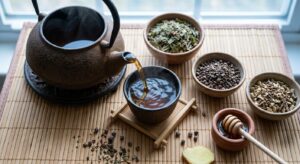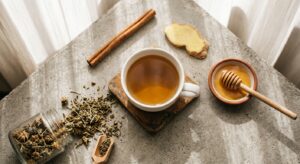
Hormonal imbalance affecting testosterone and androgen levels is far more common in women than many realize. Conditions such as polycystic ovary syndrome (PCOS), adrenal dysfunction, and perimenopause can all drive androgens higher than optimal, leading to unwanted hair growth, acne, irregular cycles, and fatigue. For centuries, herbalists across the Middle East, the Mediterranean, and indigenous North American traditions have reached for specific plants to gently coax the body back toward hormonal equilibrium. Today, a growing body of clinical research is beginning to validate what traditional healers long understood.
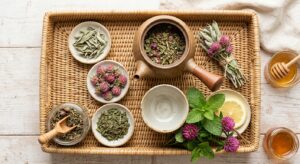
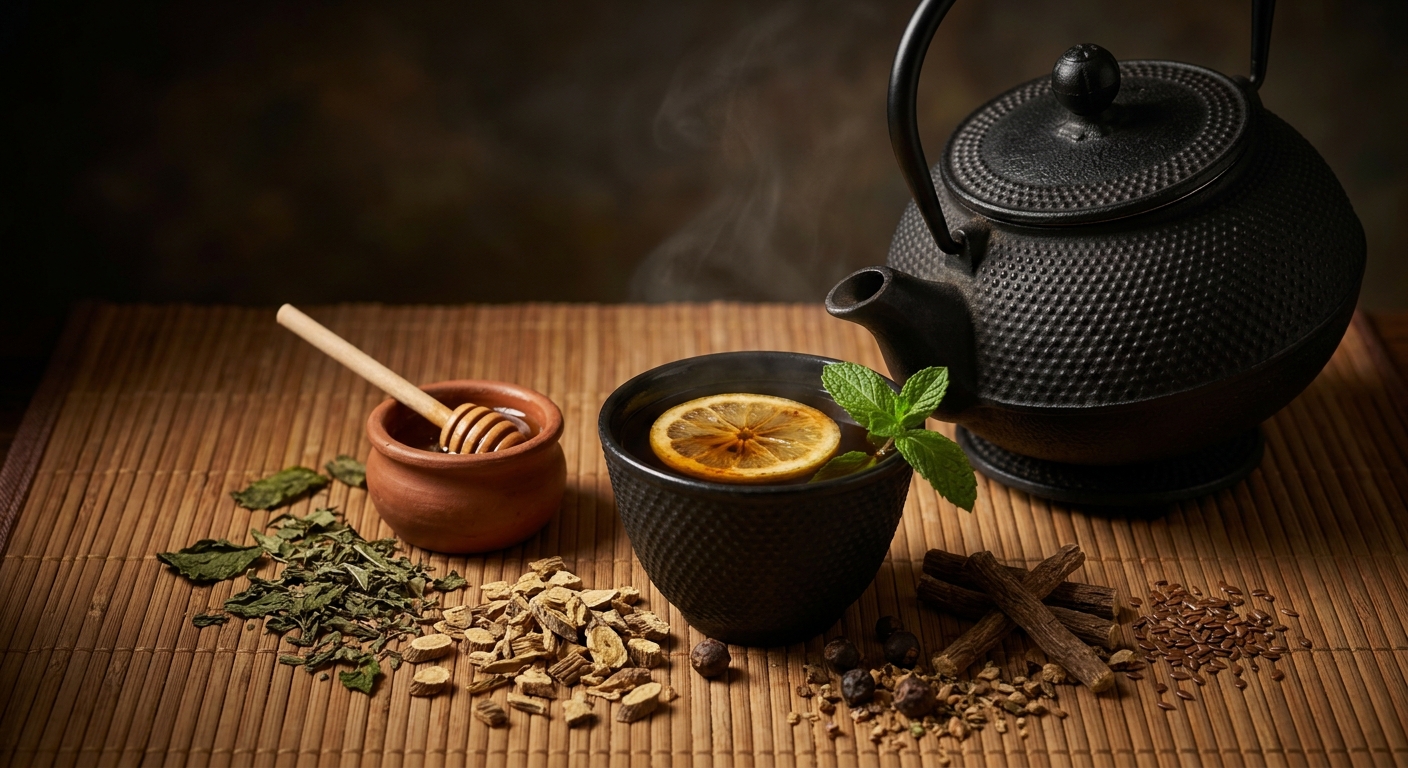
This Testosterone Balance Women’s Tea brings together three powerful botanicals: spearmint, revered in Moroccan herbal medicine and now supported by clinical trials showing reductions in free testosterone; licorice root, a cornerstone of Ayurvedic and Traditional Chinese Medicine used to modulate androgen pathways and support the adrenal glands; and saw palmetto, a sacred plant of the Seminole people of Florida that has been shown to inhibit the enzyme responsible for converting testosterone into its more potent form, dihydrotestosterone (DHT). Together, they form a synergistic blend that is both medicinal and genuinely pleasurable to drink.
Beyond its hormonal properties, this tea is a sensory delight. Spearmint contributes a bright, cooling freshness, while licorice root adds a naturally sweet, warming depth that requires no added sweetener. Saw palmetto brings a mild, earthy, slightly berry-like undertone that grounds the blend beautifully. Whether you are navigating a PCOS diagnosis, managing perimenopausal changes, or simply seeking daily hormonal support, this tea is a gentle, nourishing place to begin.
2
cups
Ingredients
- 2 tspdried spearmint leaves
- 1 tspdried licorice root (cut and sifted)
- 0.5 tspsaw palmetto berries (dried and lightly crushed)
- 480 mlwater (90°C / 194°F)
- —raw honey to taste (optional)
- —a slice of fresh lemon (optional)
How to Brew
Click on an item below to shop for the recommended items for this recipe on Amazon.
As an Amazon Associate, we earn from qualifying purchases.
- Measure 2 teaspoons of dried spearmint, 1 teaspoon of cut-and-sifted licorice root, and half a teaspoon of lightly crushed saw palmetto berries into a tea infuser or small teapot strainer.
- Heat 480 ml of filtered water to approximately 90 to 95°C (194 to 203°F). If using a standard kettle, bring water to a boil and allow it to rest for 60 to 90 seconds before pouring.
- Pour the hot water over the herb blend and cover your cup or pot immediately with a lid or small saucer. Covering traps the volatile aromatic oils of the spearmint, which carry many of its active compounds.
- Steep for 7 to 10 minutes. Begin with 7 minutes if you prefer a lighter, fresher flavor; extend to 10 minutes for a deeper, more medicinal infusion.
- Remove the infuser and gently press the herbs against the side of the strainer with the back of a spoon to release any remaining liquid and compounds.
- Taste before adding any sweetener. Licorice root provides natural sweetness, and most drinkers find no additional honey is needed. Serve immediately and enjoy while warm.
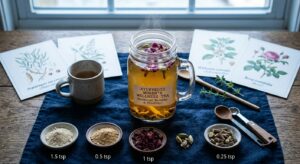
- Add 3 teaspoons of dried spearmint, 1.5 teaspoons of cut-and-sifted licorice root, and 1 teaspoon of lightly crushed saw palmetto berries to a clean glass jar. The slightly increased herb ratio compensates for the slower, cooler extraction.
- Pour 480 ml of room-temperature filtered water over the herbs. Do not use warm or hot water, as this defeats the purpose of a true cold brew and alters the flavor profile.
- Stir gently with a long spoon to ensure all the dried herbs are fully saturated. Place a lid on the jar.
- Leave the jar at room temperature for 30 minutes to begin the initial saturation, then transfer it to the refrigerator.
- Allow the blend to cold brew in the refrigerator for 10 to 14 hours. Overnight is ideal. The licorice root needs the full duration to adequately release its glycyrrhizin content into the cool water.
- Strain through a fine mesh strainer lined with a small piece of cheesecloth into a glass or pitcher. The cheesecloth catches the fine particles from the saw palmetto berries. Serve over ice and consume within 48 hours.
- Place 1.5 teaspoons of cut-and-sifted licorice root and 1 teaspoon of lightly crushed saw palmetto berries into a small saucepan. Add 600 ml of cold filtered water. Do not add the spearmint yet, as prolonged heat destroys its delicate volatile compounds.
- Bring the licorice root and saw palmetto mixture to a gentle simmer over medium-low heat. Do not allow it to reach a rolling boil. Maintain a gentle simmer for 15 to 20 minutes, stirring occasionally. The water will reduce and deepen in color to a warm amber.
- Remove the saucepan from the heat. Add 2.5 teaspoons of dried spearmint directly to the hot decoction liquid.
- Cover the saucepan with a lid and allow the spearmint to infuse in the residual heat for an additional 5 minutes. This two-phase method extracts the hard root compounds through decoction and the delicate leaf compounds through infusion without sacrificing either.
- Strain the decoction through a fine mesh strainer into your cup, pressing firmly on the spent herbs to extract all remaining liquid. You should end up with approximately 400 to 450 ml after evaporation.
- Allow to cool for 2 to 3 minutes before drinking. This method produces a noticeably sweeter, more intensely flavored cup. No sweetener is needed. Sip slowly and mindfully, treating it as a therapeutic practice.
Health Benefits
Two randomized controlled trials published in Phytotherapy Research found that women who drank two cups of spearmint tea daily for 30 days experienced significant reductions in free and total testosterone, alongside improvements in luteinizing hormone. This effect is attributed primarily to rosmarinic acid and other phenolic compounds in spearmint that modulate the hypothalamic-pituitary-gonadal axis.
Both spearmint and licorice root have been investigated specifically in women with polycystic ovary syndrome, a condition characterized by elevated androgens. Licorice root’s glycyrrhizin inhibits enzymes involved in steroid biosynthesis, helping to reduce androgen production at the adrenal and ovarian level. Clinical evidence suggests regular use may contribute to more regular ovulatory cycles in women with androgen-dominant PCOS.
Saw palmetto’s lipophilic extract has been shown to inhibit 5-alpha reductase, the enzyme that converts testosterone into dihydrotestosterone (DHT). Elevated DHT in women is associated with hair thinning, hirsutism, and cystic acne. By blocking this conversion pathway, saw palmetto may help reduce DHT-driven symptoms over time with consistent use.
The anti-androgenic activity of spearmint has been specifically studied in relation to hirsutism, or unwanted facial and body hair in women. Clinical evidence shows that spearmint tea significantly reduced the Ferriman-Gallwey hirsutism score in participants after 30 days, making it one of the few herbal teas with a direct clinical outcome for this common androgen-related complaint.
Licorice root has a well-established role in supporting adrenal function, particularly in people experiencing adrenal fatigue or chronic stress, which can secondarily drive androgen production upward. Its adaptogenic-like properties help normalize cortisol metabolism via inhibition of 11-beta-hydroxysteroid dehydrogenase, helping reduce the stress-driven androgen excess seen in many women with hormonal imbalance.
🧪 Key Bioactive Compounds
The Science Behind Spearmint
The anti-androgenic effects of spearmint are among the best-documented of any culinary herb in women’s hormonal health research. A landmark 2010 randomized controlled trial published in Phytotherapy Research by Grant found that women with PCOS who consumed two cups of spearmint tea daily for 30 days experienced statistically significant reductions in free testosterone (p less than 0.05) and total testosterone, with concurrent increases in luteinizing hormone (LH) and follicle-stimulating hormone (FSH). The mechanism is believed to involve spearmint’s high rosmarinic acid content, which appears to influence the hypothalamic-pituitary axis and may exert direct inhibitory effects on ovarian androgen synthesis. This makes spearmint an unusually evidence-backed botanical for a condition as complex as PCOS-related hyperandrogenism.
Licorice root contributes multiple complementary mechanisms. Glycyrrhizin, its primary triterpene saponin, is metabolized in the gut to glycyrrhetinic acid, which inhibits two critical enzymes in steroid biosynthesis: 11-beta-hydroxysteroid dehydrogenase (which regulates cortisol-to-cortisone conversion) and 17-beta-hydroxysteroid dehydrogenase (which catalyzes the conversion of androstenedione to testosterone). A 2004 study by Armanini and colleagues demonstrated that licorice root supplementation significantly reduced serum testosterone in healthy women within one month of use. The isoflavone liquiritigenin, a weak phytoestrogen also found in licorice, may additionally help shift the estrogen-to-androgen ratio toward a more balanced state in estrogen-deficient or androgen-dominant women.
Saw palmetto’s science centers on its lipophilic berry extract, which contains a mixture of free fatty acids and phytosterols, most notably beta-sitosterol. These compounds have been shown in multiple studies to competitively inhibit 5-alpha reductase types 1 and 2, the enzymes responsible for converting testosterone into dihydrotestosterone (DHT). DHT is approximately three to five times more potent than testosterone at androgen receptors and is the primary driver of scalp hair loss, hirsutism, and androgen-type acne in women. Saw palmetto’s fatty acids also appear to directly block androgen receptor binding, providing a second layer of anti-androgenic activity. While most clinical trials on saw palmetto have focused on benign prostatic hyperplasia in men, the underlying 5-alpha reductase inhibition mechanism is directly applicable to women experiencing DHT-driven androgenic symptoms.
Brewing Tips
- Crush the saw palmetto berries lightly using the back of a spoon or a mortar and pestle just before brewing. Fresh crushing opens the berry’s outer skin and dramatically improves extraction of its active fatty acid compounds, which would otherwise remain partially locked inside the whole berry.
- Consistency matters more than intensity with this blend. Two moderate cups per day consumed consistently over 30 days is far more effective than sporadic high-dose brewing. Treat it as a daily ritual rather than an occasional remedy and track any changes in skin, energy, or cycle regularity in a journal.
- Store your herb blend in a labeled, airtight glass jar away from light and heat. Spearmint loses its volatile oils quickly when exposed to air, and licorice root can absorb moisture. Pre-blending a two-week supply keeps your daily brew convenient and ensures the ratios are always consistent.