Breast health is one of the most intimate aspects of women’s wellness, and traditional herbalists have long turned to the plant world for support. Long before modern oncology, healers across Europe and North America relied on herbs like red clover, cleavers, and violet leaf to maintain healthy breast tissue, encourage lymphatic drainage, and moderate the hormonal fluctuations that can contribute to tenderness, cysts, and fibrocystic changes. These plants were not seen as cures but as gentle, ongoing allies in a woman’s relationship with her own body.
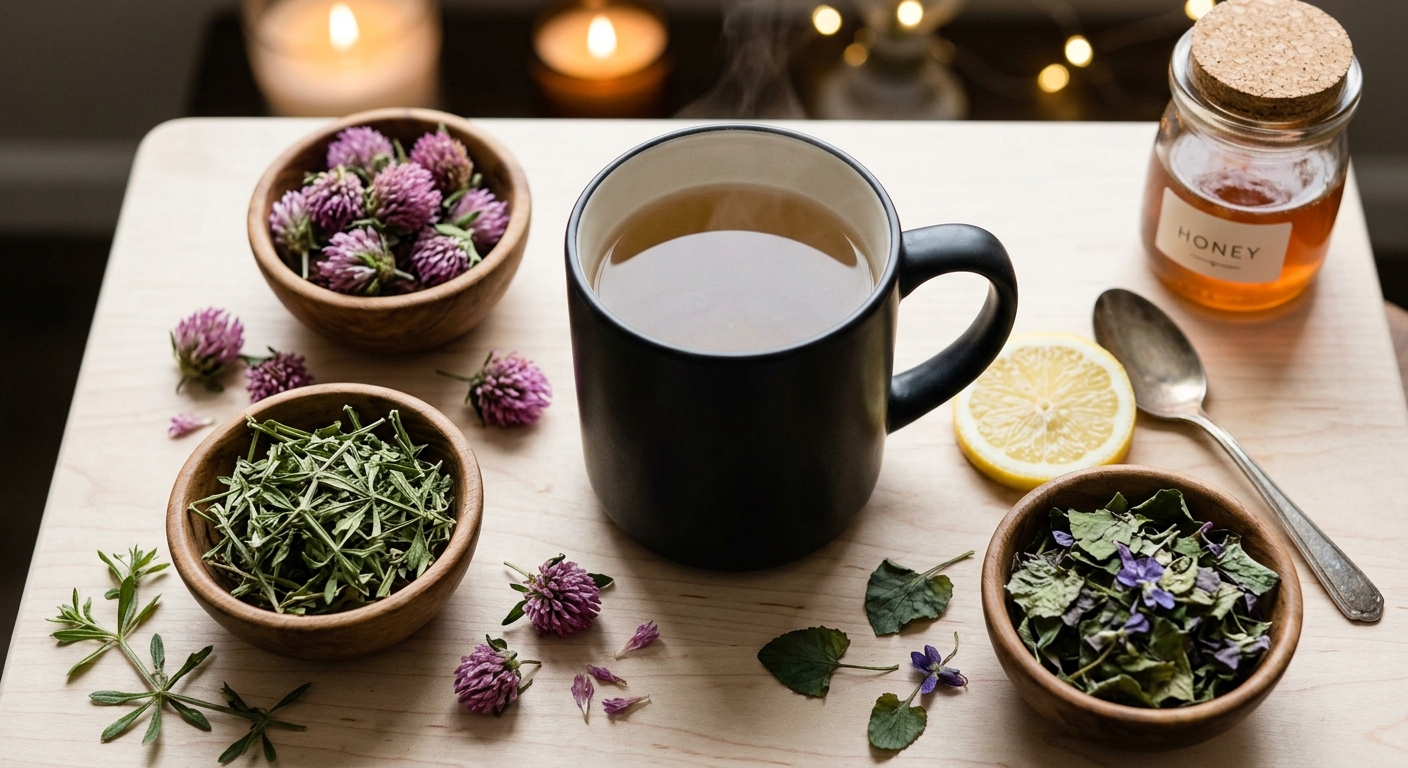
Red clover (Trifolium pratense) is the cornerstone of this blend. Rich in isoflavones including formononetin and biochanin A, it has been studied for its ability to interact with estrogen receptors in ways that may help balance circulating estrogen levels. Cleavers (Galium aparine), a humble hedgerow plant, has been used by herbalists for generations as a primary lymphatic tonic, supporting the drainage of the axillary lymph nodes that serve the breast tissue directly. Violet leaf (Viola odorata) rounds out the blend with its traditionally revered role in softening hardened or congested tissue.
What makes this blend particularly thoughtful is the synergy between its constituents. Where red clover addresses the hormonal landscape, cleavers keeps lymphatic channels clear, and violet contributes mucilaginous compounds that soothe inflammation. Together, they form a holistic cup that speaks to the full ecosystem of breast health. This tea is best enjoyed as a consistent daily ritual rather than an occasional remedy, allowing these gentle botanicals the time they need to do their quiet, nourishing work.
2
cups
Ingredients
- 2 tspdried red clover blossoms
- 1 tspdried cleavers (Galium aparine)
- 1 tspdried violet leaf (Viola odorata)
- 480 mlwater (90 to 95°C / 194 to 203°F)
- —raw honey or rose hip syrup to taste (optional)
- —a slice of fresh lemon (optional)
How to Brew
Click on an item below to shop for the recommended items for this recipe on Amazon.
As an Amazon Associate, we earn from qualifying purchases.
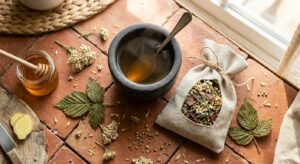
- Measure 2 teaspoons of dried red clover blossoms, 1 teaspoon of dried cleavers, and 1 teaspoon of dried violet leaf into a tea infuser or a small teapot with a built-in strainer.
- Heat filtered water to 90 to 95°C (194 to 203°F). Avoid a rolling boil, as excessive heat can degrade the delicate isoflavones in red clover. If your kettle reaches a full boil, allow it to cool for 2 minutes before pouring.
- Pour 480 ml of hot water over the herbs, covering the infuser or teapot immediately with a lid or small saucer. This trapping of steam is important as it prevents the volatile aromatic compounds from escaping.
- Steep for 10 to 15 minutes. The longer end of this range will yield a richer infusion with more noticeable mucilaginous texture from the violet leaf.
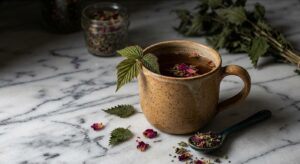
- Remove the infuser or strain the blend through a fine mesh strainer into two cups. Observe the warm amber-gold color before adding any sweetener.
- Add raw honey or rose hip syrup to taste if desired, and a slice of fresh lemon for brightness. Sip slowly and mindfully, ideally at the same time each day.
- Combine 3 teaspoons of dried red clover blossoms, 2 teaspoons of dried cleavers, and 2 teaspoons of dried violet leaf in a clean glass jar. The higher ratio compensates for the slower, cooler extraction process.
- Pour 600 ml of cold, filtered water directly over the dried herbs. Do not use warm or hot water, as the goal is a true cold extraction that honors the traditional preparation of cleavers.
- Stir briefly with a clean spoon to ensure all herbs are submerged, then cover the jar with a lid or stretch of cheesecloth secured with a rubber band.
- Leave at room temperature for 1 hour to allow initial extraction, then transfer the jar to the refrigerator and steep for a further 7 to 11 hours, for a total of 8 to 12 hours. Overnight is ideal.
- In the morning, strain the infusion through a fine mesh strainer or cheesecloth into a pitcher or directly into glasses filled with ice. Press the spent herbs gently to release any remaining liquid.
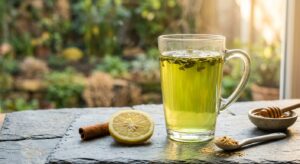
- Taste before sweetening. The cold brew version is noticeably smoother and slightly more vegetal than the hot brew. Add a drizzle of honey stirred in as a simple syrup, or serve plain over ice with a sprig of fresh mint.
- Place 4 teaspoons of dried red clover blossoms, 2 teaspoons of dried cleavers, and 2 teaspoons of dried violet leaf into a quart-sized (approximately 950 ml) glass mason jar. The larger quantity is essential as the extended steep time produces a concentrated, mineral-rich brew.
- Bring filtered water to a near-boil at 95 to 100°C (203 to 212°F) and pour it over the herbs, filling the jar to within 2 cm of the rim. Stir once to make sure all the plant material is saturated.
- Seal the jar tightly with its lid. This is critical as the sealed environment builds gentle pressure that aids extraction and prevents any aromatic compounds from escaping over the long steep.
- Wrap the jar in a thick towel or place it in an insulated bag to retain warmth during the initial hours of steeping. Leave it on the counter for the first 2 hours, then allow it to cool to room temperature naturally.
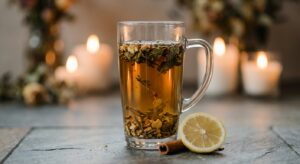
- After 4 to 8 hours of total steeping time (4 hours minimum, 8 hours for maximum potency), strain the infusion through a fine mesh strainer or cheesecloth into a clean pitcher. The resulting liquid will be a deep amber-rose, noticeably thicker and more fragrant than a standard hot brew.
- Divide into portions and refrigerate any amount you will not drink within the first 2 hours. The long infusion keeps well in the refrigerator for up to 48 hours. Drink 1 to 2 cups per day, either gently rewarmed or at room temperature, and sweeten lightly if desired.
Health Benefits
Cleavers (Galium aparine) is one of the most respected lymphagogue herbs in Western botanical medicine. The axillary lymph nodes, which drain directly from the breast, are supported by cleavers’ ability to encourage lymphatic movement, helping to clear metabolic waste and reduce the congestion that can contribute to lumps and tenderness.
The isoflavones in red clover, particularly formononetin and biochanin A, act as selective estrogen receptor modulators (SERMs) in the body. By binding to estrogen receptors, they may compete with stronger endogenous estrogens, offering a modulating effect that could reduce the risks associated with estrogen dominance, a common factor in fibrocystic breast changes.
Several clinical and observational studies have linked red clover isoflavone supplementation with a reduction in premenstrual breast tenderness and swelling. The anti-inflammatory flavonoids rutin and quercetin present in this blend further support tissue comfort by reducing prostaglandin-driven inflammation.
Red clover and violet leaf are both rich in flavonoids with potent free-radical scavenging activity. Oxidative stress is recognized as a contributing factor in abnormal cell changes in breast tissue, and regular consumption of antioxidant-rich herbs may help maintain a protective cellular environment.
Violet leaf has a long tradition in folk medicine as a remedy for hardened or congested glandular tissue. Its mucilaginous polysaccharides and anti-inflammatory flavonoids work together to soften and soothe breast tissue affected by fibrocystic changes, complementing the hormonal and lymphatic actions of the other herbs in this blend.
🧪 Key Bioactive Compounds
The Science Behind Red Clover
The most studied bioactive compounds in this blend are the isoflavones of red clover, primarily formononetin, biochanin A, daidzein, and genistein. These molecules are classified as phytoestrogens because their three-dimensional structure is similar enough to human estradiol that they can bind to estrogen receptors, particularly estrogen receptor beta (ERb). Unlike estradiol, which activates both alpha and beta receptors with equal strength, isoflavones show selective affinity for ERb. This selectivity is significant in breast health research, as ERb activation is generally associated with anti-proliferative and anti-inflammatory effects in breast tissue, while ERa activation is more closely linked to cell growth. By occupying ERb preferentially, red clover isoflavones may act as natural buffers against excess endogenous estrogen.
Cleavers contributes asperuloside, an iridoid glycoside that supports lymphatic motility. The lymphatic system is critically involved in breast health because the breast tissue is highly lymph-dense, and the axillary and internal mammary lymph nodes are primary drainage routes for metabolic byproducts and immune cells from that region. When lymphatic flow is sluggish, fluid and cellular debris can accumulate, contributing to the tenderness, swelling, and tissue congestion associated with fibrocystic changes. Regular consumption of lymphagogue herbs like cleavers is a cornerstone of traditional botanical protocols for breast wellness, and while large-scale clinical trials are limited, ethnobotanical evidence and smaller observational studies support this traditional use.
Violet leaf introduces a class of mucilaginous polysaccharides that interact with inflamed tissues directly. In vitro studies on related Viola species have demonstrated anti-inflammatory activity attributed to the inhibition of cyclooxygenase (COX) enzymes, the same pathway targeted by nonsteroidal anti-inflammatory drugs. Additionally, the flavonoid rutin, shared by both violet and red clover, has been shown to reinforce vascular integrity by inhibiting the enzyme hyaluronidase, which breaks down the connective tissue matrix around capillaries. Stronger capillary walls mean reduced leakage of fluid into surrounding breast tissue, which directly addresses the puffiness and discomfort many women experience in the luteal phase of their cycle.
Brewing Tips
- Use filtered or spring water whenever possible. The minerals and chlorine in tap water can subtly alter the extraction of delicate isoflavones and interfere with the flavor of floral herbs like red clover.
- For the greatest therapeutic consistency, choose the long infusion method and drink one to two cups daily for at least four to six weeks before assessing its effects. Gentle lymphatic and hormonal herbs work cumulatively and are not intended to produce immediate results.
- Source your cleavers from a reputable herbal supplier, as the dried herb loses potency relatively quickly. Ideally, use cleavers dried within the last 12 months, or if you have access to fresh cleavers in spring, prepare the cold infusion with fresh plant material for a noticeably more vibrant and effective brew.