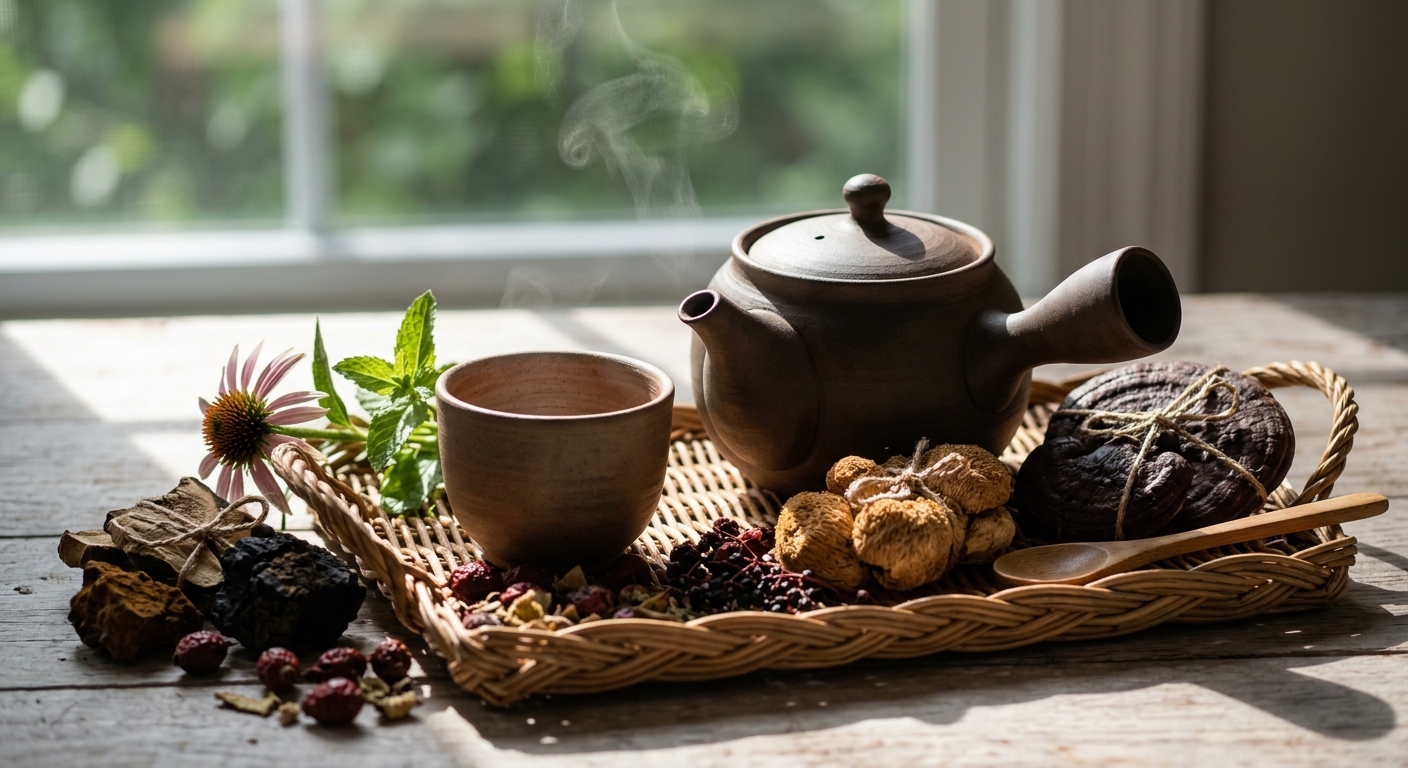
Long before modern immunology had a vocabulary for what mushrooms could do, healers across China, Siberia, and Japan were already boiling them into tonics. Reishi, revered as the “mushroom of immortality” in classical Chinese medicine, has been prescribed for over 2,000 years to strengthen the body’s defenses and calm the spirit. Chaga, a parasitic fungus that grows on birch trees across the boreal forests of Russia and Scandinavia, was brewed as a folk remedy for stomach ailments and immune weakness for centuries, sometimes traded in place of black tea during wartime shortages. Lion’s mane, the shaggy white fungus that resembles a cascade of icicles, held an honored place in traditional Chinese cuisine and Buddhist monastery kitchens, prized for sharpening the mind and steadying the nerves.
What makes this three-mushroom blend remarkable is not just the individual potency of each fungus, but the way they complement one another. Reishi brings its calming, anti-inflammatory triterpenes. Chaga contributes one of the highest concentrations of antioxidants found in any natural substance, anchored by a compound called inotodiol and a dense load of beta-glucans. Lion’s mane adds its signature nerve growth factor stimulants, hericenones and erinacines, making this the rare immune tea that also supports cognitive function. Together, they create a cup that works on multiple fronts at once, supporting the immune system without overstimulating it, a quality traditional practitioners called tonic rather than stimulant.
The flavor of this tea is deeply earthy, with a woody bitterness from the reishi, a subtle vanilla-like warmth from the chaga, and a mild, almost savory umami note from the lion’s mane. It is not a delicate herbal infusion. It is dense, grounding, and ancient-tasting in the best possible way. A small spoonful of raw honey or a splash of oat milk softens the bitterness beautifully, and the tea holds up remarkably well to reheating, making it a practical daily tonic for those who take their wellness rituals seriously.
2
cups
Ingredients
- 1 tspdried reishi mushroom slices or powder
- 1 tspchaga mushroom chunks or powder
- 1 tspdried lion’s mane mushroom pieces or powder
- 500 mlwater (90 to 95°C / 194 to 203°F)
- —raw honey or oat milk to taste (optional)
How to Brew
Click on an item below to shop for the recommended items for this recipe on Amazon.
As an Amazon Associate, we earn from qualifying purchases.
- Combine 1 tsp each of dried reishi slices, chaga chunks, and lion’s mane pieces in a small saucepan with 500 ml of cold, filtered water.
- Place the saucepan over medium heat and bring the water slowly up to a gentle simmer, around 90 to 95°C. Avoid a full rolling boil, which can degrade some of the heat-sensitive polysaccharides.
- Reduce the heat to low and maintain a gentle simmer for 20 to 30 minutes. The liquid will deepen to a rich amber or dark mahogany color as the beta-glucans and triterpenes extract into the water.
- Remove from heat and allow the decoction to rest for 5 minutes, which allows any fine particles to settle and the flavors to mellow slightly.
- Strain through a fine mesh strainer or cheesecloth into two mugs, pressing the mushroom material gently to extract every last drop of tonic liquid.
- Sweeten with raw honey or add a splash of oat milk if desired. Sip slowly and enjoy warm.
- Measure 1 tsp each of reishi powder, chaga powder, and lion’s mane powder into a clean glass jar. Powdered forms work better for cold brew than whole pieces, as the greater surface area compensates for the lack of heat.
- Pour 600 ml of cold, filtered water over the mushroom powders. Stir vigorously with a long spoon for 30 to 60 seconds to ensure the powders are fully dispersed and not clumping at the bottom.
- Cover the jar loosely with a lid or a clean cloth and leave it at room temperature for 2 hours to begin the extraction process, then transfer it to the refrigerator.
- Allow the mixture to cold brew in the refrigerator for 12 to 16 hours, or overnight. The liquid will turn a deep amber color and develop a smooth, malty character.
- Strain through a fine mesh strainer lined with cheesecloth into a clean pitcher or jar, pressing the spent mushroom material firmly to recover all the liquid.
- Pour over ice or enjoy cold straight from the jar. The cold brew concentrate keeps well in the refrigerator for up to 3 days. Add honey, cinnamon, or a small piece of fresh ginger to brighten the flavor if desired.
- Combine 3 tsp each of dried reishi slices, chaga chunks, and lion’s mane pieces with 1 liter of cold filtered water in a medium saucepan. The higher mushroom-to-water ratio is intentional, as this is a concentrate meant to be diluted at serving time.
- Bring the water to a low simmer over medium heat, then reduce to the lowest setting on your burner. The target is a barely perceptible simmer with small bubbles rising from the bottom, around 85 to 90°C, sustained for 45 to 60 minutes.
- Check the liquid level every 15 minutes and top up with a small splash of hot water if it reduces too quickly. You want to finish with approximately 500 ml of deep, richly colored concentrate.
- Remove from heat and allow to cool in the saucepan for 10 minutes before straining. This resting period helps the remaining polysaccharides settle back into the liquid rather than remaining trapped in the mushroom fibers.
- Strain through a fine mesh strainer lined with cheesecloth into a clean glass jar or bottle, pressing firmly. Discard the spent mushroom material.
- To serve, dilute one part concentrate with one to two parts hot water, adjusting to your preferred strength. Sweeten with honey, add a pinch of cinnamon or a few drops of vanilla extract, and enjoy as your daily immune tonic. Refrigerate unused concentrate immediately.
Health Benefits
The dense beta-glucan content across all three mushrooms activates multiple branches of the innate immune system, including macrophages and natural killer cells. Multiple randomized controlled trials have demonstrated that supplementation with reishi and chaga beta-glucans increases markers of immune activation in both healthy adults and immunocompromised populations.
Reishi’s ganoderic acids and chaga’s polyphenol compounds inhibit the NF-kB signaling pathway, one of the body’s primary inflammatory switches. Regular consumption has been associated with reduced levels of pro-inflammatory cytokines such as TNF-alpha and interleukin-6 in clinical and preclinical research.
Lion’s mane is the only culinary or medicinal mushroom known to stimulate synthesis of Nerve Growth Factor. A double-blind placebo-controlled trial published in Phytotherapy Research found that daily lion’s mane supplementation significantly improved cognitive function scores in older adults with mild cognitive impairment over a 16-week period.
Chaga has one of the highest ORAC antioxidant values ever recorded for a natural substance, driven by its exceptional melanin and polyphenol content. These antioxidants neutralize free radicals and protect cells from oxidative damage, a primary driver of accelerated aging and chronic disease.
Reishi is classified as an adaptogen, meaning it helps the body maintain homeostasis under physical and psychological stress. Research suggests that its triterpenes modulate the hypothalamic-pituitary-adrenal axis, supporting a calmer stress response without causing sedation, making it suitable for daytime use.
🧪 Key Bioactive Compounds
The Science Behind Reishi Mushroom
The immune-supporting power of medicinal mushrooms centers on a class of complex sugars called beta-glucans, specifically the 1,3 and 1,6 beta-D-glucan configurations found in fungal cell walls. When consumed, these molecules interact with pattern recognition receptors on immune cells, particularly Dectin-1 receptors on macrophages and neutrophils, triggering a cascade of immune activation that primes the body’s first-line defenses. Unlike stimulants, which simply accelerate immune activity, beta-glucans act as immunomodulators, enhancing under-active responses and tempering overactive ones. This bidirectional effect is why medicinal mushrooms have historically been used both during infections and as long-term tonics rather than emergency treatments.
Reishi mushroom brings a secondary layer of pharmacological activity through its triterpenes, particularly the ganoderic acid family. These compounds have demonstrated inhibition of the NF-kB inflammatory pathway in cell studies, a mechanism shared with many pharmaceutical anti-inflammatory drugs but achieved here without the associated side effects. Chaga’s unique contribution includes betulinic acid derivatives absorbed from its birch tree host, as well as an unusually high concentration of melanin pigments that function as potent antioxidants and may help neutralize reactive oxygen species at the cellular level. The combination of these compounds from all three mushrooms creates a synergistic antioxidant and anti-inflammatory profile that no single mushroom achieves alone.
The cognitive dimension of this blend is almost entirely attributable to lion’s mane and its exclusive compounds hericenones and erinacines. Hericenones, found in the fruiting body, and erinacines, found in the mycelium, are among the very few dietary compounds demonstrated to cross the blood-brain barrier and stimulate endogenous production of Nerve Growth Factor. NGF is a protein essential for the growth, maintenance, and survival of neurons. Declining NGF levels are associated with cognitive aging and neurodegenerative conditions. The 2009 randomized controlled trial by Mori et al. remains a landmark study in this area, showing measurable cognitive improvements in human subjects after 16 weeks of lion’s mane consumption, effects that reversed after supplementation stopped, suggesting an ongoing requirement for the compounds rather than a permanent structural change.
Brewing Tips
- Use whole dried mushroom pieces rather than powder for hot decoctions when possible. The slower extraction preserves a greater range of polysaccharide structures, while powder works best for cold brew or concentrate where you need maximum surface contact.
- Spent mushroom material from your decoction can be added directly to soups, broths, or grain dishes. The cell walls may already be open from the simmering process, releasing residual nutrition during cooking.
- If you find the bitterness of reishi too strong, reduce it to half a teaspoon and increase the chaga slightly. Chaga has a naturally milder, slightly sweet character that softens the overall flavor without sacrificing immune support.