Few plants carry as long and storied a medicinal legacy as the elder tree. Revered across Europe for thousands of years, Sambucus nigra was so central to folk healing that rural communities often called it the ‘medicine chest of the country people.’ Hippocrates himself referenced the elder as a foundational healing plant, and archaeological evidence suggests its use dates back to at least the Stone Age. Every part of the tree, from its flowers to its bark, held a purpose in traditional herbalism, but it was the small, dark berries ripening in late summer that became the most celebrated remedy for cold-weather ailments and flagging immunity.
In European folk traditions, elderberry preparations were standard medicine for colds, fevers, and respiratory infections long before modern pharmacology had a name for what they were doing. Elderberry syrups and wines appeared in 17th-century English apothecary texts, and indigenous North American peoples independently discovered medicinal uses for related Sambucus species. Today, elderberry is one of the most clinically studied medicinal herbs in the world, with a growing body of peer-reviewed research validating what grandmothers across the northern hemisphere already knew: a hot cup of elderberry tea at the first sign of a sniffle is a genuinely smart idea.
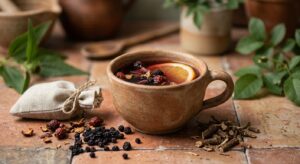
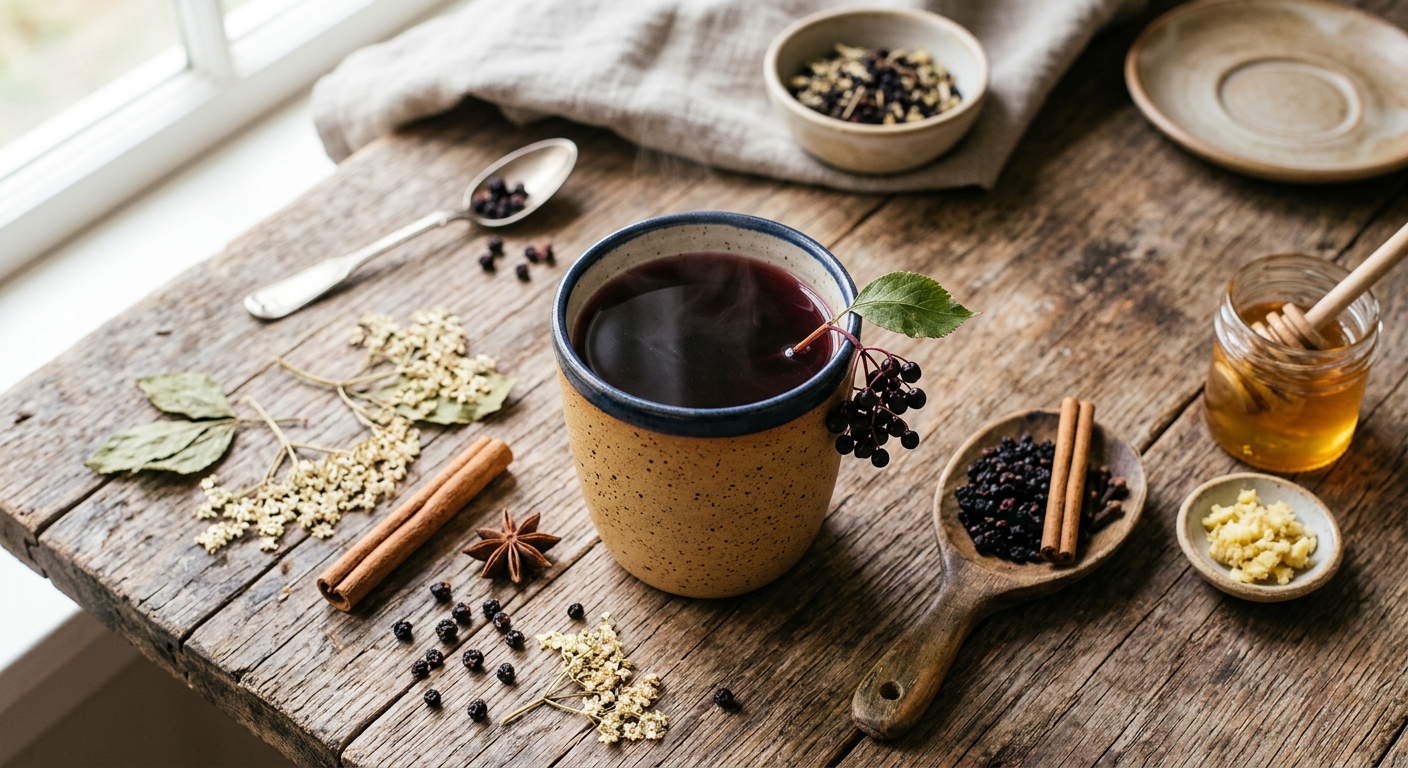
Brewed into a tea, elderberry delivers a rich, tart, and warming drink with an unmistakable depth of flavor. Its deep jewel-toned color is not just beautiful but meaningful, a visual cue to the extraordinary concentration of anthocyanins and polyphenols packed into each small berry. Whether you are reaching for it as a preventative tonic during cold season or as a comforting remedy at the first sign of illness, elderberry tea is one of the most rewarding and time-honored brews in the herbal apothecary.
2
cups
Ingredients
- 3 tbspdried elderberries (Sambucus nigra)
- 480 mlwater (for hot brew)
- 1 stickcinnamon
- 3 wholecloves
- 1 tspfreshly grated ginger (optional)
- —raw honey to taste (optional)
- —slice of lemon to serve (optional)
How to Brew
Click on an item below to shop for the recommended items for this recipe on Amazon.
As an Amazon Associate, we earn from qualifying purchases.
- Add 3 tablespoons of dried elderberries, 1 cinnamon stick, and 3 whole cloves to a small saucepan with 480 ml of cold water. If using fresh ginger, add it now.
- Bring the mixture to a full boil over medium-high heat, then immediately reduce the heat to maintain a gentle, steady simmer. You want small bubbles, not a rolling boil.
- Simmer uncovered for 15 to 20 minutes. The liquid will reduce slightly and deepen to a rich ruby-purple color. Stir occasionally and watch that it does not boil dry.
- Remove from heat and allow to cool for 3 to 4 minutes. Pour through a fine-mesh strainer into your mugs, pressing the berries gently with the back of a spoon to extract all remaining liquid.
- Add raw honey to taste while the tea is still warm so it dissolves fully. Serve with a slice of lemon if desired, and drink while comfortably hot.
- Place 3 tablespoons of dried elderberries in a clean glass jar along with the cinnamon stick and cloves. Do not add honey yet, as it can ferment overnight at room temperature.
- Pour 600 ml of cold, filtered water over the berries. The slightly higher water ratio compensates for the less efficient cold extraction process.
- Stir well to ensure all berries are submerged, then seal the jar with a lid. Leave at room temperature for 1 hour to allow the extraction to begin, then transfer to the refrigerator.
- Refrigerate for 12 to 16 hours or overnight. The liquid will turn a deep rosy-crimson and take on a smooth, subtly tart berry flavor.
- Strain through a fine-mesh strainer into a glass or pitcher, pressing berries firmly to extract remaining liquid. Stir in honey or a splash of lemon juice, and serve over ice or chilled.
- Combine 6 tablespoons of dried elderberries, 2 cinnamon sticks, 5 whole cloves, 1 tablespoon of freshly grated ginger, and 960 ml of water in a medium saucepan. This double batch will yield roughly 400 to 480 ml of finished concentrate.
- Bring to a full boil over medium-high heat, then reduce to a steady simmer. Cook uncovered for 30 to 40 minutes, stirring occasionally, until the liquid has reduced by approximately half and is deeply colored and syrupy in texture.
- Remove from heat and allow to cool for 10 minutes. Mash the softened berries against the side of the pot with a wooden spoon to release as much liquid as possible.
- Strain the mixture through a fine-mesh strainer lined with cheesecloth into a clean glass jar, pressing the solids firmly to extract every drop. Discard the spent berries and spices.
- Once the concentrate has cooled to below 40°C (104°F), stir in 3 to 4 tablespoons of raw honey to taste. Seal the jar and refrigerate. The concentrate will keep for up to 2 weeks.
- To serve as tea, mix 60 ml of concentrate with 180 ml of hot water (around 90°C / 194°F). Adjust the ratio to taste and add a squeeze of lemon for brightness.
Health Benefits
Multiple randomized controlled trials, including a 2016 study published in Nutrients and a 2004 study in the Journal of International Medical Research, found that elderberry extracts significantly shortened the duration of influenza illness and reduced symptom severity compared to placebo. The anthocyanins appear to directly bind to and neutralize influenza virions before they can enter host cells.
Elderberries contain one of the highest concentrations of anthocyanins among common fruits and berries, giving them an exceptionally high ORAC (oxygen radical absorbance capacity) value. These compounds neutralize free radicals, reduce oxidative stress in cells, and help protect against chronic disease.
Elderberry has been shown to increase the production of key immune cytokines including interleukin-1 beta, interleukin-6, and TNF-alpha in healthy individuals, effectively priming the immune system. It also enhances monocyte activity, a type of white blood cell critical to the early immune response against pathogens.
The flavonoids and phenolic acids in elderberry, particularly quercetin and chlorogenic acid, inhibit the COX-1 and COX-2 enzyme pathways involved in the inflammatory cascade. This helps explain the traditional use of elderberry preparations for relieving swollen sinuses, sore throats, and general discomfort associated with respiratory illness.
A 2016 study of air travelers found that those taking elderberry supplementation experienced significantly shorter and less severe colds than those taking placebo, suggesting elderberry provides meaningful protection against the upper respiratory infections commonly acquired in high-exposure environments.
🧪 Key Bioactive Compounds
The Science Behind Elderberry
The immune-supporting power of elderberry centers on its extraordinary concentration of anthocyanins, specifically cyanidin-3-glucoside and cyanidin-3-sambubioside. These dark pigment molecules do far more than give the berry its characteristic color. Research published in Phytochemistry demonstrated that these anthocyanins can directly bind to the surface proteins of influenza virions, physically blocking the virus from attaching to and penetrating host cells. This mechanism is distinct from how most immune herbs work, because elderberry essentially intercepts the pathogen before the immune system even needs to mount a full response.
Beyond direct antiviral activity, elderberry’s flavonoid compounds, including quercetin and rutin, modulate the immune system through cytokine regulation. A landmark study by Barak et al. showed that elderberry extract increased production of several key inflammatory cytokines in vitro, suggesting it primes the immune response to act faster and more efficiently against invaders. Quercetin has also been shown in laboratory studies to inhibit viral protease enzymes that pathogens use to replicate within cells, adding another layer of antiviral defense. Importantly, this immune stimulation appears to be regulatory rather than simply inflammatory, meaning elderberry enhances immune readiness without driving uncontrolled inflammation in most healthy individuals.
Chlorogenic acid and rutin contribute significant antioxidant protection, helping to reduce the oxidative damage that viruses and inflammatory responses inflict on tissues. The synergy between all these compounds working together in whole elderberry tea is thought to be considerably more potent than any isolated extract, a principle known in herbal medicine as the entourage effect. This is one reason traditional herbalists and modern researchers alike continue to recommend whole-berry preparations, particularly properly decocted teas and syrups, over standardized single-compound supplements.
Brewing Tips
- Always buy certified organic dried elderberries from a reputable supplier and confirm they are Sambucus nigra. Other Sambucus species vary in their safety and efficacy profiles.
- Do not skip the simmering step or substitute a simple hot steep. Elderberries must be cooked to deactivate sambunigrin and to properly extract their beneficial anthocyanins from the tough berry skins.
- Add honey only after the tea has cooled below 40°C (104°F) to preserve its beneficial enzymes and antimicrobial compounds, which are degraded by high heat.
- Pair elderberry tea with dried rosehips for an extra boost of vitamin C, or with dried ginger and black pepper to enhance bioavailability and warming effect during illness.
- Store your elderberry concentrate in a sealed glass jar in the refrigerator for up to two weeks. A small splash of brandy (traditional in folk preparations) can extend the shelf life to three to four weeks.