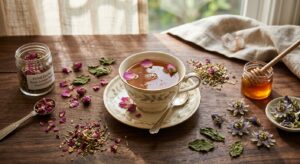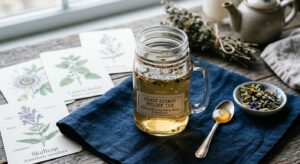
Long before modern pharmacology offered sleeping pills and anxiety medications, healers across Europe, the Americas, and the Mediterranean relied on a handful of trusted plants to calm frayed nerves and coax restless bodies into sleep. Chamomile was prescribed by ancient Egyptian physicians and sipped by Roman nobles. Passionflower was embraced by Native American tribes for its hypnotic qualities and later adopted by European herbalists in the 18th century. Lemon balm has graced monastery gardens since the Middle Ages, prized by Benedictine monks who believed it lifted the spirit. Lavender, of course, has perfumed apothecaries and bedchambers across Provence and beyond for centuries. What is remarkable is that modern science has now validated what traditional healers long understood: each of these plants carries specific bioactive compounds that act directly on the nervous system.
This blend is not simply a collection of relaxing herbs thrown together. Each ingredient plays a distinct role. Chamomile contributes apigenin, a flavonoid that binds to benzodiazepine receptors and promotes sedation without dependency. Passionflower elevates gamma-aminobutyric acid (GABA) activity in the brain, quieting the mental chatter that keeps so many people awake at night. Lemon balm inhibits an enzyme called GABA transaminase, which prolongs GABA’s calming effect, while also reducing the stress hormone cortisol. Lavender’s linalool crosses the blood-brain barrier and modulates serotonin receptors, reducing anxiety and improving sleep quality. Together, they work along complementary biochemical pathways to address stress from multiple angles simultaneously.
What makes this tea especially practical is its versatility. Brewed hot, it becomes a warming ritual before bed, signaling to the body that the day is over. Brewed cold, it transforms into a gentle afternoon tonic that takes the edge off tension without causing drowsiness at your desk. However you prepare it, the sensory experience alone, the soft floral fragrance rising from the cup, the pale golden color, the smooth herbal warmth on the palate, begins the relaxation process before you have taken a single sip.
2
cups
Ingredients
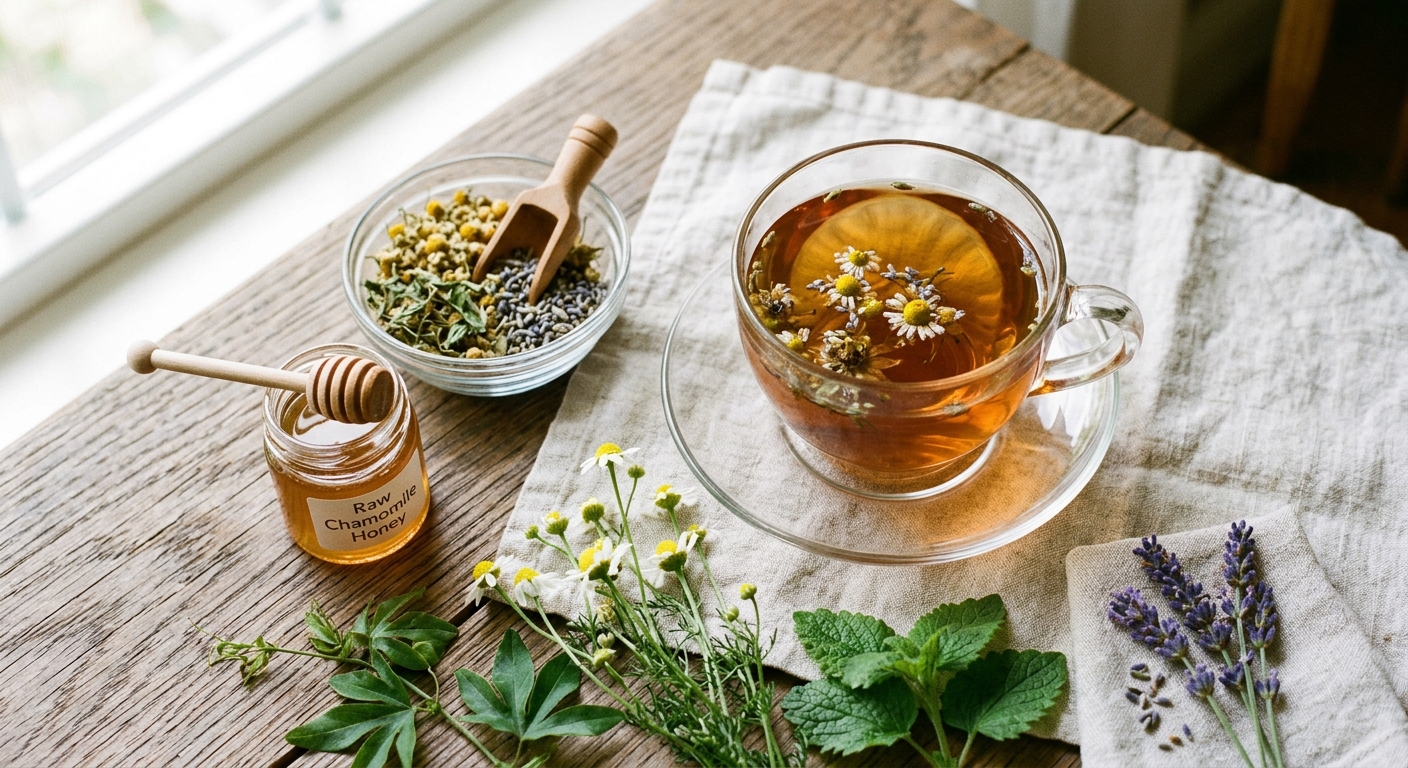
- 2 tspdried chamomile flowers
- 1 tspdried passionflower (leaf and vine)
- 1 tspdried lemon balm leaves
- 0.5 tspdried culinary lavender buds
- 480 mlwater (90°C / 194°F)
- —raw honey or chamomile honey to taste (optional)
- —thin lemon slice for garnish (optional)
How to Brew
Click on an item below to shop for the recommended items for this recipe on Amazon.
As an Amazon Associate, we earn from qualifying purchases.
- Heat filtered water to 90°C (194°F). If you do not have a temperature-controlled kettle, bring water to a full boil and then let it rest for 2 to 3 minutes before pouring.
- Combine the dried chamomile flowers, passionflower, lemon balm, and lavender buds in a tea infuser, strainer basket, or teapot. For two servings, use 4 tsp chamomile, 2 tsp passionflower, 2 tsp lemon balm, and 1 tsp lavender.
- Pour 480 ml of the heated water over the herbs and cover the vessel immediately with a lid or small plate. Covering is essential because the most calming volatile compounds, including linalool from lavender and citronellal from lemon balm, escape quickly with rising steam.
- Steep for 7 to 10 minutes. Begin with 7 minutes for a lighter, more floral cup. Extend to 10 minutes if you prefer a deeper, more herbaceous brew with stronger sedative character.
- Remove the infuser or strain the herbs out completely. Residual steeping can make the tea bitter, particularly from the passionflower.
- Allow to cool for 1 to 2 minutes, then sweeten with raw honey if desired. Add a thin lemon slice for a brightening lift. Drink 30 to 45 minutes before bed for best sleep-supporting effect.
- Measure out a double-strength ratio of herbs into a clean glass jar: 4 tsp chamomile, 2 tsp passionflower, 2 tsp lemon balm, and 1 tsp lavender per 480 ml of cold filtered water. The higher ratio compensates for the lower extraction efficiency of cold water.
- Pour cold, filtered water directly over the herbs in the jar. Stir gently to ensure all dry herbs are fully submerged. Loosely cover the jar with a lid or muslin cloth to allow a little airflow while preventing dust or contaminants from entering.
- Leave the jar on the counter at room temperature for 1 hour to begin extraction, then transfer to the refrigerator and allow to steep for a further 7 to 11 hours, for a total of 8 to 12 hours. Overnight is ideal.
- Strain the herbs through a fine mesh strainer or nut milk bag into a clean jug or pitcher, pressing the herbs gently to release the last of the liquid. Discard the spent herbs.
- Sweeten with a small amount of honey dissolved in warm water (a simple honey syrup) so it blends smoothly into the cold liquid. Serve over ice in a tall glass, garnished with a lemon slice or a few fresh lemon balm leaves.
- Bring 480 ml of filtered water to 88 to 90°C (190 to 194°F). Measure a quadruple-strength blend: 8 tsp chamomile, 4 tsp passionflower, 4 tsp lemon balm, and 2 tsp lavender buds. Place the herbs in a medium saucepan or heat-safe teapot.
- Pour the heated water over the herbs and cover tightly. Steep for 15 to 20 minutes, keeping the vessel covered throughout to trap volatile aromatics. The longer steep and higher herb ratio create a deeply concentrated extraction.
- Strain the liquid through a fine mesh strainer into a clean glass jar, pressing the herbs firmly with a spoon to extract every drop of the concentrate. Discard the spent herbs.
- Allow the concentrate to cool to room temperature, then seal the jar and refrigerate. The concentrate will keep for up to 5 days.
- To serve as a hot tea, dilute one part concentrate with two to three parts hot water (90°C / 194°F) and sweeten to taste. To serve cold, dilute one part concentrate with two parts cold water or sparkling water and pour over ice. Adjust the ratio depending on how strong you prefer your cup.
Health Benefits
The combined GABAergic activity of passionflower, chamomile, and lemon balm creates a multi-pathway approach to anxiety reduction. A 2011 randomized controlled trial published in Phytotherapy Research found that passionflower extract performed comparably to oxazepam for generalized anxiety disorder, while lemon balm has been shown in human trials to reduce anxiety scores by up to 18 percent at moderate doses.
Apigenin from chamomile and vitexin from passionflower both act at GABA-A receptor sites to reduce the time it takes to fall asleep. A clinical trial published in the Journal of Advanced Nursing found that chamomile extract significantly improved sleep onset latency in postnatal women, and a separate study on passionflower tea demonstrated improved total sleep time after just one week of nightly consumption.
Lavender’s linalool has been shown in polysomnographic studies to increase slow-wave sleep and reduce nighttime waking, while lemon balm’s rosmarinic acid prolongs GABAergic signaling to sustain deeper sleep stages. Together, these compounds help address both sleep maintenance insomnia and non-restorative sleep.
Rosmarinic acid in lemon balm has been shown in human studies to reduce salivary cortisol levels, and linalool from lavender has demonstrated a measurable blunting of the physiological stress response in aromatherapy and oral administration trials. This cortisol-modulating activity makes the blend effective as a daytime stress-management tool as well as a nighttime sleep aid.
Stress and anxiety frequently manifest as digestive discomfort, including cramping, bloating, and nausea. Chamomile’s bisabolol and chamazulene compounds have well-documented antispasmodic and anti-inflammatory effects on the gastrointestinal tract, easing the gut tension that often accompanies a stressed nervous system.
🧪 Key Bioactive Compounds
The Science Behind Chamomile, Passionflower, Lemon Balm, And Lavender Blend
The calming power of this four-herb blend comes down to one central nervous system mechanism: the enhancement of GABA (gamma-aminobutyric acid) signaling. GABA is the brain’s primary inhibitory neurotransmitter, the chemical brake pedal that slows down neural activity, reduces excitability, and creates the subjective sensation of calm. Anxiety and insomnia are frequently associated with insufficient GABA activity, whether due to deficient production, overly rapid breakdown, or poor receptor sensitivity. What is extraordinary about this blend is that each of its four herbs intervenes in the GABA pathway at a different point. Chamomile’s apigenin binds directly to the benzodiazepine site on GABA-A receptors, mimicking the mechanism of prescription anti-anxiety drugs but with a far milder and non-addictive profile. Passionflower’s flavonoid glycosides, particularly vitexin and isovitexin, modulate the same receptors and additionally inhibit GABA reuptake, keeping more of the neurotransmitter active in the synapse.
Lemon balm takes a third approach by inhibiting GABA transaminase, the enzyme responsible for breaking GABA down. By slowing GABA degradation, rosmarinic acid effectively extends the duration of each inhibitory signal. This is pharmacologically similar to the mechanism of valproic acid, a prescription anticonvulsant, though lemon balm works at a much gentler magnitude. Lavender operates somewhat differently, with linalool acting primarily at serotonin 5-HT1A receptors, which are also targeted by buspirone, a common non-benzodiazepine anti-anxiety medication. Linalool additionally modulates NMDA glutamate receptors, reducing excitatory neurotransmission, which further contributes to its sleep-deepening effect. The result of combining all four herbs is a broad, multi-target intervention across the brain’s calming chemistry.
Beyond neurotransmitter activity, this blend also addresses the hormonal dimension of stress. Chronic stress elevates cortisol from the adrenal glands, and persistently high cortisol suppresses melatonin production, directly disrupting sleep. A 2014 human trial published in Nutrients demonstrated that lemon balm supplementation significantly reduced both anxiety scores and serum cortisol in chronically stressed adults after 15 days. Lavender aromatherapy has similarly been shown to reduce salivary alpha-amylase, a biomarker of sympathetic nervous system activation, in multiple controlled trials. By lowering the hormonal stress load as well as calming neural overactivity, this blend addresses both the cause and the consequence of stress-related sleep disruption, making it a genuinely holistic intervention.
Brewing Tips
- Source your lavender carefully and always use culinary-grade dried lavender buds. Ornamental lavender varieties can have a more pungent, almost medicinal quality that overwhelms the blend. Lavandula angustifolia (true lavender or English lavender) is the preferred variety for teas.
- Brew this tea in a covered vessel every time, regardless of which method you choose. Floral terpenes like linalool and citronellal are highly volatile and escape rapidly into the air as steam. A covered teapot or a mug with a small saucer placed on top can meaningfully preserve the aroma and potency of the finished tea.
- For maximum sleep support, establish a nightly ritual around this tea rather than drinking it occasionally. The body’s relaxation response is partially conditioned, meaning the consistent sensory cues of brewing and drinking the same calming tea each evening train your nervous system to begin winding down as soon as you smell the aroma.