
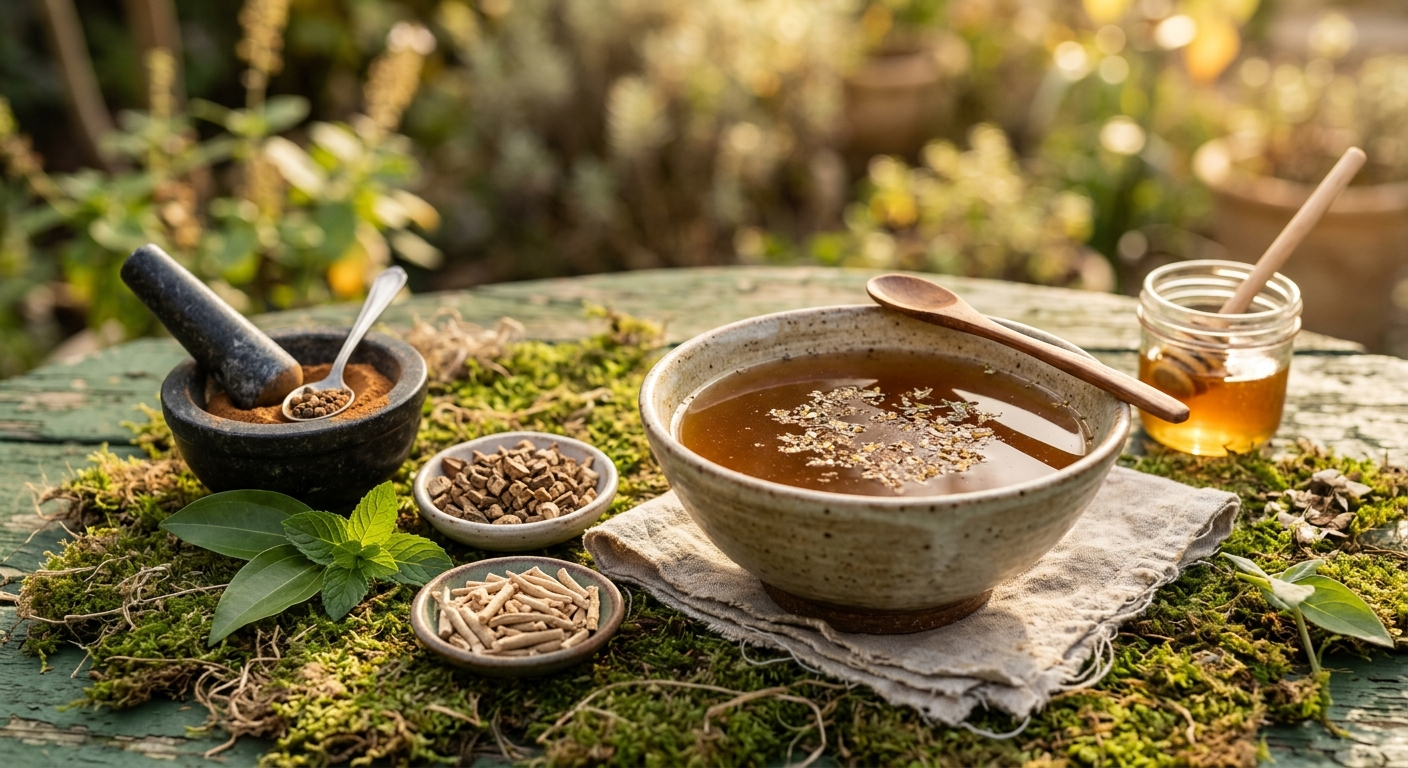
Long before modern pharmacology coined the term ‘adaptogen,’ healers in Siberia were brewing eleuthero root (Eleutherococcus senticosus) to fortify warriors, athletes, and laborers against the relentless demands of harsh climates and physical labor. Known as Siberian ginseng, eleuthero has been a cornerstone of traditional Chinese and Russian folk medicine for over two thousand years, prized for its ability to increase stamina, sharpen the mind, and help the body respond to physical and emotional stress without the crash associated with stimulants.
Ashwagandha (Withania somnifera), the other half of this blend, carries an equally storied legacy. In Ayurvedic medicine, it is classified as a rasayana, a rejuvenating tonic used to promote longevity, vitality, and calm strength. The Sanskrit name translates loosely to ‘smell of horse,’ a reference both to its distinctive earthy aroma and to the horse-like vigor it was believed to bestow. Modern researchers have validated much of what Ayurvedic practitioners observed, identifying withanolides as the primary compounds responsible for ashwagandha’s measurable effects on cortisol regulation and anxiety reduction.
Together, eleuthero and ashwagandha form a complementary adaptogenic pair: eleuthero works at the cellular level to improve the body’s non-specific resistance to stressors, while ashwagandha gently modulates the hypothalamic-pituitary-adrenal (HPA) axis, the central command system for the stress response. The result is a tea that is not a sedative and not a stimulant, but a steady, grounding daily tonic that builds resilience over time. Brewed as a decoction or a long-steeped infusion, this blend delivers a warm, slightly bitter, earthy cup that feels as nourishing as it tastes purposeful.
2
cups
Ingredients
- 1.5 tspdried eleuthero root (cut and sifted)
- 1.5 tspdried ashwagandha root (cut and sifted)
- 480 mlwater (for hot brew or decoction)
- —raw honey or maple syrup to taste (optional)
- —a pinch of cinnamon or cardamom to soften bitterness (optional)
How to Brew
Click on an item below to shop for the recommended items for this recipe on Amazon.
As an Amazon Associate, we earn from qualifying purchases.
- Measure 1.5 teaspoons of dried eleuthero root and 1.5 teaspoons of dried ashwagandha root per two servings. If using powder, reduce each to 1 teaspoon to avoid a gritty texture.
- Bring 480 ml of filtered water to just below a rolling boil, targeting 90 to 95°C (194 to 203°F). Avoid using vigorously boiling water as it can slightly degrade volatile aromatic compounds.
- Place the roots into a large tea infuser, muslin bag, or directly into a small saucepan. Pour the hot water over the roots and cover with a lid to trap heat and prevent volatile compounds from escaping with steam.
- Steep covered for 15 to 20 minutes. The tea should deepen to a rich amber-brown color. Taste at 15 minutes and continue steeping if you prefer a stronger, more robust flavor.
- Strain the roots thoroughly. If you find the taste too bitter or earthy, stir in a small amount of raw honey or a pinch of cinnamon. Pour into warmed mugs and drink within 30 minutes for the best flavor and warmth.
- Combine 1.5 teaspoons of dried eleuthero root and 1.5 teaspoons of dried ashwagandha root in a small saucepan with 600 ml of cold filtered water. Starting in cold water allows gradual extraction to begin before heat is applied.
- Place the saucepan over medium-high heat and bring the water to a full boil, stirring once. As soon as it reaches a boil, reduce the heat to low to maintain a gentle, steady simmer.
- Simmer uncovered or loosely covered for 25 to 30 minutes. The liquid will reduce by approximately 100 to 150 ml, concentrating the brew to roughly two servings. Keep the heat low enough to see gentle bubbles but not a vigorous roll.
- During the final 5 minutes, you may add optional flavor enhancers such as a small cinnamon stick, two cardamom pods, or a thin slice of fresh ginger. These additions help round out the earthy bitterness of the roots.
- Remove from heat and allow to rest for 5 minutes. Pour through a fine mesh strainer or cheesecloth into mugs, pressing the spent root material gently to extract any remaining liquid. Sweeten with honey or maple syrup if desired and serve immediately.
- Use a slightly higher ratio for cold brewing to compensate for the reduced extraction efficiency: combine 2 teaspoons of dried eleuthero root and 2 teaspoons of dried ashwagandha root in a clean glass jar with 480 ml of room temperature filtered water.
- Stir the roots and water gently to make sure the roots are fully submerged. Cover the jar loosely with a lid or a clean cloth secured with a rubber band. Allow the jar to sit at room temperature for the first 2 hours so extraction can begin without the shock of immediate refrigeration.
- Move the jar to the refrigerator and allow it to steep for an additional 10 to 14 hours, ideally overnight. The brew will take on a pale amber to medium brown color, lighter than a hot brew but still rich with flavor.
- The following morning, strain the liquid through a fine mesh strainer or cheesecloth into a clean pitcher or two glasses. Press the roots gently to extract remaining liquid.
- Serve over ice or chilled as-is. The cold brew version pairs beautifully with a splash of oat milk and a drizzle of raw honey, which soften the earthy, slightly bitter notes into a creamy tonic drink. Consume within 48 hours and keep refrigerated.
Health Benefits
Multiple double-blind, placebo-controlled trials have found that ashwagandha supplementation significantly reduces serum cortisol levels and self-reported stress scores. A 2012 study published in the Indian Journal of Psychological Medicine found a 27.9% reduction in cortisol levels in the ashwagandha group compared to placebo over 60 days.
Eleuthero has been shown in clinical studies to improve attention, mental performance under fatigue, and working memory. Ashwagandha has demonstrated neuroprotective effects and in a 2017 study in the Journal of Dietary Supplements, significantly improved memory, executive function, and information processing speed in adults with mild cognitive impairment.
Soviet-era research on eleuthero documented improvements in athletic performance, oxygen utilization, and recovery time in competitive athletes. More recent trials confirm that both herbs independently reduce fatigue markers, with eleuthero specifically increasing maximal oxygen uptake (VO2 max) and ashwagandha improving muscular strength and recovery after exercise.
Both herbs act on the hypothalamic-pituitary-adrenal axis, the central regulator of the stress hormone cascade. Rather than suppressing or stimulating the system outright, they act as bidirectional regulators, helping to normalize cortisol output whether it is chronically elevated or blunted, which is characteristic of true adaptogenic activity.
The eleutherans (polysaccharides) in eleuthero root have demonstrated immunostimulant effects, increasing natural killer cell activity and interferon production. Ashwagandha has similarly shown immune-boosting properties, reducing inflammatory cytokine markers such as CRP and IL-6 in clinical studies, making this blend particularly useful during periods of high physical or emotional demand.
🧪 Key Bioactive Compounds
The Science Behind Eleuthero And Ashwagandha
The science behind this adaptogenic blend centers on the body’s primary stress-response system: the hypothalamic-pituitary-adrenal (HPA) axis. When the brain perceives a stressor, the hypothalamus triggers a cascade that ultimately signals the adrenal glands to release cortisol. While cortisol is essential for short-term survival, chronically elevated levels disrupt sleep, impair immune function, accelerate cognitive decline, and contribute to metabolic dysfunction. Ashwagandha’s withanolides, particularly Withanolide A, appear to act at multiple points in this cascade, reducing the sensitivity of the HPA axis to stress signals and measurably lowering serum cortisol. This is supported by randomized controlled trials showing reductions in cortisol of 20 to 30% compared to placebo after 8 weeks of consistent use.
Eleuthero’s primary active compounds, the eleutherosides, operate through a complementary but distinct mechanism. Eleutheroside B (syringin) and Eleutheroside E have been shown to modulate adrenocorticotropic hormone (ACTH) activity, increase the resilience of cellular mitochondria to stress, and support the production of heat shock proteins, which help cells survive oxidative and thermal stress. In practical terms, these actions translate to improved stamina, faster recovery from physical exertion, and greater mental endurance under pressure. The immunomodulatory polysaccharides known as eleutherans further enhance the body’s defensive capacity by activating macrophages and natural killer cells without causing the inflammatory overshoot associated with direct immune stimulants.
When consumed together, eleuthero and ashwagandha appear to exert synergistic effects on the stress response. A key pharmacological concept here is bidirectionality: genuine adaptogens do not simply suppress or elevate a system but normalize it relative to the individual’s baseline. Research comparing single-herb and combination adaptogen preparations suggests that blending herbs with complementary mechanisms can extend the range and depth of this normalizing effect. The withanolides in ashwagandha offer excellent cortisol regulation and neuroprotection, while the eleutherosides supply cellular-level stress resistance and immune enhancement, together covering a broader spectrum of the adaptive stress response than either herb achieves alone.
Brewing Tips
- Buy cut and sifted root pieces rather than pre-ground powder for hot brew and decoction methods. Pieces yield a cleaner, less gritty cup while still delivering excellent extraction during longer steep times.
- To improve the palatability of this earthy blend without masking its therapeutic compounds, try adding a half teaspoon of raw cacao powder per cup. Cacao’s natural bitterness actually harmonizes with the roots’ flavor while contributing its own adaptogenic-adjacent benefits, including theobromine and magnesium.
- Adaptogens are most effective when taken consistently over weeks rather than as a one-time remedy. Build a daily ritual around this tea, ideally in the morning or early afternoon, to allow the cortisol-modulating effects to accumulate. Avoid drinking it within two hours of bedtime as eleuthero in particular has mild energizing properties that may delay sleep onset in sensitive individuals.