If you find yourself jolting awake at the slightest sound, lying wide-eyed at 3am replaying the day’s worries, or waking feeling like you barely slept at all, you are not alone. Light sleeping is one of the most common sleep complaints, and it sits in a frustrating middle ground – not quite insomnia, but far from the restorative rest your body needs. For centuries, herbalists across Europe, Asia, and the Americas have reached for specific plants to address exactly this kind of fragile, easily disrupted sleep.
This blend centers on three time-honored sedative herbs: valerian root, a staple of European folk medicine since at least the second century AD when Galen prescribed it for insomnia; passionflower, used by indigenous peoples of the Americas for its calming properties long before Spanish explorers brought it back to Europe in the 1500s; and lemon balm, beloved by medieval monks who grew it in monastery gardens and used it to ease nervous tension and encourage peaceful rest. Together, they form a tea that is greater than the sum of its parts, with each herb addressing a slightly different aspect of the sleep disturbance.
What makes this blend particularly well suited to light sleepers, rather than people who simply cannot fall asleep, is its emphasis on the nervous system’s ability to stay in a restful state. Where a single sedative herb might ease the transition into sleep, this combination works to reduce nighttime arousal, quiet the hyperactive mind that interprets every small noise as a threat, and gently extend the time spent in deeper sleep stages. Brewed properly and taken consistently, this tea can become one of the most reliable tools in a light sleeper’s evening ritual.
2
cups
Ingredients
- 2 tspdried valerian root (cut and sifted)
- 2 tspdried passionflower herb
- 2 tspdried lemon balm leaves
- 480 mlwater (95°C / 203°F)
- —raw honey or maple syrup to taste (optional)
- —a thin slice of fresh lemon (optional, brightens flavor)
How to Brew
Click on an item below to shop for the recommended items for this recipe on Amazon.
As an Amazon Associate, we earn from qualifying purchases.
- Measure 1 teaspoon each of dried valerian root, dried passionflower, and dried lemon balm per serving into your infuser or teapot. For two servings, use 2 teaspoons of each herb.
- Heat filtered water to 95°C (203°F). If you do not have a temperature-controlled kettle, bring water to a full boil and let it sit off the heat for 30 seconds before pouring.
- Pour the hot water directly over the herbs and immediately cover your mug or teapot with a lid or small saucer. This is important: covering the brew traps the volatile aromatic compounds from the lemon balm and passionflower that would otherwise escape as steam.
- Steep for a minimum of 10 minutes and up to 15 minutes. The longer end of the range extracts more valerenic acid from the root and produces a stronger sedative effect. Set a timer so you do not forget.
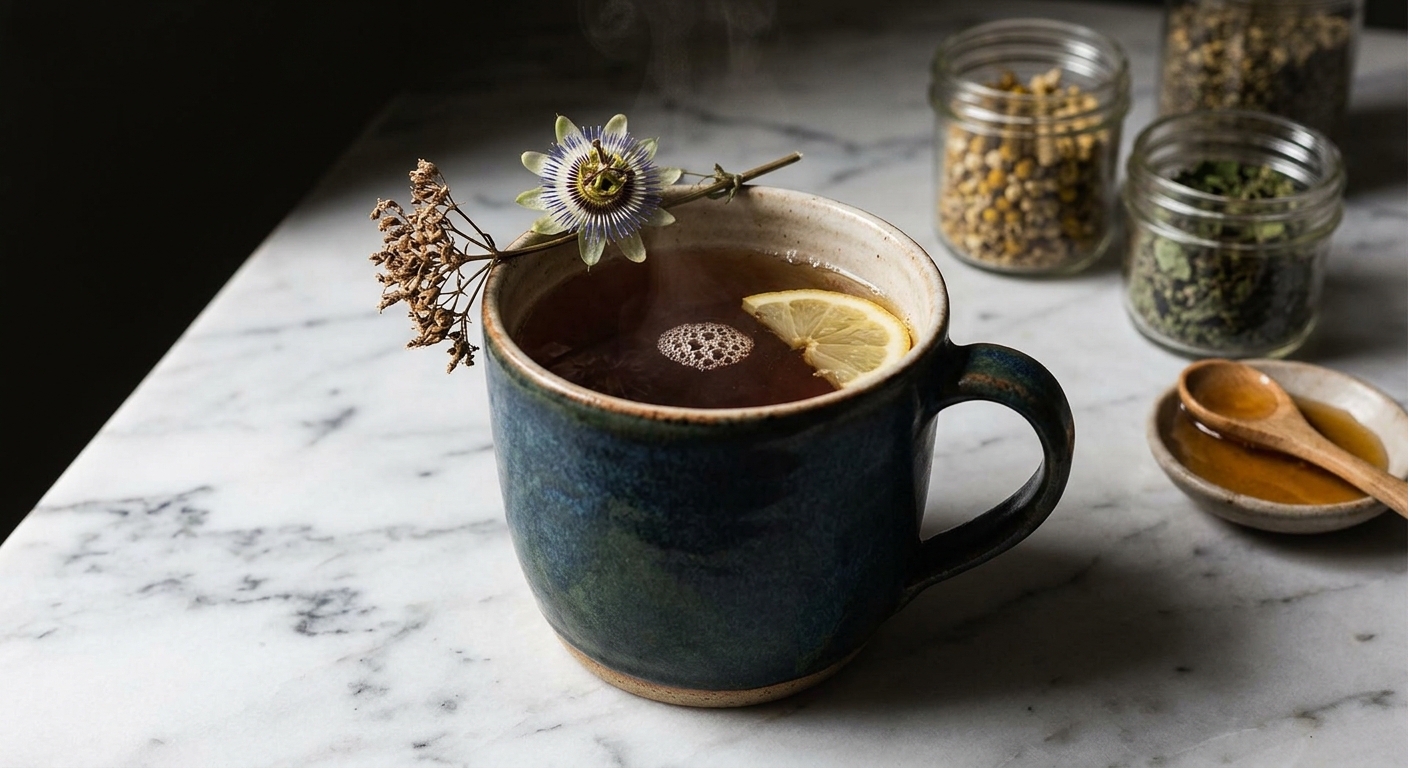
- Remove the infuser or strain the tea through a fine mesh strainer into your mug. The liquid should be a warm amber-brown color.
- Allow the tea to cool to a comfortable drinking temperature, then add honey or a squeeze of lemon if desired to mellow the earthy valerian notes. Drink 30 to 45 minutes before bed.
- Measure 1.5 teaspoons each of dried valerian root, dried passionflower, and dried lemon balm per serving into a clean glass jar. For two servings, use 3 teaspoons of each herb – cold brewing requires a slightly higher ratio than hot brewing to achieve the same potency.
- Add cold, filtered water to the jar at room temperature. Do not use hot or warm water for this method. Stir the herbs gently to ensure they are fully submerged, then loosely cover the jar with a lid or cloth.
- Allow the jar to sit at room temperature for 1 to 2 hours to initiate extraction, then transfer it to the refrigerator and leave it to cold steep overnight – ideally 8 to 10 hours total.
- In the morning, strain the tea through a fine mesh strainer or cheesecloth into a clean jar or pitcher, pressing lightly on the herbs to extract the remaining liquid. Discard the spent herbs.
- Store the cold-brewed tea in the refrigerator for up to 24 hours. To serve, pour over ice or gently warm a single portion on the stovetop over low heat without boiling. Add honey or a slice of lemon to taste before drinking, 30 to 45 minutes before sleep.
- Place 2 teaspoons of dried valerian root per serving into a small saucepan. For two servings, use 4 teaspoons of valerian root. Add approximately 600 ml of cold filtered water – slightly more than your target volume, since some will evaporate during simmering.
- Bring the valerian root and water to a very gentle simmer over medium-low heat. Do not bring it to a rolling boil, as excessive heat can degrade some of the more delicate volatile compounds. Maintain a temperature of around 85 to 90°C (185 to 194°F) with just small bubbles rising to the surface.
- Simmer the valerian root uncovered for 20 to 25 minutes, stirring occasionally. The water will reduce and deepen in color to a rich amber-brown. If the level drops significantly, add a small splash of hot water to maintain the volume.
- Remove the saucepan from the heat and add 2 teaspoons each of dried passionflower and dried lemon balm directly to the hot decoction. Cover the saucepan with a lid immediately.
- Allow the delicate herbs to steep off the heat for 10 minutes. Adding them at this stage, rather than simmering them, preserves the aromatic volatile oils in the passionflower and lemon balm that would be destroyed by prolonged heat.
- Strain the decoction through a fine mesh strainer into mugs, pressing the herbs gently. The resulting tea will be darker and more concentrated than a standard hot brew. Sweeten with honey to balance the bitterness and drink 45 minutes before bed.
Health Benefits
The combined GABA-potentiating effects of valerenic acid, vitexin, and rosmarinic acid lower the brain’s sensitivity to external stimuli during sleep, making it harder for small sounds or movements to trigger full wakefulness. Clinical trials on passionflower and valerian individually have demonstrated reductions in self-reported nighttime waking.
Valerian root has been studied in multiple randomized controlled trials and shown to reduce the time it takes to fall asleep, with one meta-analysis of 16 studies concluding that valerian may improve sleep quality without producing side effects. Lemon balm enhances this effect by easing the pre-sleep mental chatter that delays relaxation.
Passionflower has been shown in clinical studies to be comparable to low-dose oxazepam for generalized anxiety disorder, and its ability to quiet an overactive mind makes it especially valuable for light sleepers whose sleep is disrupted by anxious thinking. Lemon balm’s rosmarinic acid compounds this effect.
Animal studies on passionflower’s orientin and isovitexin compounds have shown increases in slow-wave sleep duration. While human clinical data is still emerging, traditional use and preliminary research suggest this blend may help extend the deeper, more restorative phases of the sleep cycle.
Lemon balm has a long history of use for nervous exhaustion and physical tension, and modern research confirms its mild antispasmodic and nervine properties. For light sleepers who wake due to restless legs or a sense of physical unease, lemon balm provides gentle but meaningful relief.
🧪 Key Bioactive Compounds
The Science Behind Valerian Root
The science behind this sleep blend centers on one of the brain’s most important inhibitory neurotransmitter systems: gamma-aminobutyric acid, or GABA. GABA functions as the nervous system’s primary brake pedal, reducing neuronal excitability and allowing the brain to transition from an alert, reactive state into the quieter activity patterns associated with sleep. Light sleepers often have heightened nervous system arousal, meaning their brains remain partially alert during sleep and respond strongly to minor stimuli. The three herbs in this blend each target the GABA system through slightly different mechanisms, producing a synergistic effect that is more comprehensive than any single herb alone.
Valerian root’s primary active compound, valerenic acid, has been shown in laboratory and clinical studies to bind to GABA-A receptor subunits and to inhibit the enzyme GABA-T (GABA transaminase), which is responsible for breaking GABA down. The result is that GABA remains active in the synaptic cleft for longer, prolonging its calming signal. This mechanism is similar in principle to how benzodiazepine drugs work, but considerably milder and without the dependency risks associated with pharmaceutical sedatives. Passionflower contributes its flavone glycosides, particularly vitexin and orientin, which also act as positive modulators of GABA-A receptors and have demonstrated dose-dependent sedative effects in preclinical models, including measurable increases in slow-wave sleep duration.
Lemon balm approaches the GABA pathway from a different angle entirely. Its abundant rosmarinic acid has been shown to inhibit GABA transaminase activity in vitro, preventing the enzymatic degradation of GABA and thereby increasing its availability in the brain. A 2014 study published in Nutrients found that lemon balm extract significantly reduced stress and insomnia scores in participants with mild anxiety and sleep disturbances. The compound luteolin-7-O-glucuronide from lemon balm has also shown GABA-A modulating properties in recent research. Together, these three plants offer a multi-point intervention on the same neurological pathway, making this combination more than just folk tradition – it is a botanically coherent, evidence-supported approach to supporting deeper sleep in people with hyperarousal-related light sleeping.
Brewing Tips
- Store your dried herbs separately in airtight glass jars away from light and heat, then mix them in a batch as a pre-made loose blend to save time on evenings when you are already tired.
- Valerian root’s earthy, musky aroma intensifies as it steeps – if you find it off-putting, try adding the lemon balm and a slice of fresh lemon only in the last two minutes of steeping to make the citrus notes more prominent and mask some of the root’s pungency.
- Consistency matters more than single-dose potency with this blend: research on valerian in particular suggests its sleep benefits build over two to four weeks of nightly use, so give the tea at least two weeks before judging its effectiveness.