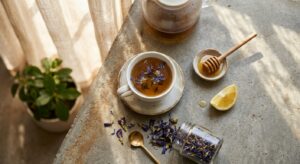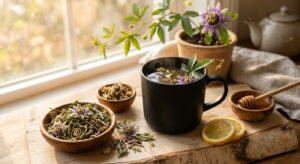
Walk down a village lane in Germany, France, or Hungary in early summer and you may be stopped in your tracks by a cloud of honeyed fragrance drifting from the linden trees overhead. Known as lime trees in Britain, tilleul in France, and Lindenblüte in Germany, the Tilia genus has been woven into European life for centuries. The trees shaded village squares, anchored folklore (the Slavic and Germanic peoples considered them sacred, associated with peace, love, and justice), and quietly supplied one of the continent’s most cherished household remedies.
The tea is made from the pale yellow blossoms together with the small, leafy bracts that cradle them, gathered by hand during the brief window when the trees flower, usually in June and July. French pharmacies still sell tilleul as a standard evening tisane, and in Germany Lindenblütentee is the traditional first response to a fever, a cough, or a night of tossing and turning. Herbalists have long used it as a diaphoretic, meaning it encourages gentle sweating, which is why it features so often in cold and flu care.
What makes linden special is its softness. It has none of the stern bitterness or medicinal punch of many sleep herbs. The infusion is golden, fragrant, and naturally sweet, with a soft floral character reminiscent of honey and hay. It is an ideal tea for people who find stronger nervines overwhelming, and for children and elders, for whom a mild herb is often the wisest choice. Sipping it slowly in the hour before bed is as much a ritual of slowing down as it is a remedy.
2
cups
Ingredients
- 2 tbspdried linden flowers and bracts (Tilia cordata or Tilia platyphyllos)
- 480 mlwater (95°C / 203°F)
- —raw honey to taste (optional)
- —a thin slice of lemon (optional)
How to Brew
Click on an item below to shop for the recommended items for this recipe on Amazon.
As an Amazon Associate, we earn from qualifying purchases.
- Bring fresh, cold water to a boil, then let it rest for about 30 seconds so it settles just below boiling. Linden blossoms are delicate and do not need a furious rolling boil.
- Measure 1 tablespoon of dried linden flowers and bracts per 240 ml of water into a teapot or directly into a mug fitted with a large infuser. Give the blossoms room to move, as they swell as they steep.
- Pour the hot water over the flowers, then immediately cover with a saucer or lid to keep the fragrant steam in the cup.
- Steep for 10 to 15 minutes. Because the blossoms are light and the infusion is gentle, a long steep extracts more of the soothing mucilage and flavonoids without turning bitter.
- Strain thoroughly, pressing the flowers lightly against the infuser to release the last of the liquid. Stir in honey or a thin slice of lemon if desired, and sip slowly about 30 to 60 minutes before bed.
- Place 2 tablespoons of dried linden flowers and bracts into a clean glass jar, using a slightly higher ratio than the hot brew since cold water extracts more slowly.
- Add 480 ml of cool, filtered water and stir gently so every blossom is wet. The flowers will float at first, so press them down with a spoon.
- Seal the jar and refrigerate for 8 to 10 hours, or overnight. Avoid steeping beyond 12 hours, as the flavor can turn flat and slightly grassy.
- Strain through a fine mesh sieve or a layer of muslin to catch the tiny bracts and any loose pollen.
- Serve chilled over ice, or sip straight from the glass. Drink within 48 hours and keep refrigerated, since cold infusions have a shorter shelf life than hot ones.
- Heat 240 ml of water to 90°C (194°F) and pour it over 2 tablespoons of linden flowers, doubling the usual strength to make a concentrated base.
- Cover and steep for 7 to 8 minutes. Because this will be diluted, a slightly shorter steep keeps the base sweet and floral rather than heavy.
- Strain into a heatproof pitcher and stir in 1 to 2 teaspoons of honey while the liquid is still warm so it dissolves completely.
- Cool to room temperature, then refrigerate for about 1 hour until thoroughly chilled.
- Fill tall glasses with ice, pour in the chilled linden concentrate until each glass is about halfway full, and top with sparkling water. Garnish with a lemon wheel and a sprig of fresh mint.
Health Benefits
Linden has a long traditional record as a mild nervine, and animal studies suggest its flavonoids and volatile oils may produce gentle sedative and anxiolytic effects. Human clinical evidence is limited, but the ritual of a warm, fragrant drink before bed adds to its relaxing reputation.
The mucilage in linden blossoms coats and calms irritated mucous membranes, making it a time-honored remedy for dry, tickly coughs. This demulcent action is well recognized in European herbal monographs.
Linden is a traditional diaphoretic, meaning it promotes gentle sweating when taken hot, which herbalists have long used to support the body during the early stages of a cold. The warm fluid also helps with hydration.
Traditional use points to linden as a mild antispasmodic, helpful when stress shows up as a tight stomach or tense muscles. Laboratory work on its flavonoids supports a relaxing effect on smooth muscle, though more human research is needed.
Linden is rich in flavonoids such as quercetin, kaempferol, and rutin, which neutralize free radicals in laboratory settings. Regular consumption as part of a varied diet may contribute modestly to overall antioxidant intake.
🧪 Key Bioactive Compounds
The Science Behind Linden Flower
Linden’s reputation as a soothing evening herb rests on a blend of compounds that work together rather than a single standout molecule. The blossoms contain a rich mix of flavonoids, including quercetin, kaempferol, and their glycosides such as rutin and tiliroside. Laboratory and animal studies suggest these compounds have antioxidant and anti-inflammatory properties, and some research indicates that linden extracts may interact with calming pathways in the nervous system, producing mild anxiolytic and sedative effects. These findings are promising but largely preclinical, and well-controlled human trials remain scarce.
The aromatic side of linden comes from its volatile oils, notably farnesol and related terpenes. These are responsible for the blossoms’ unmistakable honeyed fragrance, and inhaling warm, scented steam is itself part of the calming experience. Aromatherapy research has long suggested that pleasant, familiar scents can lower perceived stress, which may amplify the tea’s relaxing effect beyond its chemical activity alone.
The throat-soothing action of linden is easier to explain. The flowers and bracts are rich in mucilage, a gel-forming polysaccharide that dissolves in water and coats irritated tissue, forming a gentle protective layer. This demulcent effect is why European herbal monographs recognize linden for dry coughs and sore throats. Its diaphoretic reputation, meaning its tendency to promote sweating, comes from a combination of the warmth of the drink and the activity of its phenolic acids, and it explains why a steaming cup is so often reached for at the first sign of a chill.
Brewing Tips
- Always cover your cup while steeping. Linden’s honeyed aroma lives in its volatile oils, and a lid or saucer keeps them in the tea instead of the air.
- Buy whole, pale-yellow blossoms with their green bracts attached, and store them in an airtight tin away from light. Fresh linden smells sweetly floral; if it smells like dust, it is past its best.
- For the strongest calming ritual, drink your cup slowly about an hour before bed and put away screens while you do. The routine itself helps signal to your body that the day is ending.
- If you forage your own linden, harvest the blossoms in early summer when the flowers are just opening, away from roadsides, and dry them in a shaded, airy spot to preserve their color and scent.