In kitchens across the Mediterranean, India, and the Middle East, a small bowl of fennel seeds has long sat beside the dinner table. Diners chew a pinch after the meal, and in many households the seeds are steeped into a warm drink instead. Ancient Greek and Roman physicians prized fennel (Foeniculum vulgare) for settling the stomach, and Pliny the Elder wrote of it at length. Traditional European herbal medicine classed it as a carminative, an herb that helps relieve gas and cramping in the digestive tract.
Chamomile (Matricaria chamomilla) has an equally long record. Egyptians dedicated it to their sun gods, Roman soldiers drank it, and medieval European gardens kept chamomile lawns for walking on, releasing its apple scent underfoot. The name itself comes from the Greek for ‘ground apple.’ Across centuries of folk practice, chamomile has been the herb mothers reached for when a child could not settle, whether from an upset tummy or a restless mind.
Together, these two herbs make a pairing that feels almost inevitable. Fennel brings a gentle licorice sweetness and digestive support, while chamomile adds floral softness and a calming quality. The result is a tea with no caffeine and a naturally sweet finish, designed for the quiet stretch between dinner and bed. It asks nothing of you except a few minutes and a warm mug.
2
cups
Ingredients
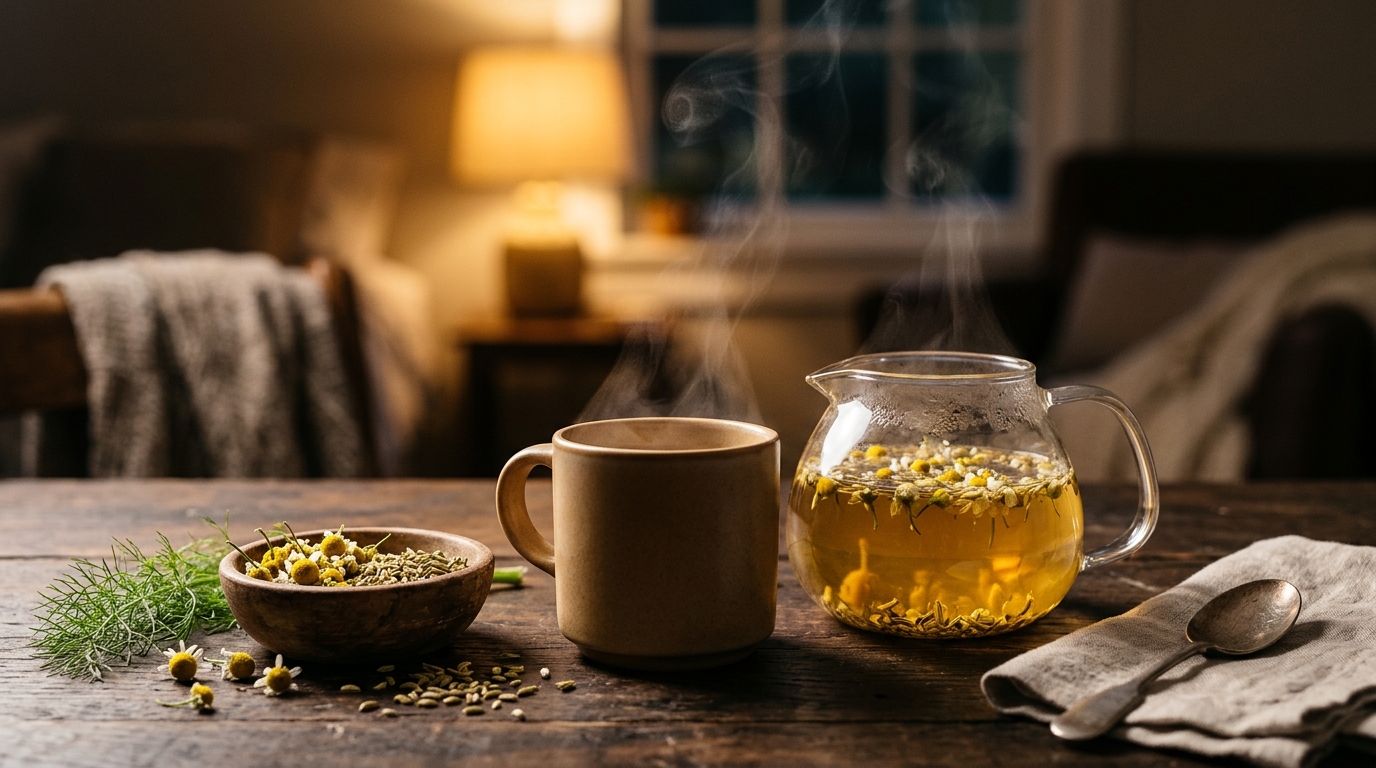
- 2 tspfennel seeds, lightly crushed
- 2 tbspdried chamomile flowers
- 480 mlwater (95°C / 203°F)
- —raw honey to taste (optional)
- —a thin slice of lemon (optional)
How to Brew
Click on an item below to shop for the recommended items for this recipe on Amazon.
As an Amazon Associate, we earn from qualifying purchases.
- Measure 2 teaspoons of fennel seeds into a mortar or onto a cutting board. Crush them lightly with a pestle or the flat side of a knife to crack the outer husk. You should smell sweet anise immediately. This step releases the aromatic oils that whole seeds hold tightly.
- Place the crushed fennel and 2 tablespoons of dried chamomile flowers into a teapot or a large mug with an infuser.
- Bring fresh water to a boil, then let it rest for about 30 seconds so it falls to roughly 95°C. Pour it over the herbs, using about 480 ml for two cups.
- Cover immediately with a saucer or lid and steep for 7 to 10 minutes. The longer end gives a rounder, more medicinal cup; the shorter end stays light and floral.
- Strain into two cups. Stir in a little raw honey if you like, and add a thin lemon slice for brightness. Sip slowly, ideally within 30 minutes of finishing dinner.
- Lightly crush 2 teaspoons of fennel seeds. Cold water extracts more slowly, so cracking the seeds matters even more here than in a hot brew.
- Add the crushed fennel and 3 tablespoons of dried chamomile flowers to a clean glass jar. The ratio is slightly higher than for hot brew to compensate for the gentler extraction.
- Pour in 700 ml of cold, filtered water. Stir once, seal the jar, and let it sit on the counter for 30 minutes to begin the infusion.
- Transfer the jar to the refrigerator and steep for 8 to 10 hours, or overnight.
- Strain through a fine mesh sieve or a coffee filter to catch the small chamomile florets. Serve over ice or at fridge temperature. Drink within 48 hours, as cold-brewed herbal teas do not keep as long as hot ones.
- Combine 2 teaspoons of lightly crushed fennel seeds with 500 ml of cold water in a small saucepan with a lid.
- Bring to a gentle simmer over medium heat, then reduce the heat to low. Keep the lid on to hold in the aromatic oils, and simmer for 10 minutes. The liquid will turn pale gold and the kitchen will smell of anise.
- Remove the pan from the heat. Immediately stir in 2 tablespoons of dried chamomile flowers, replace the lid, and let everything steep for 5 minutes. The flowers extract in the residual heat without turning harsh.
- Strain through a fine sieve into warmed cups, pressing gently on the seeds to release the last of the liquid.
- Sweeten with honey if desired. This version has a deeper, more savory-sweet character than the hot brew, closer to the fennel tea served in traditional Italian and Indian homes.
Health Benefits
Fennel’s anethole and fenchone relax the smooth muscle of the intestines, helping trapped gas move through. Fennel is recognized as a traditional carminative, and small clinical studies support its use for infant colic and functional gut discomfort.
Chamomile has long been used for upset stomach, and its anti-inflammatory and antispasmodic compounds may reduce cramping. Together with fennel, the blend addresses both muscle tension and irritation in the digestive tract.
Apigenin in chamomile interacts with GABA-related pathways and has mild sedative-like effects. A trial in postpartum women found improved sleep quality with chamomile tea, although evidence in the general population is modest.
Slowly sipping a warm, caffeine-free drink after dinner signals the body to shift into a calmer state. While this is a behavioral benefit rather than a pharmacological one, it complements the herbs’ physical effects.
Both herbs have a traditional history of use for period discomfort, and small studies on fennel and chamomile separately suggest reduced pain intensity, likely through antispasmodic action.
🧪 Key Bioactive Compounds
The Science Behind Fennel
The digestive reputation of fennel rests largely on its essential oil, which is typically 60 to 80 percent trans-anethole. Laboratory studies show that anethole and related compounds relax smooth muscle and reduce spasm in isolated intestinal tissue, which fits with fennel’s long use for gas and cramping. Fenchone and limonene add to the volatile profile. Because these oils evaporate easily, crushing the seeds just before brewing and covering the cup while it steeps both make a measurable difference in how much reaches your mug.
Chamomile contributes a different set of actions. Its flavonoids, especially apigenin, have been shown in animal and cell studies to bind to receptors involved in calming neural activity. Alpha-bisabolol and chamazulene are studied for their anti-inflammatory effects, which may help explain chamomile’s traditional use for irritated stomachs. Note that chamazulene is largely produced from matricin during heating, so a hot-steeped chamomile tea generally delivers more of it than a cold brew.
It is worth being honest about the strength of the evidence. Many of the mechanistic findings come from laboratory or animal work, and human trials, while encouraging, tend to be small. Infant colic studies of fennel and sleep-quality studies of chamomile are among the better-known examples, yet neither herb is a cure for any condition. Think of this blend as gentle, supportive, and rooted in centuries of traditional use, best enjoyed as part of a calm evening routine alongside a balanced diet and good sleep habits.
Brewing Tips
- Crush the fennel seeds right before brewing. Pre-crushed or old seeds lose much of their aromatic oil and make a flat, dusty cup.
- Always cover your cup or teapot while steeping. The volatile oils that make this tea digestive and fragrant escape quickly with the steam.
- Choose whole dried chamomile flowers over fine tea-bag dust when you can. Whole flowers look like tiny yellow-centered daisies and give a sweeter, more complex flavor.
- Drink the tea about 20 to 30 minutes after eating rather than during the meal, so it can work on the settling stomach.
- Store both herbs in airtight, opaque containers away from heat and light, and use within a year for the best flavor.