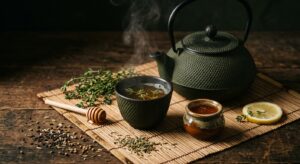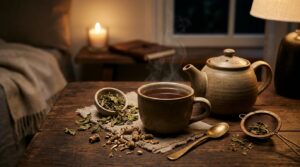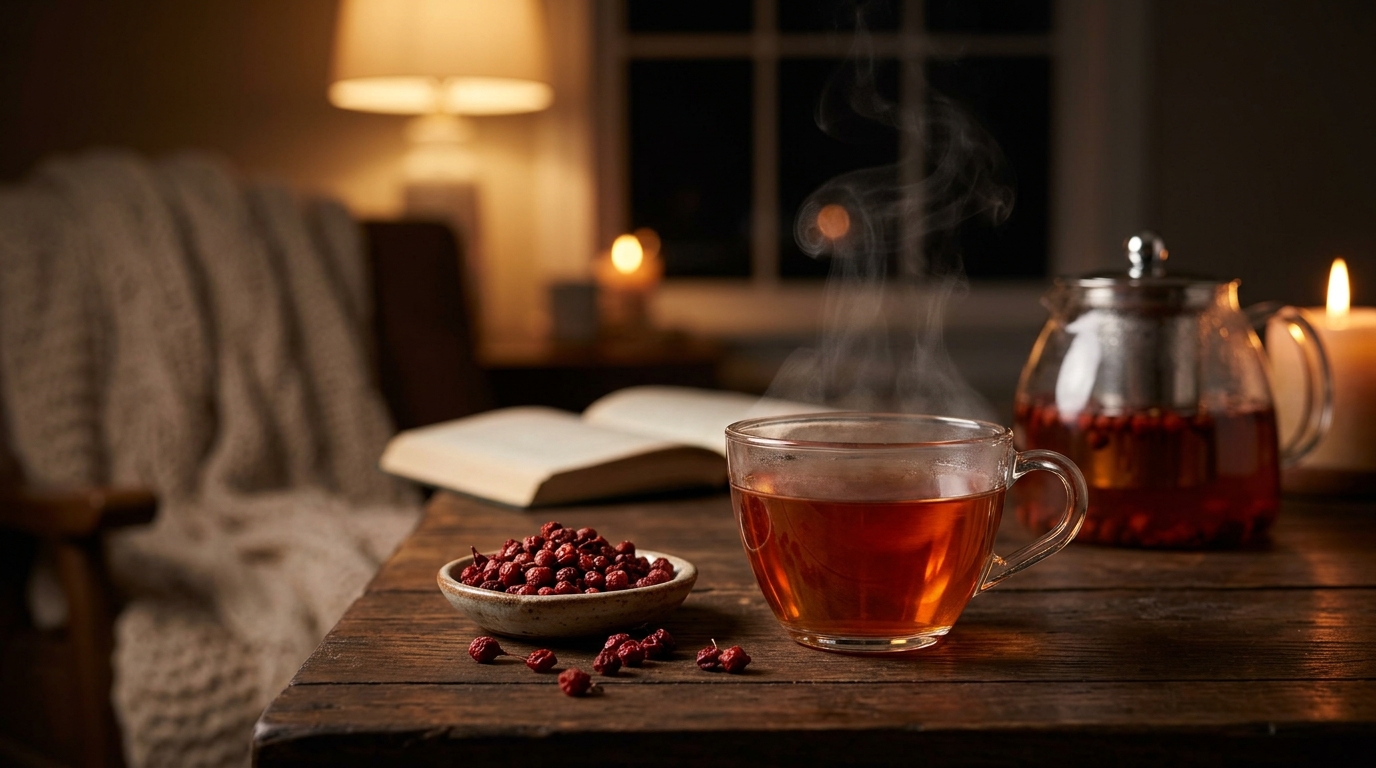
In Chinese herbal medicine, schisandra is called wu wei zi, which translates to ‘five flavor fruit.’ The name is no accident. A single dried berry delivers sweet, sour, salty, bitter, and pungent notes in succession, and each of those flavors was traditionally associated with a different organ system. Records of its use stretch back more than two thousand years, where it appeared in classical texts as a tonic believed to calm the spirit, steady the heart, and preserve vital energy.
The berry traveled well beyond China. Nanai hunters of the Russian Far East were said to chew the berries to sharpen their eyesight and stave off fatigue during long winter hunts. In the twentieth century, Soviet researchers studied schisandra alongside eleuthero and rhodiola, and it earned its place in the adaptogen category: herbs that help the body maintain balance under physical and mental strain without acting as a blunt stimulant or sedative.
What makes schisandra special as an evening tea is that quiet duality. It is gently tonifying yet calming, tart yet faintly sweet, and it asks nothing of you but a few unhurried minutes. Steeped, the berries release a tart, jewel-toned infusion that feels like the exhale at the end of a long day.
2
cups
Ingredients
- 2 tbspdried schisandra berries, lightly crushed
- 480 mlwater (95°C / 203°F)
- 1 tspdried lemon balm (optional, for extra calm)
- —raw honey or a slice of fresh ginger to taste (optional)
How to Brew
Click on an item below to shop for the recommended items for this recipe on Amazon.
As an Amazon Associate, we earn from qualifying purchases.
- Measure the schisandra berries into a mortar or a small bowl and press them gently with the back of a spoon or pestle until the skins crack. You are not grinding them to powder, only opening them so the flavor can escape.
- Bring fresh water to a near boil, then let it rest for about 30 seconds so it sits around 95°C (203°F). Water that is too violently boiling can push the tea toward harsh bitterness.
- Place the crushed berries (and lemon balm, if using) in a teapot or mug with an infuser, and pour the hot water over them.
- Cover the vessel with a lid or saucer to trap the volatile aromatics and let it steep for 10 to 15 minutes. The longer you steep, the more the sour and bitter notes assert themselves, so start tasting at 10 minutes.
- Strain into your cup. Stir in honey if you like; its sweetness softens the tart edge beautifully.
- Sip slowly an hour or two before bed, ideally somewhere dim and quiet, and leave your phone in another room.
- Lightly crush 2 tablespoons of schisandra berries, then add them to a clean glass jar.
- Pour in 480 ml of cool filtered water and stir once to wet all the berries. Add the lemon balm now if using.
- Seal the jar and place it in the refrigerator for 8 to 12 hours, or overnight. Because the water is cold, extraction is gentle and slow.
- In the morning or at serving time, strain through a fine mesh sieve into a fresh glass, pressing the berries lightly to release their liquid.
- Taste the tea. It should be bright, fruity, and noticeably less sharp than the hot version. Add a splash of water if it seems too concentrated.
- Serve chilled over ice or let it come to room temperature if you prefer a softer, more aromatic cup.
- Add 2 tablespoons of whole, uncrushed schisandra berries to a small saucepan with 600 ml of cold water. Starting cold allows the berries to release their compounds gradually as the water warms.
- Bring the pot slowly to a gentle simmer over medium-low heat. You should see small bubbles at the edges but never a rolling boil.
- Reduce the heat, partially cover the pot, and simmer for 15 minutes. The liquid will reduce slightly and deepen to a rich burgundy.
- Turn off the heat, add the lemon balm or a thin slice of ginger if you like, cover fully, and let the decoction rest for 5 minutes so the delicate herbs infuse without overcooking.
- Strain through a fine sieve into a mug, pressing the berries lightly with a spoon to extract the last of the liquid.
- Taste and sweeten with honey if desired. This method yields the most concentrated, robust cup, so you may wish to dilute it with a little hot water.
Health Benefits
As a classic adaptogen, schisandra appears to help modulate the hypothalamic-pituitary-adrenal axis. Small human and animal studies suggest it can improve resilience to mental and physical strain, though larger trials are still needed.
Traditional use describes schisandra as calming the shen (spirit) while sharpening attention. Preliminary research points to improved concentration and reduced fatigue under stress, without the jittery edge of a stimulant.
Schisandra lignans have been studied in Chinese clinical settings for supporting liver enzyme balance and protecting liver cells. This is one of the better-documented areas of schisandra research.
The anthocyanins and lignans in the berry display strong free-radical scavenging activity in laboratory studies, which may help buffer the oxidative load that accompanies chronic stress.
Traditionally used by hunters and athletes alike, schisandra has shown modest benefits for stamina and recovery in small trials, likely tied to improved cellular energy handling.
🧪 Key Bioactive Compounds
The Science Behind Schisandra Berry
The pharmacology of schisandra centers on a family of compounds called dibenzocyclooctadiene lignans, which are found almost exclusively in the Schisandraceae plant family. Schisandrin, gomisin A, and deoxyschizandrin are among the best studied. In laboratory and animal research, these lignans appear to influence the liver’s phase I and phase II detoxification enzymes, which helps explain both the berry’s reputation as a hepatic tonic and its capacity to interact with certain medications.
The adaptogenic reputation rests on a different line of evidence. Adaptogens are defined by their ability to increase the body’s non-specific resistance to stress. Studies on schisandra suggest it may modulate stress-related signaling, including pathways involving cortisol and nitric oxide, and may support mitochondrial efficiency, the cell’s energy-making machinery. In small human trials, extracts have been linked to improvements in attention, mental performance, and perceived fatigue under demanding conditions.
It is worth being honest about the limits of the evidence. Much of the supporting data comes from cell studies, animal models, and modest human trials, often using concentrated extracts rather than a simple cup of tea. A brewed infusion delivers a gentler, lower dose of these compounds, along with water-soluble anthocyanins and organic acids. The tea is best understood as a pleasant, traditionally grounded daily practice that may support resilience over time, not a quick fix for anxiety or insomnia.
Brewing Tips
- Crush the berries lightly before steeping; their tough skin otherwise holds back much of the flavor and many of the beneficial compounds.
- Reuse the same berries for a second, milder steep. The first infusion is bold and tart, while the second is smoother and more mellow.
- If the tea tastes too sour, add a small spoonful of honey, a slice of fresh ginger, or dilute it with a little hot water rather than steeping it for less time.
- Drink it in the early evening rather than right at bedtime if you are sensitive to acidic drinks, to avoid any stomach discomfort.
- Store dried berries in an airtight jar away from light and heat; they keep their flavor and potency for up to two years.