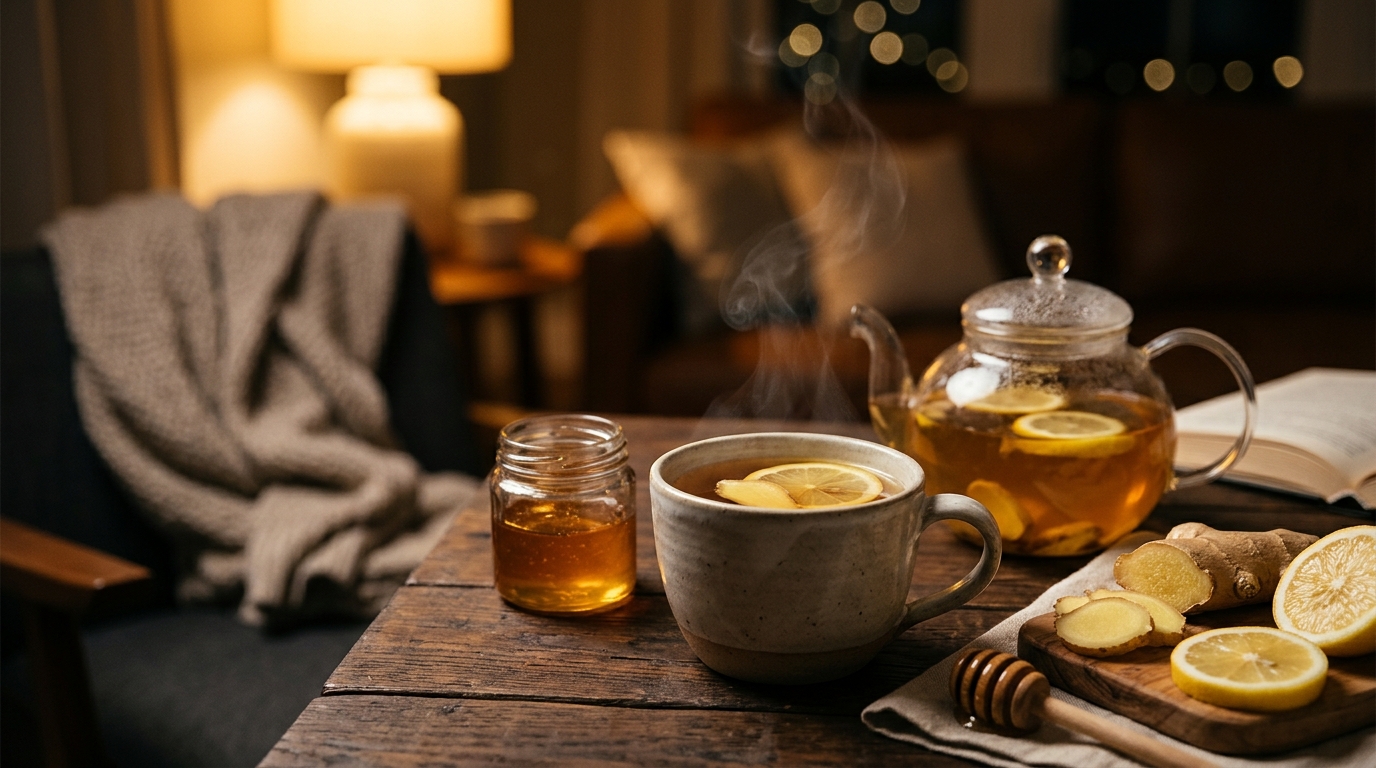
Few home remedies are as widely trusted as a mug of hot ginger, honey, and lemon. Ginger (Zingiber officinale) has been prized for over 5,000 years, appearing in Chinese, Indian Ayurvedic, and Greek medical traditions as a warming remedy for chills, nausea, coughs, and what we would now call the common cold. Traditional Chinese medicine classes fresh ginger as a herb that releases the exterior, meaning it encourages sweating to push out the early stages of a cold.
Honey and lemon joined ginger in folk medicine across many cultures. Honey has been used for coughs and throat irritation since ancient Egypt, and lemon was long valued as a source of vitamin C for sailors and households alike. Together the three ingredients form a drink that works on several levels at once: ginger warms and stimulates circulation, honey coats the throat, and lemon adds brightness and acidity that cuts through a heavy, stuffy head.
This is an evening tea by tradition. The ritual of a steaming mug before bed, with its fiery aroma and soft sweetness, signals the body to slow down. Because it contains no caffeine, it can be sipped late without interfering with sleep, and many people find the warmth alone helps them settle when a cold has made lying down uncomfortable.
2
cups
Ingredients
- 40 gfresh ginger root, thinly sliced (about a 5 cm / 2 inch piece)
- 480 mlwater
- 2 tbspfresh lemon juice (about 1 small lemon)
- 2 tspraw honey, or to taste
- —a pinch of cayenne or a cinnamon stick (optional)
How to Brew
Click on an item below to shop for the recommended items for this recipe on Amazon.
As an Amazon Associate, we earn from qualifying purchases.
- Scrub the ginger well and slice it into thin coins, leaving the skin on if the root is fresh and organic, as the skin holds flavor and some of the pungent compounds.
- Bring the water to a full boil in a kettle or small saucepan, then pour it over the ginger slices in a teapot or heatproof pitcher.
- Cover and steep for 10 to 15 minutes. Longer steeping gives a spicier, more intense brew, so choose 15 minutes if you want a stronger sore-throat tea.
- Strain the ginger out into your mugs and let the tea cool for 1 to 2 minutes until it is hot but comfortable to sip.
- Stir in the lemon juice and honey, dividing them between the two mugs. Taste and adjust, adding more honey for sweetness or lemon for brightness.
- Sip slowly while it is warm, ideally 30 to 60 minutes before bed.
- Slice the ginger into thin coins, or lightly crush them with the flat of a knife to help release flavor into cold water.
- Place the ginger and lemon slices (use two or three thin slices instead of juice at this stage) in a glass jar and cover with 480 ml of cold, filtered water.
- Seal the jar and refrigerate for 8 to 12 hours, or overnight, until the water turns pale gold and smells distinctly of ginger.
- Strain out the ginger and lemon slices. Stir the honey into a small splash of warm water first so it dissolves, then mix it into the cold tea.
- Add fresh lemon juice to taste, stir well, and serve over ice. Store any leftover tea in the refrigerator for up to 3 days.
- Slice or coarsely grate 40 g of fresh ginger. Grating exposes more surface area and makes the decoction noticeably more potent.
- Combine the ginger and 480 ml of cold water in a small saucepan and bring it slowly to a boil over medium heat.
- Reduce the heat to low, cover the pan with a lid, and simmer gently for 15 to 20 minutes. The liquid should reduce slightly and turn a deeper amber.
- Turn off the heat and let the decoction rest, covered, for 5 minutes so the flavors settle and the temperature drops a little.
- Strain through a fine mesh strainer into mugs, pressing the ginger gently to release the last of the liquid.
- Stir in the lemon juice and honey once the tea is comfortably warm, and add a cinnamon stick or pinch of cayenne if you want extra warmth.
Health Benefits
Honey forms a protective coating over irritated throat tissue, and studies in children and adults suggest it can reduce nighttime cough frequency and severity. Ginger’s anti-inflammatory gingerols add to the soothing effect.
Ginger is a traditional diaphoretic, meaning it promotes gentle sweating and a feeling of warmth. This is why it has long been used at the first sign of a chill or cold.
Ginger has some of the strongest clinical support among herbs for nausea, and gingerols and shogaols appear to act on the digestive tract and serotonin receptors. This helps when a cold brings queasiness or a poor appetite.
Gingerols, shogaols, and the vitamin C from lemon help neutralize free radicals and moderate inflammatory pathways, which may reduce the achy, heavy feeling that comes with a cold.
A warm, caffeine-free drink helps maintain fluid intake during illness and loosens mucus, and the calming ritual makes it easier to wind down and sleep when congested.
🧪 Key Bioactive Compounds
The Science Behind Ginger
The heat of fresh ginger comes mainly from gingerols, with 6-gingerol the most abundant. In laboratory and clinical research, gingerols inhibit inflammatory pathways, including enzymes involved in producing prostaglandins, which helps explain ginger’s traditional use for aches, sore throats, and general inflammation. When ginger is heated, as in a hot brew or decoction, some gingerols convert into shogaols, which are even more pungent and in some studies more potent. This is one reason a simmered or hot-steeped ginger tea tastes spicier and feels stronger than a cold infusion.
Ginger’s anti-nausea effect is among its best-supported benefits. Several clinical trials show it can reduce nausea from pregnancy, chemotherapy, and motion, likely through action on serotonin receptors in the gut and effects on gastric motility. For someone with a cold, queasiness and poor appetite are common, so this gentle digestive support is a genuine practical benefit rather than just folklore.
Honey’s role is better studied than many people expect. Systematic reviews have found honey to be at least as effective as some over-the-counter cough suppressants for acute cough in children over one year, likely because its viscosity and mild antimicrobial and anti-inflammatory activity soothe irritated tissue. Lemon contributes vitamin C and citric acid. While vitamin C supplementation has not been shown to reliably prevent colds in the general population, it does support normal immune function, and the tart, aromatic quality of lemon makes the tea more appealing and encourages the fluid intake that helps during illness.
Brewing Tips
- Use fresh ginger root rather than powdered ginger. The fresh root contains more gingerols and gives a brighter, cleaner flavor.
- Let the tea cool for a minute or two before adding honey and lemon. This preserves the delicate flavor and character of raw honey and protects the vitamin C in the lemon.
- Make a ginger concentrate by simmering a larger batch, straining it, and storing it in the fridge for up to 4 days. Reheat a portion and add fresh lemon and honey each evening.
- Choose a darker, more flavorful raw honey such as buckwheat or manuka if you want extra throat-soothing power, though any raw honey works well.