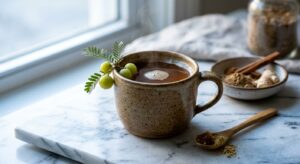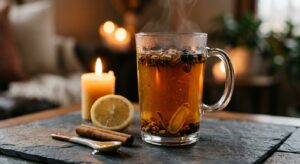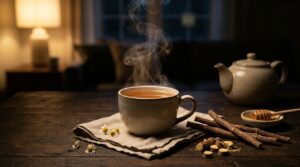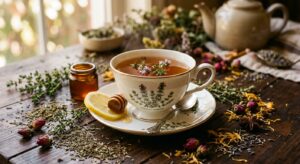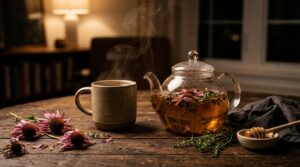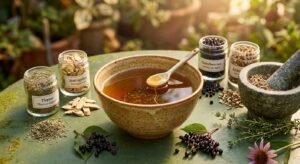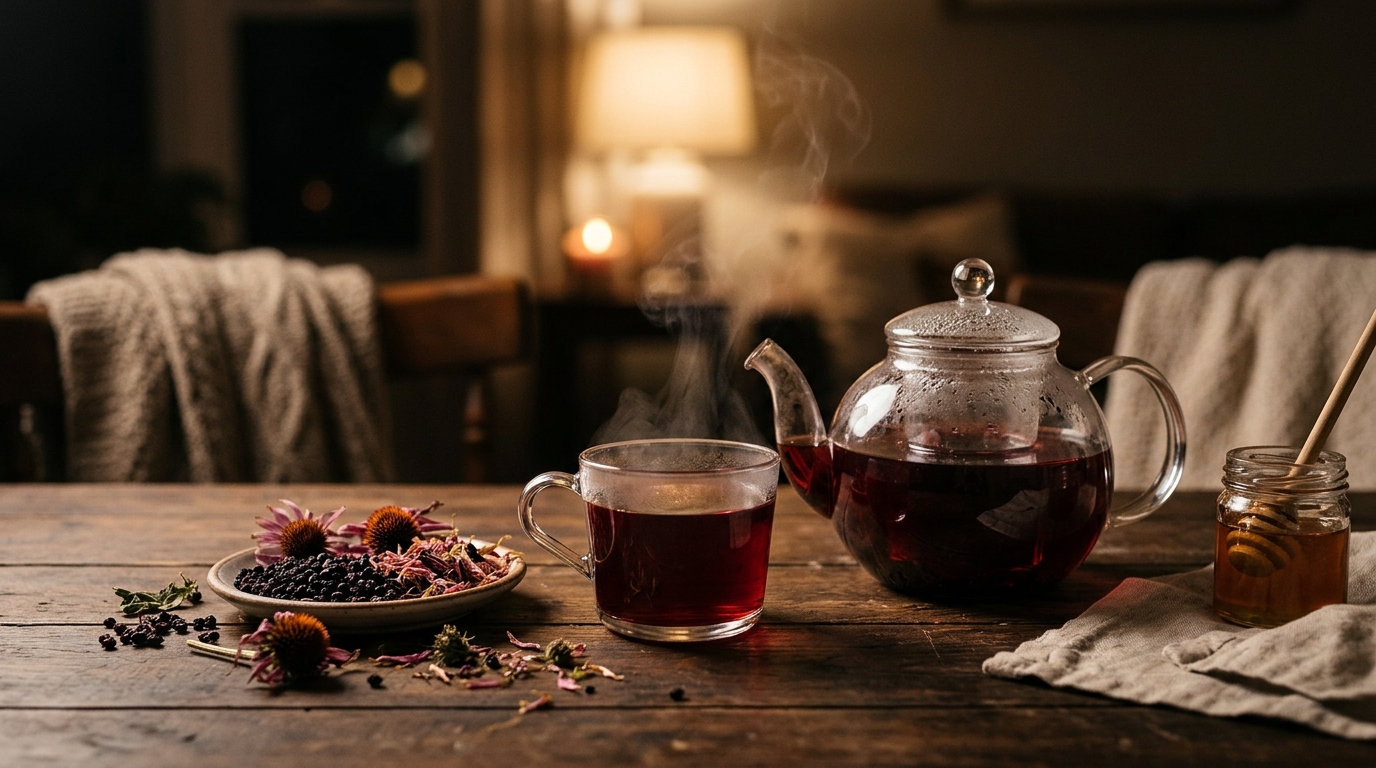
Elderberry (Sambucus nigra) has been a fixture of European household medicine for centuries. Hippocrates is often said to have called the elder tree his medicine chest, and by the Middle Ages, villagers were simmering the dark berries into syrups, wines, and warming cordials to see them through damp winters. The berries were never eaten raw in folk practice, since uncooked elder fruit can upset the stomach, but gentle heat turns them into a deep purple, pleasantly tart brew.
Echinacea (Echinacea purpurea and E. angustifolia) comes from a different tradition altogether. Native peoples of the Great Plains, including the Lakota and Comanche, used the coneflower’s roots and flowers for infections, wounds, and sore throats long before settlers took notice. By the early 1900s it was one of the most widely prescribed herbs in American medicine, and it remains one of the best-known immune herbs in the world today.
Together, the two make a natural pair for the evening ritual. Elderberry brings fruity depth, color, and a rich anthocyanin content, while echinacea adds an earthy, slightly tingling note that has a distinctive effect on the tongue. Because neither herb is stimulating, the blend works well as a wind-down cup, and a spoonful of honey and a slice of ginger or lemon turns it into a cozy bedtime habit during cold and flu season.
2
cups
Ingredients
- 2 tbspdried elderberries
- 1 tbspdried echinacea aerial parts (leaf, flower, and stem)
- 1 tspdried orange peel or rose hips (optional, for brightness)
- 480 mlwater (95°C / 203°F)
- —raw honey to taste (optional)
- —fresh lemon slice or a few slices of fresh ginger (optional)
How to Brew
Click on an item below to shop for the recommended items for this recipe on Amazon.
As an Amazon Associate, we earn from qualifying purchases.
- Add the dried elderberries and 480 ml of water to a small saucepan and bring to a boil, then reduce the heat to a gentle simmer.
- Simmer the elderberries uncovered for 10 minutes. The water will darken to a deep purple and the berries will soften and plump.
- While the berries simmer, place the echinacea and optional orange peel into a teapot or heatproof jar.
- Pour the hot elderberry liquid, berries and all, over the echinacea. Cover and steep for 5 minutes to keep the aromatic compounds from escaping.
- Strain through a fine mesh strainer into two mugs, gently pressing the berries with the back of a spoon to release their juice.
- Stir in honey and add a lemon slice or ginger to taste. Sip slowly about 30 to 60 minutes before bed.
- Simmer the dried elderberries in 240 ml of water for 10 minutes, then remove from heat and let cool completely to room temperature.
- Place the echinacea and optional orange peel in a clean glass jar and add 240 ml of cold, filtered water.
- Strain the cooled elderberry liquid into the jar, pressing the berries to extract all of the color. Stir gently.
- Seal the jar and refrigerate for 10 to 12 hours, or overnight.
- Strain through a fine mesh strainer or a coffee filter to remove the plant material, then taste and sweeten with a little honey if desired.
- Serve over a few ice cubes or at fridge temperature. Keep refrigerated and drink within 48 hours.
- Combine 2 tbsp dried elderberries, 1 tbsp chopped dried echinacea root, and 480 ml of cold water in a small saucepan.
- Slowly bring the mixture up to a simmer over medium heat. Starting with cold water helps draw more from the roots.
- Reduce the heat to low, cover with a lid slightly ajar, and simmer gently for 20 to 25 minutes, stirring occasionally. Do not let it boil hard.
- Turn off the heat and add the optional orange peel and a slice of fresh ginger. Cover and let stand for 5 minutes.
- Strain through a fine mesh strainer into a mug, pressing the berries to release their juice. You should have roughly 360 ml of dark, concentrated tea.
- Sweeten with honey, dilute with a splash of hot water if the flavor is too strong, and enjoy warm before bed.
Health Benefits
Several clinical trials, including a well-cited study on a standardized elderberry extract, found that participants recovered from influenza symptoms about two to four days sooner than those on placebo. Evidence for the tea itself is more limited, but the active anthocyanins are present.
Echinacea’s alkamides and polysaccharides appear to stimulate macrophages and other immune cells in laboratory and some human studies. A Cochrane review found modest benefit for cold prevention, though results vary widely between echinacea products.
Elderberries rank among the most anthocyanin-dense fruits, and these pigments neutralize free radicals that increase during infection and stress. This antioxidant load is part of why the herb has been valued as a restorative.
A warm, flavonoid-rich liquid helps hydrate and coat irritated tissue, while elderberry has traditionally been used to ease upper respiratory discomfort. The warm steam itself also helps loosen congestion.
Although neither herb is a sedative, a warm, caffeine-free cup before bed supports hydration and relaxation, both of which matter for the quality of rest the body needs when fighting off illness.
🧪 Key Bioactive Compounds
The Science Behind Elderberry
Elderberry’s reputation rests largely on its anthocyanins, particularly cyanidin-3-glucoside and cyanidin-3-sambubioside. In laboratory studies, extracts rich in these pigments have been shown to bind to viral surface proteins and interfere with the ability of influenza viruses to enter and replicate in host cells. Human trials are smaller but encouraging: a randomized study of air travelers found that those taking elderberry had shorter and less severe cold symptoms than the control group, though the products tested were standardized extracts rather than brewed tea.
Echinacea’s activity is more complex, because its effects come from several families of compounds working together. Alkamides, which cause the characteristic tingle on the tongue, interact with CB2 receptors on immune cells and appear to influence the release of cytokines. Cichoric acid and other phenolic compounds add antioxidant and possible antiviral activity, while polysaccharides may help prime macrophages. Because the content of these compounds varies greatly between species, plant parts, and preparations, clinical results have been inconsistent, which is why quality sourcing matters.
Stacking the two herbs makes intuitive sense: elderberry offers antioxidant and antiviral flavonoids, while echinacea contributes immune-modulating alkamides and phenolics. It is important to be honest that neither herb is a cure, and evidence for the combination as tea is largely traditional. Still, as a warm, hydrating, caffeine-free ritual during cold season, it supports the simple conditions the body needs most: fluids, warmth, and rest.
Brewing Tips
- Always simmer elderberries for at least 10 minutes before drinking, since heat neutralizes the compounds that can cause stomach upset in raw berries.
- Choose echinacea labeled as aerial parts or root from a reputable supplier, and look for fragrant, vividly colored material that still has a faint tingle when chewed.
- Cycle the tea rather than drinking it constantly: use it daily for up to a week when you feel run down, then take a break for a week or more.
- Strain the tea twice, once through a mesh strainer and once through a paper filter, if you prefer a clearer cup without berry sediment.
- Make a double batch of the elderberry base and refrigerate it for up to three days, then reheat a portion and steep it over fresh echinacea each evening.