Lemon balm (Melissa officinalis) has been valued for over two thousand years. Greek and Roman physicians prescribed it for melancholy and nervous complaints, and medieval monks grew it in monastery gardens as a restorative for the spirit. The 17th-century herbalist John Evelyn wrote that it “is fit to be put into the cup of a wounded spirit.” Its name comes from the Greek word for honeybee, because beekeepers rubbed the leaves inside hives to keep colonies settled and content.
Valerian (Valeriana officinalis) has an equally long history as a calming root. Hippocrates described its properties, and Galen later recommended it for sleeplessness. By the Middle Ages it was a staple of European folk medicine for “nervous” conditions, and during the London air raids of World War II it was reportedly used to steady frayed nerves. Its smell is famously pungent, something like damp earth and old socks, which is the root’s price of admission.
Brewed together, the two herbs balance each other beautifully. Lemon balm brings a bright lemony lift and a gentle, mood-soothing quality, while valerian provides the deeper, sedative backbone. The lemon balm softens valerian’s heavy aroma, turning a challenging brew into a genuinely comforting evening ritual.
2
cups
Ingredients
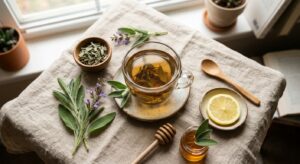
- 2 tspdried lemon balm leaf
- 1 tspdried valerian root, roughly chopped
- 480 mlwater (95°C / 203°F)
- —raw honey to taste (optional)
- —a thin slice of fresh lemon (optional)
How to Brew
Click on an item below to shop for the recommended items for this recipe on Amazon.
As an Amazon Associate, we earn from qualifying purchases.
- Bring fresh, filtered water to a near boil, then let it rest for about 30 seconds so it settles around 95°C (203°F).
- Combine the lemon balm leaf and chopped valerian root in a teapot or large mug with a lid, using an infuser basket so the root pieces are easy to remove.
- Pour the hot water over the herbs and cover immediately to trap the volatile oils.
- Steep for 10 to 12 minutes. Valerian root needs this longer time to release its active compounds, and lemon balm holds up well without turning harsh.
- Strain, then sweeten with a little raw honey if you like. A thin slice of lemon brightens the flavor and offsets valerian’s earthiness.
- Drink slowly about 30 to 45 minutes before bed, in dim light and away from screens.
- Add the lemon balm leaf and chopped valerian root to a glass jar, using the same herb quantities but doubling the water to 480 ml of cold, filtered water per two servings.
- Stir well for a few seconds to wet all the plant material, then seal the jar with its lid.
- Refrigerate for 8 to 10 hours, or overnight. Gently shake the jar once or twice if you pass by it.
- Strain through a fine mesh strainer, pressing lightly on the herbs to release the last of the liquid.
- Serve over ice with a slice of lemon, or drink straight from the glass. Store any extra in the refrigerator and finish within 24 hours.
- Add the chopped valerian root and 480 ml of cold water to a small saucepan with a lid.
- Bring to a gentle simmer over medium heat, then reduce to low and cover. Simmer for 15 minutes, taking care not to let it boil hard.
- Remove the pan from the heat and immediately stir in the dried lemon balm leaf. Cover again.
- Let the mixture steep off the heat for 8 minutes so the lemon balm releases its flavor without cooking away its volatile oils.
- Strain into a mug, pressing the herbs gently against the strainer to extract the last of the liquid.
- Add honey and lemon to taste. This method produces the strongest cup of the three, so sip it slowly.
Health Benefits
Lemon balm has been shown in small human trials to improve calmness and reduce self-reported anxiety, likely through its effect on GABA activity. Valerian’s valerenic acid acts on related receptors, which is why the two are so often paired.
Several studies and reviews suggest valerian may shorten the time it takes to fall asleep and improve subjective sleep quality, though results vary between individuals and trials. A lemon balm and valerian combination has shown promise for mild sleep disturbances.
Lemon balm has a long record as a mood-lifting herb, and research suggests it can improve calmness and alertness at modest doses. This helps quiet racing thoughts before bed.
Lemon balm is a traditional carminative, used to ease cramping and nervous stomach. Because stress often shows up in the gut, this gentle digestive support complements the blend’s calming effect.
Beyond the plant chemistry, the warm cup, the aroma, and the slow sipping help signal to the body that the day is ending, which supports healthy sleep habits.
🧪 Key Bioactive Compounds
The Science Behind Lemon Balm
The calming reputation of this blend rests largely on the GABA system, the brain’s main inhibitory neurotransmitter network. Lemon balm’s rosmarinic acid has been shown in laboratory studies to inhibit GABA transaminase, the enzyme that breaks down GABA, which may help sustain its calming signal. Valerian’s valerenic acid, meanwhile, appears to bind to GABA-A receptors and enhance their activity, a mechanism loosely comparable to how some prescription sedatives work, though far milder.
Clinical evidence is encouraging but not conclusive. A number of small trials report that lemon balm improves calmness and cognitive performance under stress, and valerian has been studied extensively for sleep, with some reviews showing modest improvements in sleep onset and subjective quality while others find little difference from placebo. Combination preparations of lemon balm and valerian have shown benefits for restlessness and sleep difficulty in some studies, including trials in children and adults, suggesting the herbs may work better together than alone.
It is worth knowing that valerian’s effect often builds with consistent use over a couple of weeks rather than appearing from a single cup, and individual responses vary widely. Preparation also matters: valerian’s key compounds are better extracted with hot water, which is why the hot brew and decoction methods produce a stronger result than cold brew. The pungent smell comes from isovaleric acid, a byproduct of drying, and is harmless despite being unappealing to many people.
Brewing Tips
- Buy valerian root that smells strongly earthy when you open the bag, since a faint smell often means old, weak material.
- Store both herbs in airtight, opaque containers away from heat and light to protect their volatile oils.
- Start with a weaker ratio, such as half a teaspoon of valerian, until you learn how your body responds, then adjust upward.
- Drink the tea about 30 to 45 minutes before bed rather than right as you lie down, giving the herbs time to take effect.
- Use fresh lemon balm leaves when they are in season, doubling the amount to about 4 teaspoons of chopped fresh leaf in place of the dried.