Long before oats landed in breakfast bowls, farmers and herbalists noticed something remarkable about the plant itself. Avena sativa, harvested while still green and in its milky stage, was brewed as a restorative for people who were worn thin by overwork, worry, and sleepless nights. Traditional European herbal practice classed it as a nervine tonic, a category of plants thought to feed and steady the nervous system rather than simply sedate it. Old herbals even describe the milky oat tops as a remedy for nervous exhaustion and for those struggling to settle after long, demanding days.
What sets oat straw apart from more assertive sleep herbs like valerian is its gentleness. There is no heavy, sedating punch and no medicinal bite. Instead, the tea tastes like a sunlit field after rain: soft, grassy, faintly sweet, and rounded with a mild creaminess that hints at its grain heritage. It is a tea you can drink nightly, which is exactly how traditional herbalists used it, building up its calming effects over weeks rather than expecting a dramatic overnight result.
Oat straw is also a mineral-rich herb, containing silica, calcium, and magnesium, which is part of why it has been valued as a general tonic for bones, skin, and hair as well as for the nerves. Whether you are winding down after a busy day or looking for a caffeine-free ritual to mark the end of your evening, oat straw offers a quiet, nourishing way to slow down.
2
cups
Ingredients
- 2 tbspdried oat straw (milky oat tops and green stems)
- 480 mlwater (95°C / 203°F)
- —raw honey or maple syrup to taste (optional)
- —a strip of lemon peel or a slice of fresh ginger (optional)
How to Brew
Click on an item below to shop for the recommended items for this recipe on Amazon.
As an Amazon Associate, we earn from qualifying purchases.
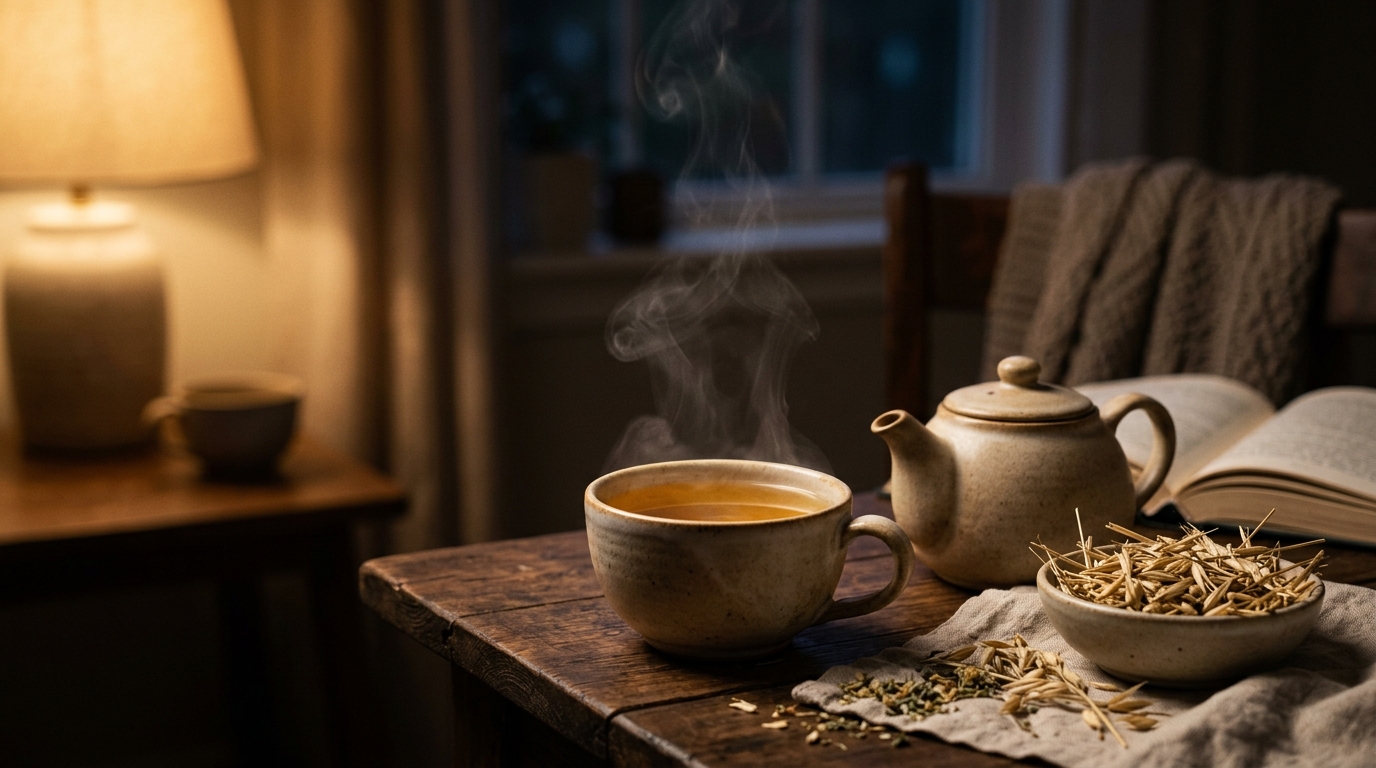
- Measure 2 tablespoons of dried oat straw into a teapot or a large mug fitted with a mesh infuser. The herb looks like a lot of pale green stems, which is exactly right.
- Bring fresh water to a boil, then let it rest for about 30 seconds so it sits near 95°C (203°F). Pour 480 ml over the oat straw, making sure all the herb is submerged.
- Cover the teapot or mug with a saucer or lid immediately. This traps the gentle aromatic compounds that would otherwise escape with the steam.
- Steep for 10 to 15 minutes. Because oat straw is mild, a longer steep gives a fuller, sweeter cup without bitterness. Set a timer and resist the urge to rush.
- Strain the tea into a cup, pressing lightly on the herb to release the last of the liquid. Stir in a little honey or maple syrup if you like, and sip slowly in the hour before bed.
- Add 3 tablespoons of dried oat straw to a clean 1-liter glass jar. Cold extraction is gentler, so use slightly more herb than you would for a hot brew.
- Pour 1 liter of cool, filtered water over the herb. Stir once with a spoon to wet all the plant material, then seal the jar.
- Place the jar in the refrigerator and let it steep for 8 to 12 hours, or overnight. There is no need to babysit it. The slow, cool extraction keeps the flavor round and smooth.
- Strain through a fine mesh sieve lined with muslin or a coffee filter to catch the tiny bits of plant matter. Discard the herb.
- Serve over ice or straight from the fridge. A squeeze of lemon or a few mint leaves brightens the mellow, hay-sweet flavor. Drink within 48 hours.
- Place 1/2 cup (about 30 g) of dried oat straw into a 1-liter heatproof glass jar or French press. This higher ratio is what makes a true nourishing infusion.
- Boil 1 liter of water and pour it directly over the herb, filling the jar to the top. Stir gently to saturate the oat straw.
- Cover tightly with a lid and leave the jar on the counter to steep for at least 4 hours, or overnight for up to 8 hours. The water will turn a rich golden-green and taste notably fuller and sweeter.
- Strain through a fine sieve into a clean jar, squeezing the soaked herb to extract every drop of the concentrated liquid.
- Drink 1 to 2 cups, either gently rewarmed on the stove (do not boil) or at room temperature. Store the rest in the refrigerator for up to 2 days.
Health Benefits
Oat straw is classically used as a nervine tonic for nervous exhaustion and stress. Animal and early human studies on green oat extract suggest it may influence mood and cognitive function, though more research is needed and effects are subtle and cumulative.
While not a strong sedative, its gentle calming action and magnesium content make it a soothing bedtime ritual that helps the body transition toward sleep without grogginess.
A long infusion of oat straw delivers calcium, magnesium, and silica, minerals traditionally associated with healthy bones, skin, and nerve function.
The silica and avenanthramides in oats are linked to skin-soothing and antioxidant benefits, and herbalists have long drunk oat straw tea to support hair, skin, and nails.
Small trials using standardized green oat extract have reported modest improvements in attention and cognitive performance, suggesting oat straw may calm the mind without dulling it.
🧪 Key Bioactive Compounds
The Science Behind Oat Straw
The calming reputation of oat straw rests on a combination of traditional use and a growing, though still modest, body of research. The green, milky-stage tops of Avena sativa contain a distinctive mix of flavonoids, saponins, and avenanthramides, along with trace minerals. Flavonoids such as apigenin and luteolin are well studied for their interactions with receptors in the brain, including GABA pathways involved in relaxation, though the concentrations in a cup of tea are far lower than in concentrated supplements.
Most clinical interest has focused on standardized extracts of green oat rather than brewed tea. In a few small human trials, such extracts were associated with improved attention, working memory, and cognitive performance, particularly in older adults, suggesting oat’s effects may be gently supportive of the nervous system rather than sedating. Avenanthramides, found only in oats, have shown antioxidant and anti-inflammatory activity in laboratory and topical studies, which helps explain oat’s well-known skin-soothing properties.
It is important to be realistic: oat straw tea is not a potent sleep aid, and its benefits tend to build with regular use over weeks. Its real strength lies in being a nourishing, caffeine-free ritual that delivers minerals like magnesium and silica while encouraging you to slow down. That combination of mild physiological support and mindful evening routine is often what makes it effective for people seeking gentle, sustainable calm.
Brewing Tips
- Use a generous amount of herb. Oat straw is light and fluffy, so 2 tablespoons per 480 ml is a good starting point, and you can go higher for a stronger, more nutritive cup.
- Always steep covered and for at least 10 minutes. Short steeps produce a thin, watery tea, while patience rewards you with a sweet, full-bodied infusion.
- Buy organic, gluten-free-certified oat straw if you are sensitive to gluten, and look for pale green, fragrant material rather than dull, brown, or dusty herb.
- Drink it consistently. Traditional herbalists treated oat straw as a daily tonic, so a nightly cup over several weeks will tell you far more than a single serving.