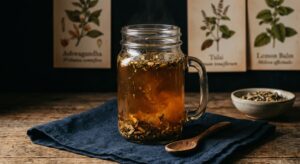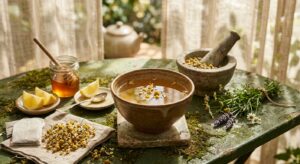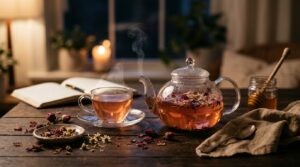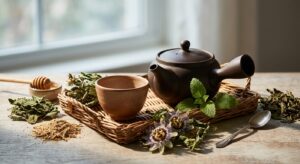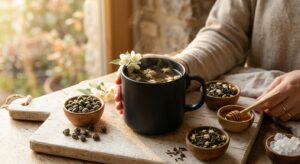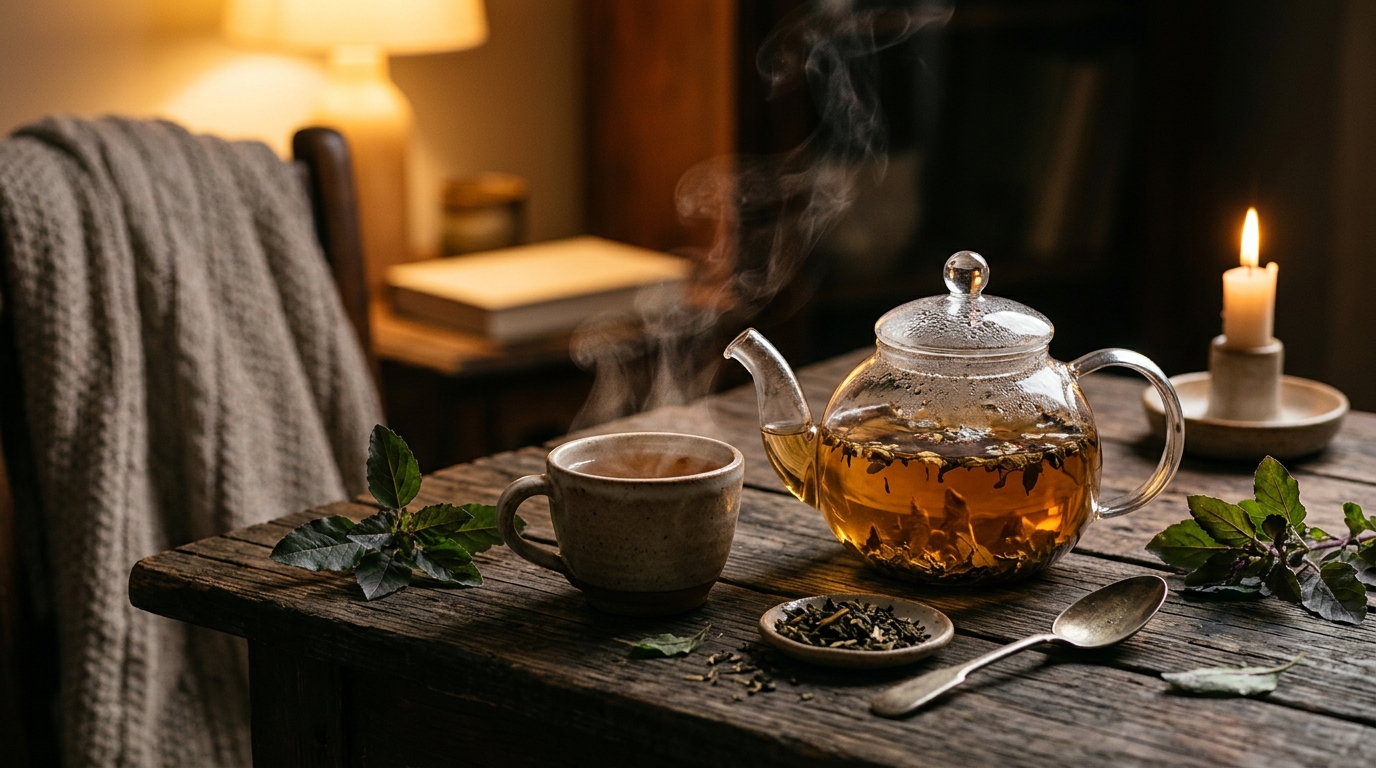
In India, tulsi (Ocimum tenuiflorum, also called Ocimum sanctum) is far more than a kitchen herb. It is revered as a living goddess, an incarnation of Lakshmi, and countless households keep a tulsi plant in a raised courtyard planter where family members circle it each morning and evening. In Ayurveda, it has been called the ‘Queen of Herbs’ and ‘The Incomparable One’ for over three thousand years, prescribed for everything from coughs and fevers to the heavy weight of a restless mind.
Tulsi is classed as an adaptogen, a term for herbs thought to help the body adapt to physical and emotional stress. Unlike the sweet Italian basil on your pizza, holy basil has a peppery, clove-like fragrance with hints of mint and a faint citrus lift. Three main types are grown for tea: Rama (mild and green), Krishna or Shyama (purple-leaved, more pungent), and Vana (wild, bright and lemony). Many blends combine all three for a layered cup.
As an evening ritual, tulsi tea is a gentle companion. It is naturally caffeine-free, warming without being heavy, and its aroma alone signals the nervous system to slow down. Brewing it mindfully, watching the leaves unfurl and breathing in the steam, turns a simple cup into a small ceremony that marks the end of the working day.
2
cups
Ingredients
- 2 tspdried holy basil (tulsi) leaves
- 480 mlwater (95°C / 203°F)
- —raw honey or a small slice of fresh ginger to taste (optional)
- —a few drops of lemon juice (optional)
How to Brew
Click on an item below to shop for the recommended items for this recipe on Amazon.
As an Amazon Associate, we earn from qualifying purchases.
- Bring fresh, filtered water to a boil, then let it rest for about 30 seconds so it settles near 95°C (203°F). Tulsi leaves are delicate, and a fully raging boil can flatten their aroma.
- Measure 1 teaspoon of dried tulsi leaves per mug (240 ml) and place them in a tea infuser or directly in a teapot. Gently crush the leaves between your fingers first to wake up their oils.
- Pour the hot water over the leaves, then cover the mug or pot with a small plate or lid. This keeps the fragrant steam from escaping.
- Steep for 5 to 7 minutes. Five minutes gives a lighter, sweeter cup; seven brings out the peppery, clove-like depth.
- Remove the infuser or strain the leaves. Stir in honey or a squeeze of lemon if you like, then sip slowly, ideally an hour before bed.
- Add 2 tablespoons of dried tulsi leaves to a clean glass jar. Use a slightly higher ratio than hot brewing, since cold water extracts more slowly.
- Fill the jar with 1 liter of cold, filtered water and stir gently so all the leaves are submerged.
- Seal the jar and refrigerate for 8 to 10 hours, or overnight. Avoid steeping beyond 12 hours, which can make the flavor grassy.
- Strain through a fine-mesh sieve into a clean pitcher, pressing the leaves lightly to release the last of the infusion.
- Serve over ice with a lemon slice or a few fresh mint leaves. Keep refrigerated and drink within 2 days.
- Pour 480 ml of water into a small saucepan and add 3 or 4 thin slices of fresh ginger. Bring to a gentle simmer over medium heat.
- Add 2 teaspoons of dried tulsi leaves (or a small handful of fresh leaves) along with an optional pinch of black peppercorns or a small cinnamon stick.
- Reduce the heat to low and simmer uncovered for about 10 minutes, keeping it at a bare bubble rather than a rolling boil. The liquid will deepen to a rich amber.
- Turn off the heat, cover the pan, and let the mixture rest for 5 minutes so the flavors meld.
- Strain into two mugs and sweeten with a little honey once the tea has cooled slightly, since high heat can dull honey’s character. Sip while warm.
Health Benefits
As an adaptogen, tulsi appears to help moderate cortisol and the body’s reaction to physical and mental stress. Several small human trials have reported reduced stress scores and improved mood with regular use, though larger studies are still needed.
Clinical studies on tulsi extracts have noted reductions in feelings of anxiety, forgetfulness, and fatigue over several weeks. The soothing aroma of the tea itself may add to the calming effect.
While tulsi is not a sedative, its gentle nervous-system balancing action and caffeine-free nature make it a good wind-down drink that can help prepare the body for rest.
Some trials suggest tulsi may help modestly lower fasting and post-meal blood glucose, likely through its polyphenol content. It should complement, not replace, medical care.
Rich in rosmarinic acid, eugenol, and flavonoids, tulsi provides antioxidant activity and has been traditionally used for seasonal respiratory comfort.
🧪 Key Bioactive Compounds
The Science Behind Holy Basil
Tulsi’s reputation as an adaptogen rests on a diverse chemical profile. Its leaves contain essential oils rich in eugenol, linalool, and caryophyllene, alongside non-volatile compounds such as ursolic acid, rosmarinic acid, and flavonoids like apigenin and orientin. Together these constituents appear to influence several pathways at once, rather than acting through a single mechanism, which fits the broad, balancing nature of an adaptogen.
Research into tulsi’s stress effects has focused on the hypothalamic-pituitary-adrenal (HPA) axis, the system that governs cortisol release. Animal studies and a handful of small human trials suggest tulsi extracts may help moderate stress-induced cortisol spikes and reduce markers of oxidative stress. In placebo-controlled studies lasting several weeks, participants taking tulsi reported lower perceived stress, better sleep quality, and reduced symptoms such as forgetfulness and exhaustion.
It is worth noting the limits of the evidence. Many studies use concentrated leaf extracts rather than a simple tea infusion, sample sizes are small, and results vary. A cup of tulsi tea delivers a gentler dose of these compounds, so think of it as a supportive daily ritual rather than a treatment. The calming effect likely comes from a blend of the herb’s phytochemistry, the warmth of the drink, and the mindful pause of preparing it.
Brewing Tips
- Crush dried leaves lightly between your fingers just before brewing to release more of their aromatic oils.
- Always cover your cup while steeping, as tulsi’s calming scent comes from volatile oils that escape easily with the steam.
- Try a three-tulsi blend (Rama, Krishna, and Vana) for a more complex, layered flavor than a single variety offers.
- Make tulsi a consistent evening habit; adaptogens tend to work best with regular use over weeks rather than a single cup.
- Source organic, whole-leaf tulsi when possible, and store it in an airtight, opaque container away from heat and light to preserve its potency.