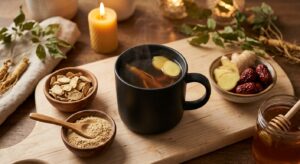
Rhodiola rosea, sometimes called golden root or arctic root, grows in the cold, rocky highlands of Siberia, Scandinavia, and the Rocky Mountains. For centuries, Scandinavian Vikings were said to use it for endurance, and Russian folk medicine prized it as a tonic for surviving harsh winters and long journeys. In the twentieth century, Soviet researchers studied it extensively as an adaptogen, a term coined to describe plants that help the body resist physical, chemical, and emotional stress.
Asian ginseng, Panax ginseng, has an even longer record. Chinese herbalists have valued the forked, human-shaped root for over two thousand years, calling it the king of herbs and reaching for it when the body felt depleted or worn thin. Where rhodiola is often described as sharp and quick-acting, ginseng is traditionally seen as deeper and more fortifying. Together they make a complementary pair: one lifts mental clarity, the other builds underlying vitality.
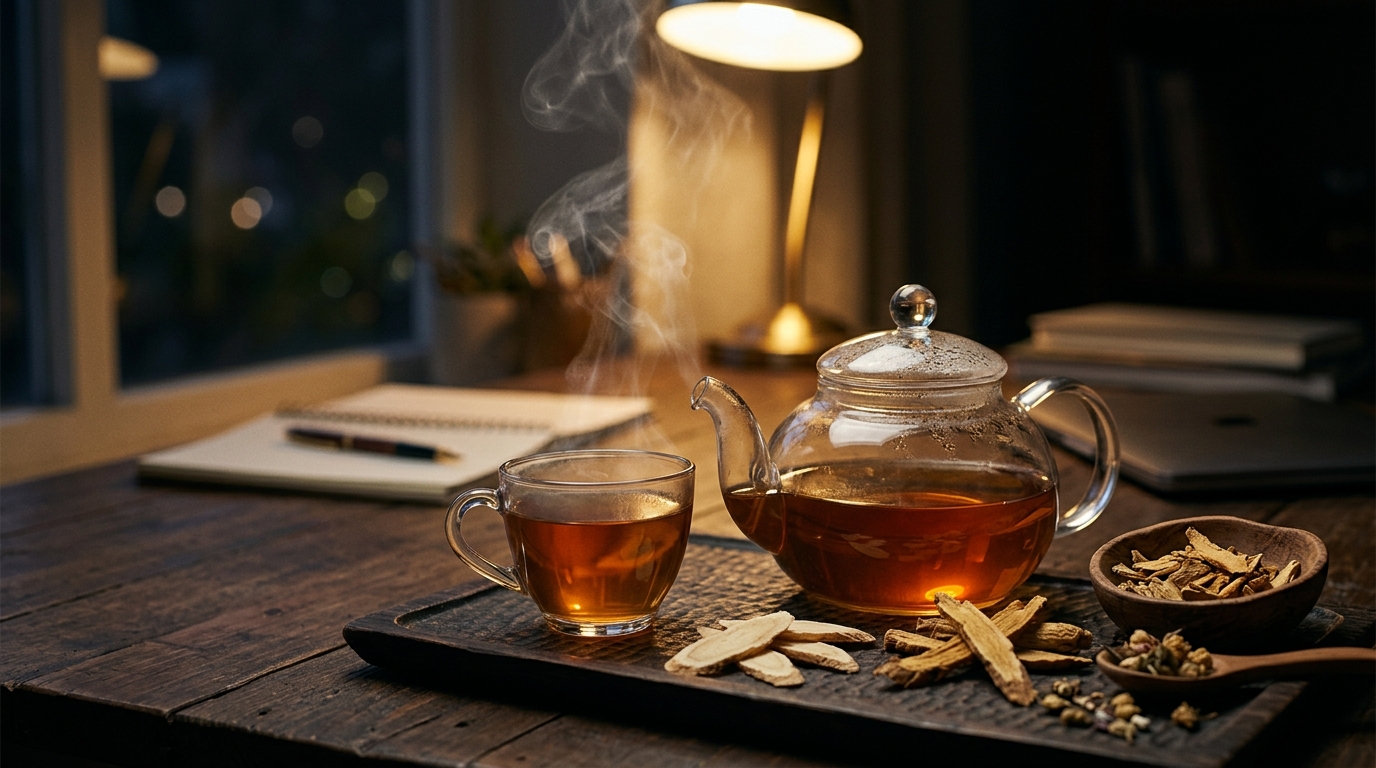
Both roots are tough, woody materials, which means this is not a delicate tea. The flavor is deeply earthy with a faint rose-like note from the rhodiola and a lingering, slightly bittersweet finish from the ginseng. Because neither herb contains caffeine, this blend suits the late shift well, offering alertness support without the sleep disruption that a strong black tea or coffee can cause once the clock passes midnight.
2
cups
Ingredients
- 1 tspdried rhodiola root, cut and sifted
- 1 tspdried Asian ginseng root, sliced or cut
- 480 mlwater (95°C / 203°F)
- —raw honey or a slice of fresh ginger to taste (optional)
- —a thin strip of lemon peel (optional)
How to Brew
Click on an item below to shop for the recommended items for this recipe on Amazon.
As an Amazon Associate, we earn from qualifying purchases.
- Bring fresh filtered water to a full boil, then let it rest for about 30 seconds so it settles near 95°C (203°F).
- Add the rhodiola root and ginseng root to a teapot or large mug with a built-in infuser. Use a roughly equal ratio of the two roots for balance.
- Pour the hot water over the roots and cover the vessel immediately with a lid or saucer to trap the aromatic compounds.
- Steep for 10 to 15 minutes. Start tasting at 10 minutes; longer steeping increases earthiness and bitterness, which some drinkers prefer.
- Strain into cups. If desired, stir in a little honey or add a strip of lemon peel to round out the earthy edges.
- The roots can be re-steeped once for a milder second cup, extending the steep time to about 15 to 18 minutes.
- Add 2 tablespoons of the rhodiola and ginseng root blend (equal parts) to a clean glass jar.
- Pour in 1 liter of cold filtered water and stir gently so all the root pieces are submerged.
- Seal the jar and place it in the refrigerator. Steep for 10 to 12 hours, ideally overnight so it is ready before your shift.
- Strain through a fine mesh strainer or a coffee filter into a clean bottle or pitcher, pressing the roots lightly to release extra liquid.
- Serve over ice, or pour into an insulated bottle to carry to work. Consume within 48 hours and keep refrigerated.
- Add 1 teaspoon of rhodiola root and 1 teaspoon of ginseng root to a small saucepan with 500 ml of cold filtered water.
- Bring the pot slowly to a boil over medium heat, then immediately reduce to the lowest heat for a gentle simmer.
- Partially cover the pot and simmer for 20 to 25 minutes, allowing the liquid to reduce slightly and darken to a rich amber.
- Remove from the heat and let the decoction rest, covered, for 5 minutes to deepen the flavor.
- Strain through a fine mesh sieve into a mug, pressing the roots to extract every bit of liquid.
- Sip slowly. Because decoction is concentrated, many people dilute it with a splash of hot water or enjoy a smaller cup.
Health Benefits
Several clinical trials, including studies on stress-related fatigue and on night-duty physicians, found that rhodiola extract improved measures of fatigue and mental performance. Results vary by dose and preparation, but the evidence is among the stronger for adaptogens.
Ginseng has been shown in small human studies to modestly improve working memory and reaction time, while rhodiola may help maintain attention under pressure. Together they are traditionally used to keep the mind clear during demanding hours.
Both herbs are classified as adaptogens and appear to modulate the hypothalamic-pituitary-adrenal axis, the body’s central stress system. This may help reduce the feeling of being frazzled during long or irregular work schedules.
Phenolic compounds in rhodiola and saponins in ginseng demonstrate antioxidant activity in laboratory studies, which may help counter oxidative strain from stress and sleep disruption, though human evidence is still developing.
Because neither root contains caffeine, this tea can lift alertness through adaptogenic pathways rather than direct stimulation, making it a gentler option for those sensitive to caffeine or trying to protect their sleep.
🧪 Key Bioactive Compounds
The Science Behind Rhodiola
The effects of this blend come largely from two families of compounds. Rhodiola’s signature actives are salidroside and rosavin, a group of glycosides that appear to influence how the body responds to stress. Research suggests they may modulate monoamine neurotransmitters such as serotonin and dopamine, and may support cellular energy metabolism, which helps explain the traditional use of rhodiola for stamina and mental endurance.
Ginseng’s key actives are ginsenosides, a diverse class of triterpenoid saponins. Different ginsenosides appear to have different, sometimes opposing, effects: Rg1 tends to be associated with stimulation and alertness, while Rb1 is linked to calming and neuroprotective actions. This internal balance is part of why ginseng is described as an adaptogen rather than a simple stimulant, supporting the body toward equilibrium rather than pushing it in a single direction.
It is worth being honest about the evidence. Rhodiola has a reasonable body of human trials supporting its use for fatigue, though many used standardized extracts rather than tea. Ginseng research is mixed, with some studies showing benefits for cognition and fatigue and others showing little effect. A tea delivers a lower and more variable dose of these compounds than a standardized extract, so it is best viewed as a gentle, ritual-friendly way to include these herbs rather than a guaranteed therapeutic dose.
Brewing Tips
- Choose root material that is cut and sifted or sliced rather than powdered, which makes straining easier and produces a cleaner cup.
- Taste your first cup at the shorter end of the steep time, since the earthy bitterness builds quickly and personal preference varies widely.
- Prepare a batch of cold brew before your shift and carry it in an insulated bottle so you can sip steadily through the night without reheating.
- Drink this tea at the start of your shift rather than the end, and avoid it within a few hours of the sleep you are trying to protect.
- Look for rhodiola labeled Rhodiola rosea specifically, as other rhodiola species lack rosavin and may not match the traditional herb.