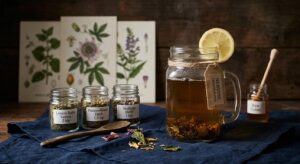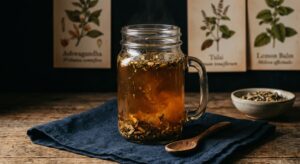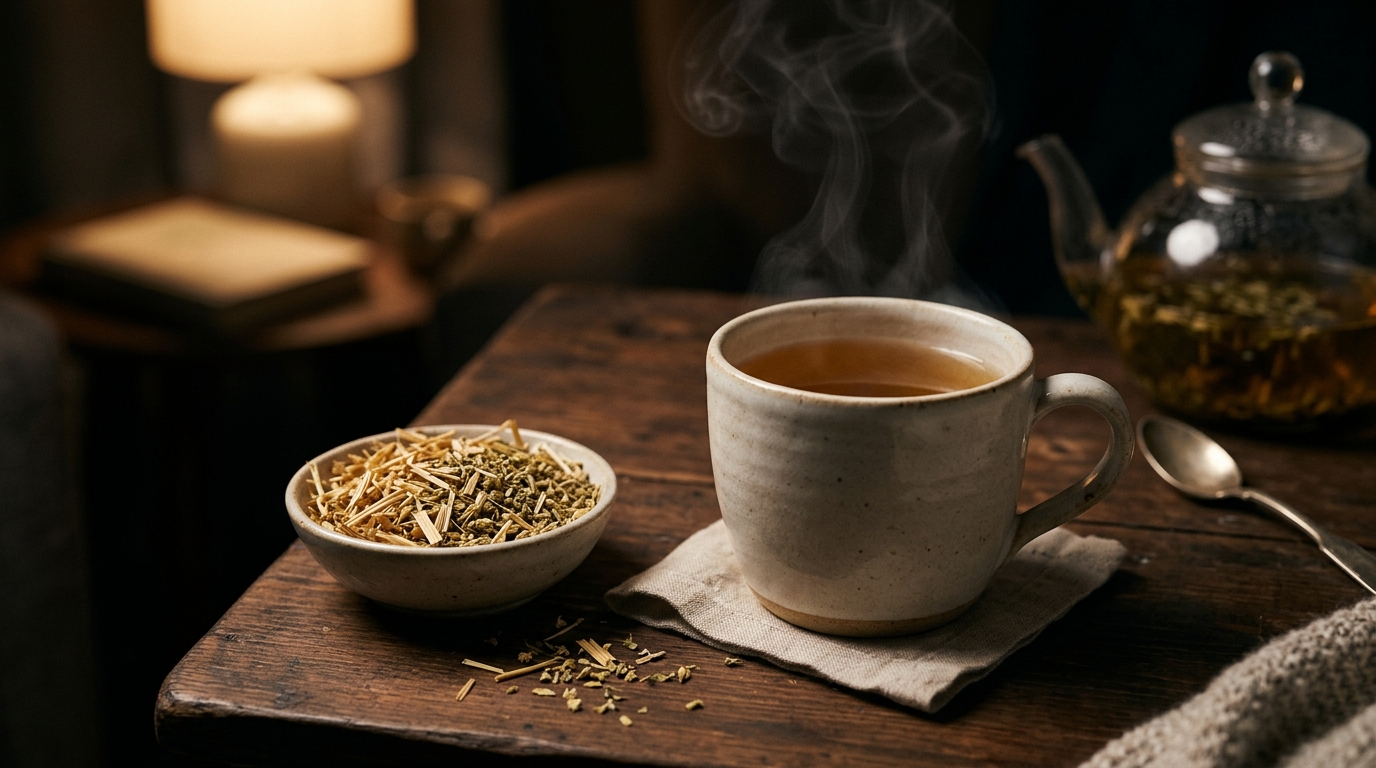
Skullcap (Scutellaria lateriflora) earned its place in Western herbal medicine in the 1700s, when American physicians and Eclectic practitioners prescribed it for nervous tension, restlessness, and what they called “nervous exhaustion.” It was even used for a time as a rabies remedy, which is how it picked up the folk name “mad-dog skullcap.” Today herbalists reach for it as a trophorestorative nervine, an herb said to calm the nervous system while gently supporting it rather than simply knocking it out.
Oat straw (Avena sativa) is the green, flowering tops and stalks of the oat plant, harvested before the grain fully ripens. Where skullcap quiets the mental chatter, oat straw is the nourishing partner. Traditional herbalists have long relied on it for people who feel wrung out, thin-nerved, and over-stimulated, and its mineral-rich, hay-like infusion has been a staple of nervous system tonics for generations.
Brewed together, the two herbs make a soft, pale, grassy tea with a faint bitterness balanced by a sweet, cereal-like roundness. It is a tea built for the last hour of the day: no stimulants, no sharp flavors, just a warm, steady cup that invites you to put down the phone and let your shoulders drop.
2
cups
Ingredients
- 2 tspdried skullcap (aerial parts)
- 2 tbspdried oat straw (milky oat tops, cut and sifted)
- 480 mlwater (95°C / 203°F)
- —raw honey to taste (optional)
- —a strip of lemon peel (optional)
How to Brew
Click on an item below to shop for the recommended items for this recipe on Amazon.
As an Amazon Associate, we earn from qualifying purchases.
- Bring fresh water to a full boil, then let it rest for about a minute so it settles near 95°C (203°F).
- Combine the skullcap and oat straw in a teapot or French press. Oat straw is bulky, so use a roomy vessel rather than a small infuser.
- Pour the hot water over the herbs, cover immediately, and steep for 10 to 15 minutes. The longer end of the range pulls more minerals from the oat straw and gives a stronger, more nourishing cup.
- Strain into two mugs, pressing the herbs gently to release the liquid trapped in the oat straw.
- Sweeten with a little raw honey if the bitterness is stronger than you like, and add a strip of lemon peel for brightness. Sip slowly about 30 to 60 minutes before bed.
- Add the skullcap and oat straw to a large glass jar. Use the same herb quantities as the hot method, but increase the water to 700 ml so the bulky oat straw can float freely.
- Pour cold, filtered water over the herbs and stir gently so everything is submerged.
- Cover the jar and refrigerate for 6 to 8 hours, or overnight. Avoid going much past 8 hours, since skullcap can turn noticeably more bitter and grassy.
- Strain through a fine mesh sieve or a layer of muslin, pressing lightly on the herbs.
- Serve over ice with a squeeze of lemon, or pour a glass in the late afternoon as a gentle wind-down drink. Keep refrigerated and drink within 24 hours.
- Place 4 tablespoons of oat straw and 2 teaspoons of skullcap in a quart-sized (1 liter) heatproof glass jar.
- Pour boiling water to within a couple of centimeters of the top, stir once, and screw the lid on tightly.
- Let the jar sit on the counter for at least 4 hours, or leave it overnight for 8 hours. The liquid will turn a deep golden brown as the minerals and mucilage release.
- Strain well, squeezing the herbs to extract the thick, slightly viscous liquid.
- Drink one cup gently reheated in the evening, and refrigerate the rest for the next day. This stronger brew is best sipped slowly, ideally without sweetener, to appreciate its full-bodied, almost broth-like character.
Health Benefits
Skullcap’s flavonoids, particularly baicalin and wogonin, appear to modulate GABA receptors, and small human and animal studies suggest mild anxiolytic effects without significant sedation.
By quieting an overactive mind and relaxing physical tension, this blend can make it easier to fall asleep, though it works as a gentle wind-down aid rather than a sedative.
Oat straw has a long traditional use as a nervous system tonic, and early research on oat extracts suggests possible benefits for attention and mood, though evidence for the tea itself is still limited.
A small clinical study found that skullcap extract improved self-reported mood without reducing alertness, which supports its traditional role as a calming but non-drowsy nervine.
A long-steeped oat straw infusion extracts calcium, magnesium, and silica, minerals involved in normal muscle and nerve function.
🧪 Key Bioactive Compounds
The Science Behind Skullcap
Skullcap’s calming reputation rests largely on its flavonoids, especially baicalin, baicalein, scutellarin, and wogonin. Laboratory and animal studies show these compounds can bind to benzodiazepine-like sites on GABA-A receptors, the same inhibitory system targeted by many anti-anxiety medications, though far more gently. A small, placebo-controlled human trial of Scutellaria lateriflora reported improved mood without a loss of energy or cognition, but larger trials are still needed.
Oat straw contributes a different kind of support. Its tops contain avenanthramides, saponins, and a notable mineral load, along with beta-glucan that gives long infusions their slightly slippery texture. Research on green oat extracts has pointed toward modest improvements in attention and cognitive performance, possibly through effects on brain blood flow and enzyme activity, though most studies use concentrated extracts rather than tea.
It is worth being honest about the evidence: most data on these herbs comes from animal studies, small human trials, and centuries of traditional use rather than large clinical trials. As a tea, the effects are subtle and cumulative. Many people find the ritual itself, a warm cup, a quiet pause, and a predictable evening signal, is as meaningful as the chemistry.
Brewing Tips
- Buy skullcap and oat straw from a trusted herb supplier and look for the botanical name Scutellaria lateriflora on the label to avoid adulterated products.
- Oat straw is bulky, so use a teapot, French press, or large jar instead of a small tea ball so the herbs have room to expand.
- Start with a single cup in the evening for a week or two and notice how you feel before making it a nightly habit.
- Steep covered and for a full 10 minutes or more; shorter steeping under-extracts both the minerals and the calming flavonoids.
- Store dried herbs in airtight glass jars away from light and heat, and use within a year for best potency.