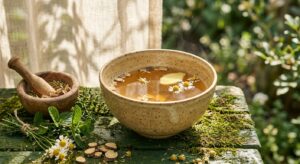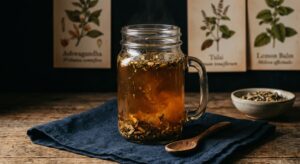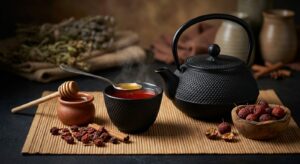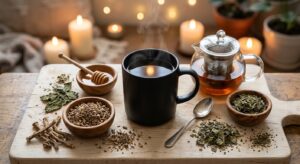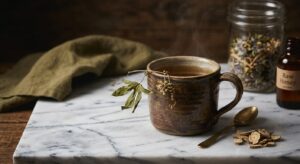
In India, holy basil (Ocimum tenuiflorum, also called Ocimum sanctum) is not just a herb, it is a living goddess. Known as tulsi, meaning “the incomparable one,” it has been grown in courtyards and temple gardens for more than three thousand years. Many Hindu households keep a tulsi plant at the center of the home, tend it daily, and offer it prayers at dawn and dusk. In Ayurveda, the traditional medicine of India, tulsi is called the “Queen of Herbs” and is prized as a rasayana, a tonic believed to promote longevity and balance the mind and body.
What makes tulsi special among herbal teas is its classification as an adaptogen, a plant traditionally used to help the body respond to physical and mental stress. Where mint wakes you up and chamomile sedates, holy basil sits somewhere in the middle: it tends to leave you feeling calm yet clear-headed. Ayurvedic practitioners have long recommended it for frazzled nerves, a restless mind, and the tension that builds up through a demanding day.
The tea itself is a sensory pleasure. Brewed from the dried leaves and flowering tops, it carries a warm, clove-like spiciness with peppery, minty, and faintly sweet notes, quite unlike the Italian basil in your pasta sauce. Stirred with a little raw honey, it becomes a soothing evening ritual that takes five minutes to make. That small pause, the steam, the scent, the slow sipping, is part of the medicine.
1
cups
Ingredients
- 2 tspdried holy basil (tulsi) leaves
- 240 mlwater (95°C / 203°F)
- 1 tspraw honey, or to taste
- —a thin slice of fresh ginger or a squeeze of lemon (optional)
How to Brew
Click on an item below to shop for the recommended items for this recipe on Amazon.
As an Amazon Associate, we earn from qualifying purchases.
- Bring fresh, filtered water to a boil, then let it rest for about 30 seconds so it sits near 95°C (203°F). Fully boiling water can flatten the delicate aromatics.
- Place 2 teaspoons of dried tulsi leaves in a tea infuser or directly into your mug. Gently rub the leaves between your fingers first to release their oils.
- Pour the hot water over the leaves and immediately cover the mug with a small saucer or lid to trap the volatile oils.
- Steep for 5 to 7 minutes. Closer to 5 gives a lighter, sweeter cup, while 7 brings out the peppery, clove-like depth.
- Remove the infuser or strain out the leaves. Let the tea cool for a minute or two until comfortably warm, then stir in 1 teaspoon of raw honey.
- Sip slowly, ideally an hour or so before bed, away from screens.
- Add 3 tablespoons of dried tulsi leaves to a clean 1-liter glass jar. Cold extraction is gentler, so you need a slightly higher leaf-to-water ratio than hot brewing.
- Pour in 1 liter of cold, filtered water and stir gently so all the leaves are wet.
- Seal the jar and refrigerate for 8 to 12 hours, or overnight.
- Strain through a fine mesh sieve or a cloth-lined strainer into a clean pitcher, pressing the leaves lightly to extract the last of the liquid.
- Serve over ice, or pour a glass and stir in a teaspoon of honey. Because honey dissolves poorly in cold liquid, first mix it with a splash of warm water to make a thin syrup, then stir that in.
- Store in the refrigerator and drink within 48 hours for the freshest flavor.
- Heat 500 ml of water to about 95°C (203°F).
- Add 3 tablespoons of dried tulsi leaves to a heatproof pitcher or jar and pour the hot water over them. This makes a concentrate, roughly twice the strength of a normal cup.
- Cover and steep for 10 minutes, then strain out the leaves.
- While the concentrate is still warm, stir in 1 to 2 tablespoons of raw honey until fully dissolved. Honey blends far better into warm tea than cold.
- Fill two tall glasses with ice and pour the warm concentrate over the ice. The ice dilutes it to the perfect drinking strength.
- Garnish with a lemon wheel, a sprig of fresh mint, or a few fresh tulsi leaves and serve right away.
Health Benefits
As an adaptogen, tulsi is thought to help modulate cortisol, the body’s primary stress hormone. Small human trials have reported lower self-reported stress and improved mood with regular use, though larger studies are still needed.
Several small clinical studies using tulsi extract found reductions in anxiety, depression, and stress scores over several weeks. The warm ritual of sipping the tea likely adds to the calming effect.
Unlike strongly sedating herbs, tulsi tends to calm the nervous system while leaving the mind alert, making it a useful evening wind-down tea that does not cause grogginess.
Tulsi is rich in polyphenols such as rosmarinic acid and orientin, which help neutralize free radicals and may support overall cellular health.
Traditionally taken after meals in India, tulsi’s warming, carminative qualities may help ease bloating and mild digestive discomfort, which often accompany stress.
🧪 Key Bioactive Compounds
The Science Behind Holy Basil
Tulsi’s reputation as an adaptogen rests on a rich mix of bioactive compounds, including phenolic acids, flavonoids, terpenoids, and essential oils. Eugenol, the compound that gives clove its signature scent, makes up a large share of tulsi’s volatile oil, while rosmarinic acid and ursolic acid contribute strong antioxidant and anti-inflammatory activity. Together, these compounds are believed to help the body cope with physical, chemical, and emotional stressors.
Animal studies suggest tulsi may help regulate the hypothalamic-pituitary-adrenal (HPA) axis, the system that controls the release of cortisol. In small human trials, participants taking tulsi extract reported meaningful reductions in stress, anxiety, forgetfulness, and sleep problems compared with placebo over four to six weeks. It is worth noting that most of these studies used concentrated extracts rather than tea, so the effects of a daily cup are likely gentler and more cumulative.
Flavonoids such as apigenin and aromatic terpenes like linalool may add to the calming effect by interacting with relaxation pathways in the nervous system. While more large-scale, high-quality human research is needed, tulsi’s long history of traditional use and encouraging early findings make it a thoughtful, low-risk addition to an evening routine for most healthy adults.
Brewing Tips
- Cover your mug while steeping. Tulsi’s aromatic oils evaporate quickly, and a lid or saucer keeps them in your cup instead of the air.
- Add honey after the tea has cooled slightly. Very hot water can degrade honey’s delicate enzymes and aromatic compounds.
- Choose whole-leaf, organic tulsi when you can. Look for Rama (green), Krishna (purple), or Vana varieties, each with a slightly different flavor, and store dried leaves in an airtight, light-proof container for up to a year.
- Make it a ritual. Brew at the same time each evening, put your phone down, and breathe in the steam before the first sip. The consistency is part of how the tea works.