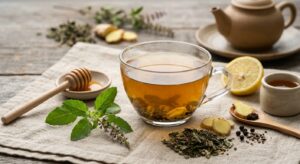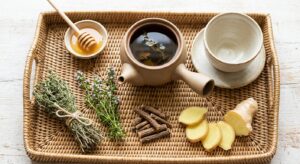
Few herbal partnerships have a longer pedigree than licorice and thyme. Licorice root was found among the treasures in Tutankhamun’s tomb, and Egyptian, Greek, and Chinese healers all prized it as a remedy for the chest and throat. The Greek physician Theophrastus recommended it for coughs and asthma, and in Traditional Chinese Medicine it is known as gan cao, the great harmonizer, added to formulas to soften harsh flavors and carry other herbs where they need to go.
Thyme has an equally storied place in the herbal medicine chest. The ancient Greeks burned it as incense and used it for courage, while medieval European herbalists brewed it for whooping cough and chest congestion. Today, thyme remains one of the best-studied cough herbs in Europe, where standardized thyme extracts are licensed for use in bronchitis and productive coughs. Its leaves hold volatile oils that relax airway muscle and help the body move mucus along.
Together, the two herbs make a nighttime ritual worth keeping. Licorice brings a deep, honeyed sweetness and a soothing, coating quality that calms a scratchy throat. Thyme adds a warm, savory, resinous note that opens the airways and clears the head. Sipped slowly before bed, the blend is as comforting to the senses as it is helpful to the body, easing the dry, tickling cough that tends to flare when you lie down.
2
cups
Ingredients
- 1 tbspdried licorice root, chopped or cut
- 2 tspdried thyme leaves
- 480 mlwater (95°C / 203°F)
- —raw honey to taste (optional)
- —a thin slice of fresh lemon (optional)
How to Brew
Click on an item below to shop for the recommended items for this recipe on Amazon.
As an Amazon Associate, we earn from qualifying purchases.
- Measure the licorice root and thyme into a teapot or a large mug fitted with a fine mesh infuser. Gently crush the thyme leaves between your fingers first to release their volatile oils.
- Heat fresh water until it just comes off the boil, then pour it over the herbs. Licorice root is dense and woody, so it needs very hot water to give up its sweet compounds.
- Cover the vessel immediately with a saucer or lid. This traps the aromatic thyme oils that would otherwise escape with the steam, and those oils are a large part of the tea’s soothing effect.
- Steep for 8 to 10 minutes. Because licorice sweetens as it steeps, taste at the 8 minute mark and continue if you would like a richer cup.
- Strain into two cups. Add a spoonful of honey and a squeeze of lemon if desired, then sip slowly while the tea is still warm and the steam can reach your airways.
- Combine 1 tablespoon of licorice root and 2 teaspoons of thyme in a clean glass jar. Pour in 500 ml of cold, filtered water and stir well so the herbs are fully submerged.
- Seal the jar and refrigerate for 8 to 12 hours, ideally overnight. Give it a gentle shake once or twice if you remember.
- Strain through a fine mesh sieve or a coffee filter to remove all the small particles of root and leaf.
- Pour over a glass of ice or enjoy cool straight from the jar. For a throat-soothing sipper, stir in a teaspoon of honey and a few drops of lemon juice.
- Store any remaining tea in the refrigerator and drink within 48 hours for best flavor and freshness.
- Add 1 tablespoon of chopped licorice root to a small saucepan with 500 ml of cold water. Starting with cold water allows the root to release its compounds gradually.
- Bring to a gentle simmer over medium-low heat, then reduce the heat, partially cover, and simmer for 15 minutes. The liquid will darken and turn noticeably sweet.
- Remove the pan from the heat and add 2 teaspoons of thyme. Cover at once and let it steep for 5 minutes, which preserves the volatile oils.
- Strain through a fine sieve into a warmed mug, pressing lightly on the herbs to extract every drop.
- Sweeten with honey if you like and drink warm. This is the strongest version of the tea, ideal for a stubborn, deep-seated cough.
Health Benefits
Licorice root is a classic demulcent, forming a soft, protective layer over irritated mucous membranes. Its glycyrrhizin also has anti-inflammatory activity, and licorice-based gargles and lozenges have been studied for easing sore throat pain.
Thyme is licensed in Europe as an expectorant, and clinical studies on thyme extracts show they reduce cough frequency and help clear mucus in acute bronchitis. Licorice supports this by encouraging the thinning and movement of secretions.
Thymol and flavonoids such as luteolin have shown antispasmodic effects on bronchial smooth muscle in laboratory research, which may explain why thyme eases the tight, spasmodic quality of some coughs.
Thymol and carvacrol are among the most active antimicrobial compounds in common culinary herbs, showing effects against many respiratory pathogens in lab studies, though this does not replace medical treatment for infection.
Both herbs are rich in anti-inflammatory flavonoids and phenolic acids, which may help reduce the swelling and irritation that keep a cough going, especially at night.
🧪 Key Bioactive Compounds
The Science Behind Licorice
The effectiveness of this blend rests on two very different groups of compounds. Licorice is dominated by glycyrrhizin and a family of flavonoids including liquiritin and isoliquiritigenin. Glycyrrhizin is roughly 50 times sweeter than sugar and acts as a demulcent, while research suggests it has anti-inflammatory and antiviral properties, partly by modulating inflammatory signaling in tissues. The flavonoids add antioxidant and mild cough-suppressing activity.
Thyme, by contrast, is valued for its volatile oil, which can be up to 60 percent thymol and carvacrol depending on the variety. These phenolic compounds disrupt the cell membranes of bacteria and fungi in laboratory studies, and they appear to relax the smooth muscle lining the bronchi. Clinical trials of thyme preparations, often combined with ivy or primrose, have reported meaningful reductions in cough severity and duration in people with acute bronchitis, and thyme is recognized by the European Medicines Agency for the traditional treatment of productive cough.
It is worth being clear about the limits of the evidence. Much of the data on thymol and carvacrol comes from test-tube studies, and the human trials often use concentrated extracts rather than tea. A cup of licorice and thyme tea is best understood as a comforting, supportive remedy: the warm liquid, the steam, the coating action of licorice, and the aromatic oils of thyme all work together to ease symptoms, even if the tea is gentler than a standardized extract.
Brewing Tips
- Always cover your cup or teapot while steeping so the volatile thyme oils stay in the tea instead of drifting away with the steam.
- Choose cut and sifted licorice root rather than powder, which turns the tea cloudy and can make it overly sweet and difficult to strain.
- Breathe in the rising steam for a few moments before you take your first sip, as the warm aromatic vapor helps loosen congestion.
- Keep an eye on your licorice intake and take regular breaks, since the glycyrrhizin in the root is meant for short-term rather than daily long-term use.