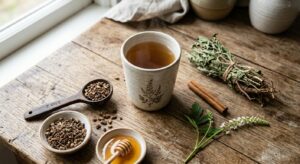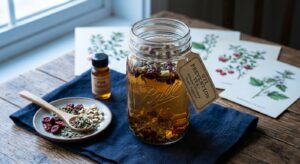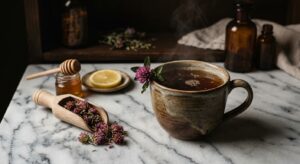
The luteal phase, the 12 to 16 days between ovulation and menstruation, is when progesterone rises and then falls sharply, triggering the familiar cascade of PMS symptoms that affect an estimated 75 percent of menstruating people. For centuries, herbalists across Europe, Asia, and the Americas have reached for specific plants during this phase, not to override the body’s natural rhythms, but to support them. Red raspberry leaf was brewed by midwives throughout the British Isles to tone the uterine muscles. Vitex agnus-castus, also called chaste tree berry, was grown in ancient Greek temple gardens and used by Hippocrates to regulate the female cycle. Lemon balm was treasured by medieval apothecaries who described it as a remedy for a troubled heart, one of the earliest recorded treatments for what we now call mood-related PMS.
What makes a luteal phase tea different from a general wellness blend is its specificity. Each herb is chosen to address a distinct hormonal or physiological mechanism. Raspberry leaf provides the astringent tannins and fragarine alkaloid that support uterine tone and reduce cramping. Vitex works upstream at the level of the pituitary gland, gently nudging the body toward better progesterone-to-estrogen balance. Lemon balm calms the nervous system through its action on GABA receptors, easing anxiety, irritability, and insomnia. Chamomile rounds out the blend with its anti-spasmodic and anti-inflammatory properties, soothing both the digestive discomfort and the emotional restlessness that are hallmarks of the late luteal phase.
This blend is designed to be sipped daily from ovulation through the first day of menstruation, making it a gentle, ritual form of cyclical self-care. Whether you are drawn to plant medicine for its tradition, its science, or simply the comfort of a warm cup on a difficult evening, this tea meets you exactly where you are. The flavour is a lovely combination of earthy, slightly tart, and subtly floral, grounded by the berry-like warmth of vitex and brightened by the citrus lift of lemon balm.
2
cups
Ingredients
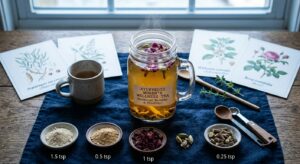
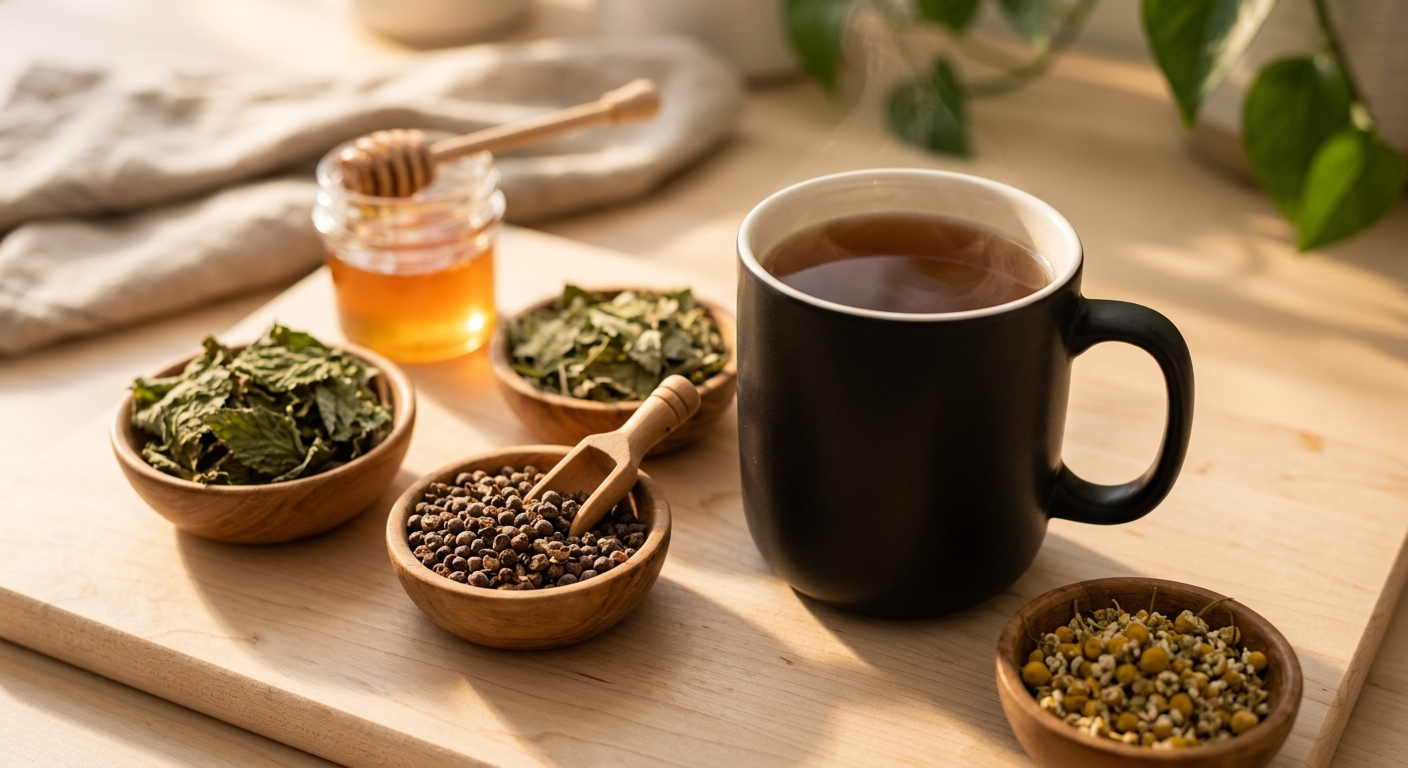
- 2 tspdried red raspberry leaf
- 1 tspdried vitex (chaste tree) berries, lightly crushed
- 1 tspdried lemon balm leaf
- 1 tspdried chamomile flowers
- 480 mlwater (95°C / 203°F)
- —raw honey to taste (optional)
- —a thin slice of fresh lemon (optional)
How to Brew
Click on an item below to shop for the recommended items for this recipe on Amazon.
As an Amazon Associate, we earn from qualifying purchases.
- Lightly crush the dried vitex berries using a mortar and pestle or the back of a spoon. This cracks the hard outer shell and significantly improves the extraction of the active compounds into the water.
- Measure 2 teaspoons of dried raspberry leaf, 1 teaspoon of crushed vitex berries, 1 teaspoon of lemon balm, and 1 teaspoon of chamomile flowers into a tea infuser or tea filter bag. Place the infuser inside a prewarmed teapot or large mug.
- Heat filtered water to 95°C (203°F). If you do not have a temperature-controlled kettle, bring water to a full boil then let it rest for 60 to 90 seconds before pouring.
- Pour 480 ml of hot water over the infuser. Cover the mug or teapot with a lid, saucer, or small plate to trap the volatile aromatic oils, especially those from the lemon balm and chamomile.
- Steep for 7 to 10 minutes. A 7-minute steep produces a lighter, more floral cup. A full 10-minute steep gives a deeper, more tannic, more therapeutically concentrated brew.
- Remove the infuser, add honey or a squeeze of lemon if desired, and sip slowly. Aim for 1 to 2 cups daily throughout the luteal phase, ideally in the evening.
- Lightly crush the dried vitex berries as with the hot brew method. Cold water is less efficient at extracting the hard berry compounds, so crushing them is especially important here.
- Add 2 teaspoons of raspberry leaf, 1 teaspoon of crushed vitex berries, 1 teaspoon of lemon balm, and 1 teaspoon of chamomile flowers to a glass jar. Do not use a metal container, as the tannins in raspberry leaf can react with some metals over a long steep.
- Pour 480 ml of cold, filtered water over the herbs. Stir gently to ensure all the plant material is submerged. If any herbs float persistently to the surface, place a small heatproof plate or glass weight over them.
- Cover the jar tightly with a lid and leave at room temperature for the first 2 hours, then transfer to the refrigerator and continue steeping for a further 6 to 10 hours, or overnight.
- When ready, strain the tea through a fine mesh strainer or cheesecloth into a clean glass, pressing the herbs gently to extract the last of the liquid. Discard or compost the spent herbs.
- Drink cold as-is, or allow it to come to room temperature before drinking. Add a few ice cubes, a drizzle of honey dissolved in a small amount of warm water, or a sprig of fresh mint for extra brightness. The cold brew keeps in the refrigerator for up to 24 hours.
- Double the herb quantities: use 4 teaspoons of red raspberry leaf, 2 teaspoons of crushed vitex berries, 2 teaspoons of lemon balm, and 2 teaspoons of chamomile flowers. Place them directly into a small saucepan or heatproof bowl rather than an infuser, to allow maximum surface area contact with the water.
- Pour 480 ml of water heated to 95°C (203°F) over the herbs. This double-strength ratio will ultimately yield a concentrate that is diluted 1:1 before drinking, resulting in the same herb-per-serving ratio as the standard hot brew.
- Cover the saucepan or bowl tightly with a lid and steep for 15 to 20 minutes. The extended steep time and larger herb quantity together create a deeply extracted, rich concentrate. Avoid simmering or boiling during this stage.
- Strain the concentrate through a fine mesh strainer lined with cheesecloth into a clean glass jar with a tight-fitting lid, pressing the herbs firmly to extract as much liquid as possible. You should end up with approximately 400 ml of concentrate after the herbs absorb some liquid.
- Allow the concentrate to cool to room temperature, then seal and refrigerate. Label the jar with the date. The concentrate keeps for up to 4 days in the refrigerator.
- To serve, combine equal parts concentrate and hot water (or warm oat milk for a creamier, more comforting drink). Sweeten with honey or a splash of tart cherry juice, which adds additional anti-inflammatory proanthocyanidins. One serving equals roughly 100 ml of concentrate diluted with 100 ml of liquid.
Health Benefits
Red raspberry leaf’s fragarine alkaloid tones uterine smooth muscle while its ellagitannins reduce prostaglandin-driven inflammation, a combination supported by traditional midwifery practice and preliminary clinical observations. This dual action helps reduce both the intensity of cramps and the duration of pelvic heaviness in the days before menstruation begins.
Vitex agnus-castus has been studied in multiple randomized controlled trials showing significant reductions in PMS symptom scores, with researchers attributing the effect to agnuside’s dopaminergic activity in the pituitary gland, which lowers elevated prolactin and supports the rise in progesterone characteristic of a healthy luteal phase. Regular use over two to three menstrual cycles is typically recommended before full effects are noticed.
Lemon balm’s rosmarinic acid and other volatile compounds have demonstrated anxiolytic effects in randomized clinical trials, with participants reporting reductions in anxiety, restlessness, and mood instability. Combined with chamomile’s apigenin, which binds directly to GABA-A receptors, this blend provides gentle nervous system support precisely when progesterone-driven neurological sensitivity peaks.
Chamomile’s anti-spasmodic flavonoids relax the smooth muscle of the gastrointestinal tract, reducing the bloating, cramping, and sluggish digestion that many people experience in the luteal phase due to progesterone’s overall slowing effect on gut motility. Lemon balm contributes carminative properties that further ease gas and abdominal tension.
The combination of lemon balm and chamomile has been studied specifically for its effect on insomnia and sleep-onset difficulties, with rosmarinic acid and apigenin working synergistically to reduce the time taken to fall asleep and increase slow-wave sleep duration. Since cortisol dysregulation and oestrogen fluctuations in the late luteal phase frequently disrupt sleep, this is one of the most practically valued effects of this blend.
🧪 Key Bioactive Compounds
The Science Behind Red Raspberry Leaf
The scientific foundation of this luteal phase tea blend lies in its multi-target approach to the hormonal and neurological cascade of PMS. The most studied compound in the blend is agnuside, the primary iridoid glycoside in vitex berries. Research published in the British Medical Journal and several subsequent meta-analyses has demonstrated that vitex extract significantly reduces the total symptom burden of PMS compared to placebo, with effects observed across irritability, mood depression, headache, bloating, and breast tenderness. The mechanism involves agnuside binding to dopamine D2 receptors in the anterior pituitary, which reduces the secretion of prolactin. Elevated prolactin in the luteal phase is associated with breast tenderness, water retention, and suppression of progesterone production, so normalising it creates a downstream improvement in progesterone availability and symptom severity. This is a genuinely upstream intervention, not just symptomatic relief.
Red raspberry leaf’s fragarine alkaloid acts specifically on uterine smooth muscle through a mechanism that appears to be both tonic and relaxant depending on tissue state, contracting a lax uterus while easing a hyper-contracted one. This dual effect is sometimes described as regulatory rather than stimulating or suppressing. The ellagitannins in raspberry leaf also inhibit the cyclooxygenase (COX) pathway, the same pathway targeted by ibuprofen, which reduces the production of inflammatory prostaglandins, particularly PGF2-alpha, the primary driver of menstrual cramping. While the research on raspberry leaf is still largely observational and traditional rather than from large-scale RCTs, its pharmacological constituents have well-characterised mechanisms that align precisely with its historical use.
Lemon balm and chamomile act primarily on the GABAergic system, the brain’s principal inhibitory neurotransmitter pathway. Rosmarinic acid in lemon balm inhibits GABA transaminase, the enzyme responsible for breaking down GABA in the synaptic cleft, effectively increasing the available concentration of this calming neurotransmitter. Chamomile’s apigenin directly binds to the benzodiazepine site of the GABA-A receptor, producing anxiolytic and mild sedative effects without the dependency risks of pharmaceutical benzodiazepines. A 2017 randomized controlled trial in Phytomedicine demonstrated that long-term chamomile use not only reduced generalised anxiety but also significantly lowered relapse rates, suggesting durable neurochemical effects rather than merely acute sedation. Together, these two herbs provide neurological grounding during the phase of the cycle when oestrogen withdrawal and progesterone-driven GABA sensitivity create the neurological conditions for heightened anxiety, emotional reactivity, and insomnia.
Brewing Tips
- Begin drinking this tea from the day after ovulation, roughly cycle day 15 to 16 for a standard 28-day cycle, and continue through the first day of your period. Consistency over the entire luteal phase produces noticeably better results than drinking it only when symptoms flare.
- Vitex works cumulatively over months rather than days. If you are using this blend primarily for hormonal balancing via vitex, commit to daily use for at least two to three full cycles before assessing its effects. Some people notice meaningful shifts in cycle regularity and PMS severity only after three to four months of consistent use.
- Store your dried herb blend in a sealed, airtight glass jar away from direct light and heat. Pre-mixing a month’s supply saves time and ensures a consistent ratio. The blend stays fresh for up to six months when stored correctly, though the volatile oils in lemon balm begin to fade after four months.