Few herbs carry as much history in their silvery-green leaves as sage. Revered by ancient Greeks, Romans, and medieval European herbalists alike, Salvia officinalis takes its name from the Latin word salvere, meaning “to be saved” or “to be in good health.” For centuries, it was considered so essential to human wellbeing that a 9th-century Carolingian proverb asked, “Why should a man die who grows sage in his garden?” Used in monastic medicine, Indigenous American smudging ceremonies, and Ayurvedic tradition, sage has always occupied a place of quiet authority in plant medicine.
As a tea, sage offers something genuinely distinctive: a bold, resinous warmth that feels both grounding and clarifying. Unlike many calming herbs that simply sedate, sage works with a more nuanced touch, easing nervous tension while simultaneously sharpening cognition. Traditional European herbalists prescribed sage infusions for “weakness of the nerves,” excessive worry, and mental exhaustion, particularly during periods of change or convalescence. This dual action, calming without clouding, makes it especially valuable for those dealing with stress that must coexist with productivity.
What makes sage particularly fascinating is that its traditional reputation has held up remarkably well under scientific scrutiny. Modern research has identified specific compounds in sage that interact with neurotransmitter systems governing mood, memory, and stress response. Whether you grow it fresh on a kitchen windowsill or reach for a jar of dried leaves, sage tea rewards you with a cup that smells of the Mediterranean hillside and tastes of centuries of accumulated wisdom.
2
cups
Ingredients
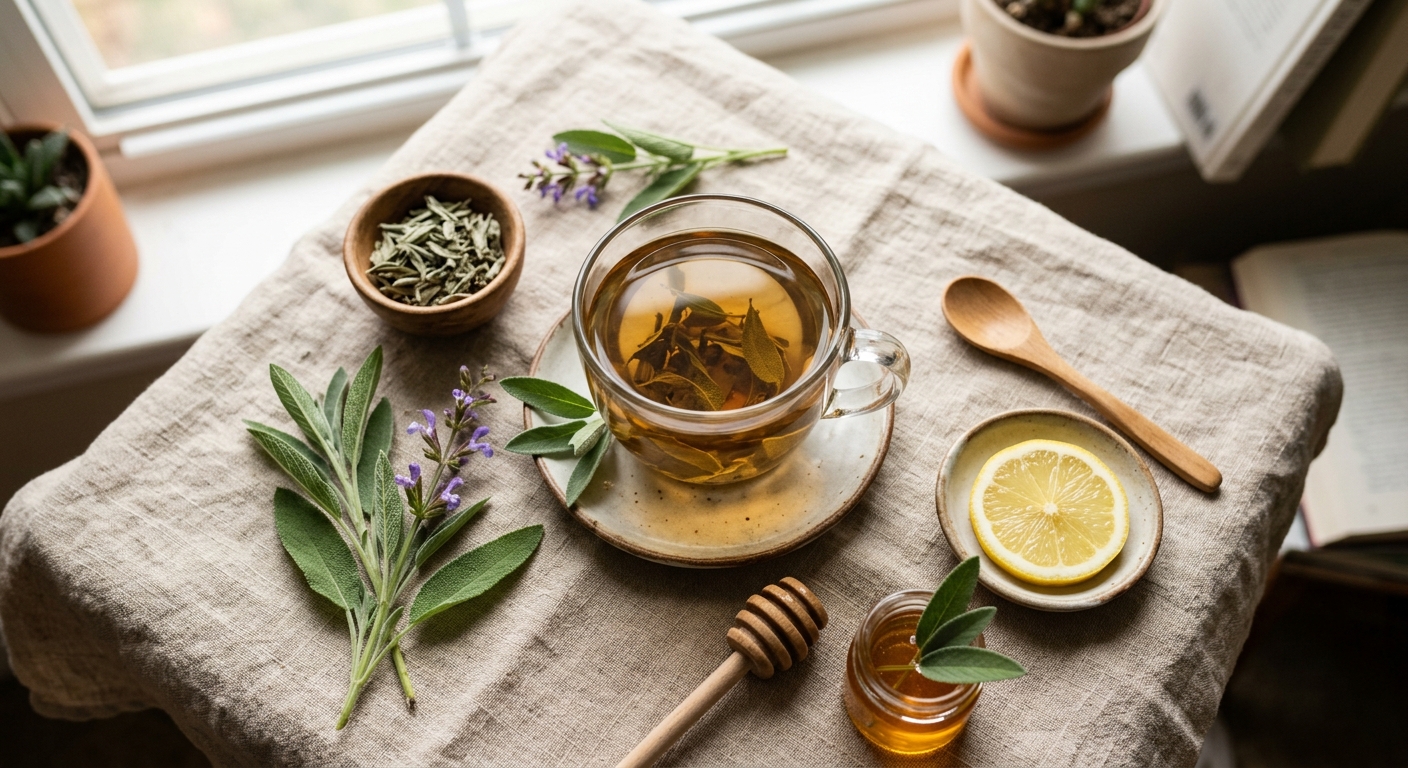
- 2 tspdried sage leaves (or 4 to 6 fresh sage leaves per cup)
- 240 mlwater (90°C / 194°F) per serving
- —raw honey to taste (optional)
- —lemon slice or squeeze of fresh lemon juice (optional)
How to Brew
Click on an item below to shop for the recommended items for this recipe on Amazon.
As an Amazon Associate, we earn from qualifying purchases.
- Heat filtered water to 90 to 95°C (194 to 203°F). If you do not have a temperature-controlled kettle, bring water to a full boil and allow it to rest for 60 to 90 seconds before using.
- Place 2 teaspoons of dried sage leaves, or 4 to 6 whole fresh leaves lightly bruised between your fingers, into a tea infuser or directly into your mug.
- Pour 240 ml of hot water over the sage and cover the mug immediately with a small saucer or lid. This traps the volatile aromatic oils that would otherwise escape with the steam, preserving both flavor and therapeutic compounds.
- Steep for 5 to 7 minutes. Five minutes yields a lighter, more floral cup; 7 minutes produces a bolder, more resinous brew with a pleasantly bitter finish.
- Remove the infuser or strain out the leaves. Add raw honey and a squeeze of fresh lemon if desired. Lemon juice brightens the flavor and adds a dose of vitamin C that helps with absorption of sage’s antioxidants.
- Sip slowly while warm. This tea is best enjoyed mid-morning or early afternoon when you need calm focus, rather than sedation.
- Add 3 teaspoons of dried sage leaves, or 8 to 10 fresh leaves lightly torn to expose more surface area, to a clean glass jar or pitcher. Because cold water extracts compounds more slowly, a slightly higher leaf ratio ensures a flavorful result.
- Pour 500 ml of cold, filtered water over the sage. Avoid warm or hot water entirely, as the goal here is a slow, cool extraction that yields a milder flavor profile.
- Stir the mixture gently to ensure all leaves are submerged, then cover the jar with a lid or stretch of muslin cloth secured with a rubber band to keep it clean.
- Let the jar sit at room temperature for 1 hour to begin extraction, then transfer it to the refrigerator. Allow it to steep for a further 7 to 11 hours, for a total of 8 to 12 hours. Overnight cold brewing is a convenient and reliable approach.
- Strain the infusion through a fine-mesh sieve or cheesecloth into a glass. The resulting liquid should be a delicate pale gold with a soft herbal aroma.
- Serve over ice with a thin slice of lemon, a sprig of fresh mint, or a drizzle of light honey dissolved directly in the cold liquid. Cold brew sage tea keeps well in the refrigerator for up to 2 days.
- Place 4 teaspoons of dried sage leaves, or a generous handful of 10 to 12 fresh whole leaves, into a large, clear glass jar. A wide-mouthed jar works best as it maximizes light exposure through the liquid.
- Fill the jar with 750 ml of cold, filtered water. The clarity of the glass allows sunlight to penetrate and gently warm the infusion throughout the steeping process.
- Seal the jar loosely with its lid or cover with a piece of clean muslin. Place it in a sunny outdoor spot or a sun-facing windowsill where it will receive unobstructed direct sunlight.
- Allow the jar to infuse in the sunlight for 3 to 4 hours. You will notice the water gradually shifting from clear to a warm olive-gold as the sage releases its compounds. The aroma that rises when you lift the lid should be fragrant and herbal, with hints of pine and warm resin.
- Bring the jar indoors once fully brewed. Strain out the sage leaves using a fine-mesh sieve and pour the sun tea into a clean pitcher or directly into glasses filled with ice.
- Taste and adjust with honey or lemon as preferred. Because sun tea is brewed at low temperatures without pasteurization, it should be consumed within a few hours and never left out overnight. Do not use this method on cloudy days or if ambient temperatures are below 24°C (75°F).
Health Benefits
Rosmarinic acid in sage inhibits the breakdown of GABA, the brain’s primary calming neurotransmitter, while luteolin acts on receptor sites associated with anxiety reduction. A 2021 study published in Nutrients found that sage extract significantly reduced anxiety scores in healthy adults within hours of consumption.
The compound 1,8-cineole inhibits acetylcholinesterase, the enzyme responsible for breaking down acetylcholine, a neurotransmitter central to learning and memory consolidation. Multiple clinical studies have demonstrated improved word recall and attention in adults who consumed sage extract or essential oil.
Sage has been shown in double-blind trials to improve self-rated calmness, contentment, and alertness compared to placebo. The combined effect of its volatile oils and polyphenols on the cholinergic and GABAergic systems appears to produce a distinctive state of calm attentiveness rather than drowsiness.
Carnosic acid and rosmarinic acid are both potent free-radical scavengers that specifically protect neural tissue. Chronic psychological stress generates oxidative damage in the brain, and sage’s antioxidant load may help counter this effect over time with regular consumption.
Sage has a long-documented traditional use for symptoms associated with menopause, including mood swings, night sweats, and nervous irritability. Clinical trials have confirmed that sage preparations significantly reduce the frequency and intensity of hot flashes, likely due to its mild estrogenic activity and thermoregulatory effects.
🧪 Key Bioactive Compounds
The Science Behind Sage
The calming and cognitive effects of sage tea are not folk legend but the result of several well-characterized pharmacological mechanisms. The most significant involves rosmarinic acid, a polyphenol abundant in Salvia officinalis that inhibits the enzyme GABA transaminase. This enzyme is responsible for breaking down gamma-aminobutyric acid, the brain’s chief inhibitory neurotransmitter. By slowing this breakdown, rosmarinic acid effectively prolongs GABA’s calming signal, reducing neuronal excitability and producing effects that parallel, in a milder and entirely natural way, the action of some pharmaceutical anxiolytics. Luteolin complements this by binding to allosteric sites on GABA-A receptors, reinforcing the same calming pathway through a slightly different mechanism.
Equally compelling is sage’s impact on the cholinergic system. The volatile monoterpene 1,8-cineole, also known as eucalyptol, is a potent inhibitor of acetylcholinesterase, the enzyme that degrades acetylcholine after it has fired across a synapse. Acetylcholine is fundamental to working memory, sustained attention, and the encoding of new information. By preserving higher levels of this neurotransmitter, sage supports a state of alert, focused calm rather than sedation, which distinguishes it from herbs like valerian or passionflower. This dual action on both GABA and acetylcholine systems is likely responsible for the distinctive quality that clinical trial participants consistently report: feeling calmer and yet simultaneously more mentally clear.
The neuroprotective dimension of sage is driven largely by carnosic acid and ursolic acid, two compounds with strong antioxidant and anti-inflammatory activity concentrated in the leaf tissue. Chronic psychological stress accelerates oxidative damage in the hippocampus and prefrontal cortex, the brain regions most involved in memory and emotional regulation. Carnosic acid is particularly notable because it is a pro-electrophilic compound that only activates its antioxidant properties in response to oxidative stress, making it an unusually targeted neuroprotective agent. Regular moderate consumption of sage tea may therefore offer cumulative protection against the neurological wear that stress imposes over time, supporting not just immediate calm but long-term cognitive resilience.
Brewing Tips
- Always cover your mug while sage steeps. The volatile oils responsible for much of its aroma, flavor, and therapeutic activity escape readily with steam, and a simple saucer placed on top can preserve a meaningful amount of these compounds.
- Fresh sage leaves make a noticeably more aromatic and less bitter cup than dried, especially in the cold brew method. If you have access to a garden or a farmers market, fresh leaves bruised gently before steeping release their oils more readily and yield a rounder, more complex flavor.
- Do not steep sage for longer than 10 minutes in hot water. Extended steeping amplifies the camphor and thujone notes to an unpleasant degree and increases the concentration of compounds that are best consumed in moderate amounts. When in doubt, taste at 5 minutes and decide from there.