Long before modern pharmacology arrived with its bottled solutions to nervous tension, Indigenous peoples of the American Southeast were already steeping passionflower into soothing teas. The Cherokees, Houmas, and other nations used Passiflora incarnata to treat restlessness, inflammation, and what we might today describe as anxiety. Spanish explorers encountering the plant in the 16th century named it the “passion flower” not for romantic passion, but because its intricate floral structure reminded missionaries of the Passion of Christ, with the corona representing the crown of thorns and the five stamens symbolizing wounds. That layered symbolism speaks to something real about this plant: it is quietly extraordinary beneath a beautiful surface.
Passionflower entered European herbalism with remarkable speed, becoming a staple of 19th-century botanical pharmacopeias as a nerve tonic and antispasmodic. Herbalists prescribed it for neuralgia, hysteria, insomnia, and the kind of circular overthinking that makes it impossible to fall asleep. Today, it remains one of the most respected herbs in the Western tradition for anxiety support, and modern clinical research has begun to validate what herbalists observed for generations. Unlike stronger sedative herbs such as valerian, passionflower works with a lighter touch, calming mental chatter without inducing heavy drowsiness, which makes it an ideal companion for anxious afternoons as well as restless nights.
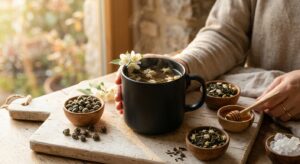
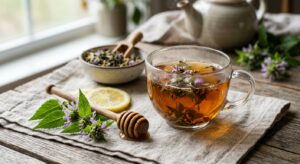
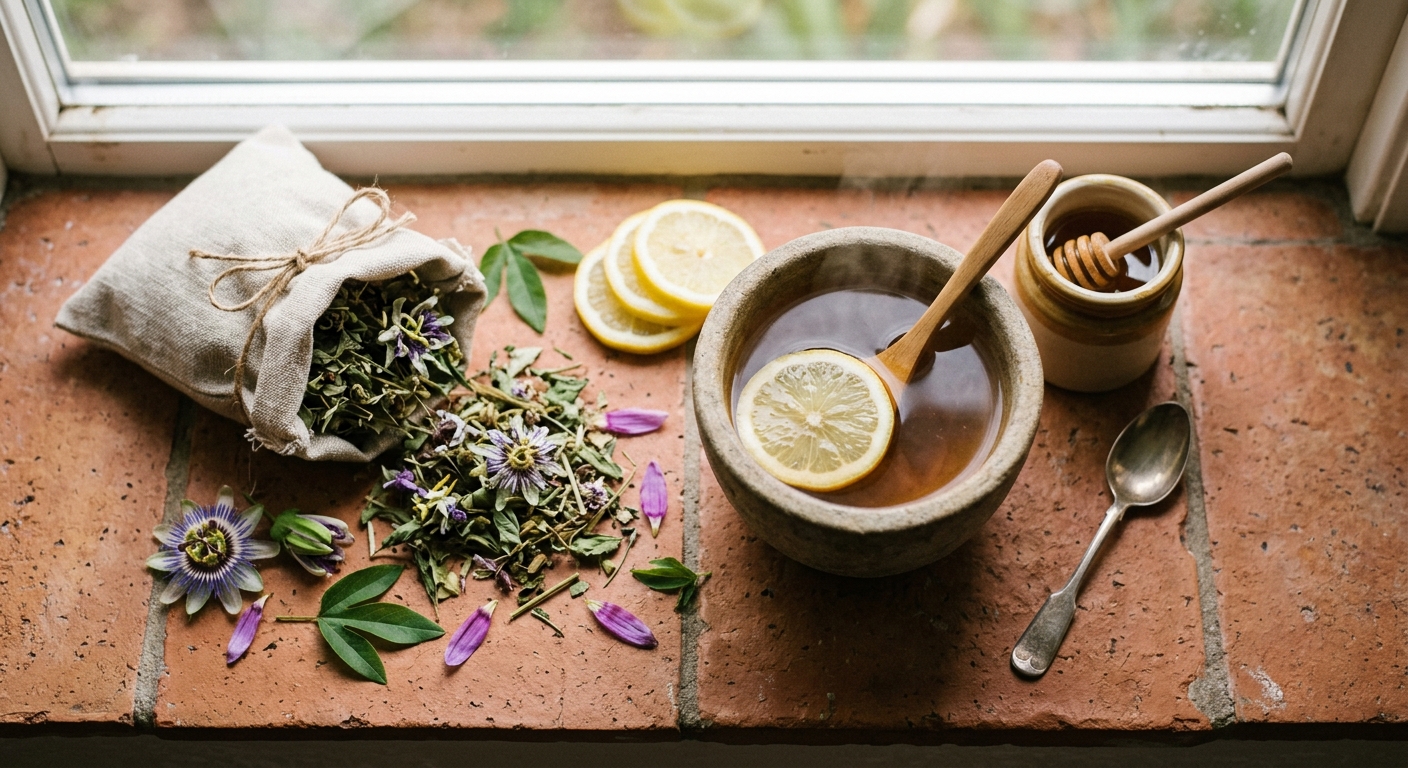
The aerial parts of the plant, including the leaves, tendrils, stems, and flowers, are all used medicinally, and the resulting tea carries a gently grassy, subtly floral character. It brews to a warm amber or pale golden color, and its flavor is mild enough to blend beautifully with lavender, lemon balm, or a drizzle of honey. Whether you are navigating a demanding workday or seeking a pre-sleep ritual, passionflower tea offers something rare: genuine botanical calm in a cup.
2
cups
Ingredients
- 2 tbspdried passionflower herb (leaves, stems, flowers)
- 480 mlwater (85 to 90°C / 185 to 194°F)
- —raw honey or agave to taste (optional)
- —fresh lemon slice for serving (optional)
How to Brew
Click on an item below to shop for the recommended items for this recipe on Amazon.
As an Amazon Associate, we earn from qualifying purchases.
- Heat filtered water to 85 to 90°C (185 to 194°F). Avoid boiling water, as excessive heat can degrade the more volatile aromatic compounds in the flowers and leaves.
- Measure 1 tablespoon of dried passionflower herb per cup (240 ml) and place it into a tea infuser or directly into a teapot. The herb is bulky, so use a roomy infuser or a pot with generous space.
- Pour the hot water slowly over the herb and cover the teapot or mug immediately with a lid or small saucer. Covering traps the volatile aromatic compounds that would otherwise escape with the steam, preserving both flavor and therapeutic value.
- Steep for 10 to 15 minutes. For a milder, afternoon-friendly cup, stop at 10 minutes. For a deeper evening brew aimed at promoting sleep, allow the full 15 minutes.
- Remove the infuser or strain the tea through a fine mesh strainer into your mug. Taste the tea before adding sweetener; the natural earthiness is pleasant on its own, but a small spoonful of raw honey and a squeeze of lemon brighten the flavor considerably.
- Sip slowly in a calm environment, ideally 30 to 60 minutes before bed or during a deliberate rest break in your day.
- Measure 3 tablespoons of dried passionflower herb for every 480 ml of cold, filtered water. Cold brewing requires a higher ratio of herb to water because the lower temperature extracts compounds more slowly and less completely than heat.
- Combine the herb and cold water in a glass jar or pitcher. Stir briefly to ensure all plant material is submerged. If using a jar, seal the lid; if using a pitcher, cover with plastic wrap or a plate to prevent the absorption of refrigerator odors.
- Allow the jar to sit at room temperature for 1 hour, then transfer it to the refrigerator. Cold brew passionflower for a minimum of 8 hours and up to 12 hours. Overnight preparation is ideal for a ready-to-drink morning or midday calm tea.
- When brewing is complete, pour the tea through a fine mesh strainer or nut milk bag into a clean glass or pitcher, pressing gently on the herb to extract the remaining liquid.
- Serve over ice in a tall glass. Add a thin slice of lemon, a few fresh mint leaves, or a small drizzle of honey stirred in while the liquid is at room temperature so it dissolves easily. The cold brew keeps refrigerated for up to 48 hours.
- Measure 3 tablespoons of dried passionflower herb and place it into a clean, large glass jar. Use only glass, as plastic can leach compounds into the tea over prolonged sun exposure.
- Fill the jar with 480 ml of cold, filtered water. Stir gently to saturate all the herb, then seal the jar loosely with its lid to allow slight air circulation while keeping insects out.
- Place the sealed jar in a sunny outdoor spot or a sun-facing windowsill where it will receive consistent, direct sunlight. The gentle, sustained warmth of the sun slowly draws the botanical compounds into the water without the harshness of rapid heat.
- Allow the jar to steep in sunlight for 3 to 5 hours, checking periodically. The tea is ready when it reaches a warm amber or golden green color and carries a pleasant herbaceous aroma. Do not steep beyond 5 hours, as excessive time can introduce unwanted bacterial growth in the warm water.
- Bring the jar indoors, strain the tea through a fine mesh strainer into a pitcher, and refrigerate immediately for at least 30 minutes before serving. Serve over ice with a slice of lemon or a sprig of fresh lavender for a beautiful, calming summer drink.
Health Benefits
Multiple randomized controlled trials have found passionflower extract to be comparable to low-dose pharmaceutical anxiolytics (such as oxazepam) in reducing generalized anxiety, with fewer side effects. Its primary mechanism involves modulating GABA-A receptor activity through flavonoids like chrysin and vitexin, which quiets overactivated neural pathways.
Clinical studies have shown that passionflower tea consumed before bed significantly improves sleep quality scores, including longer sleep duration and fewer nighttime awakenings. It achieves this not by forcing sedation but by reducing the pre-sleep rumination and nervous excitation that commonly delay sleep onset.
Passionflower has a documented antispasmodic action on smooth and skeletal muscle, which explains its traditional use for tension headaches, gastrointestinal cramping related to stress, and the physical tightness that accompanies anxiety. This effect is mediated in part by its alkaloid content and GABA-modulating flavonoids.
Preliminary research and traditional use suggest passionflower may help moderate stress-induced elevations in blood pressure, likely through its central nervous system calming effects and mild vasodilatory properties. While not a substitute for cardiovascular medication, it may serve as a complementary support during periods of heightened stress.
A small but notable clinical trial found that passionflower, when added to clonidine therapy, significantly reduced the psychological symptoms of opioid withdrawal, including anxiety, irritability, and cravings, more effectively than clonidine alone. This positions it as a potentially valuable adjunct herb in integrative addiction recovery contexts.
🧪 Key Bioactive Compounds
The Science Behind Passionflower
Passionflower’s anxiolytic reputation is grounded in its rich profile of flavone C-glycosides, particularly vitexin, isovitexin, and orientin, alongside the potent flavonoid chrysin. These compounds interact with gamma-aminobutyric acid (GABA) receptors in the central nervous system, the same receptor family targeted by benzodiazepine drugs. By enhancing GABAergic inhibitory activity, they reduce the rate of neuronal firing in brain regions associated with fear, hypervigilance, and the stress response. Unlike pharmaceutical GABA modulators, passionflower’s phytochemical matrix appears to engage these receptors more gently, producing calming effects without the pronounced sedation, dependency potential, or cognitive impairment associated with prescribed anxiolytics.
The presence of beta-carboline alkaloids, most notably harmane (harman), adds another dimension to passionflower’s pharmacology. Beta-carbolines can inhibit monoamine oxidase (MAO), the enzyme responsible for breaking down neurotransmitters such as serotonin, dopamine, and norepinephrine. By mildly slowing this degradation, passionflower may contribute to a subtle elevation in mood-stabilizing neurotransmitter availability. This dual mechanism, GABAergic modulation combined with mild MAO inhibition, may explain why passionflower influences both the cognitive dimension of anxiety (racing thoughts, worry loops) and the somatic dimension (muscle tension, elevated heart rate). Research published in the journal Phytotherapy Research has supported passionflower extract’s equivalence to low-dose oxazepam for generalized anxiety disorder, with a superior side-effect profile.
Sleep research has further confirmed that passionflower’s effects extend meaningfully into the realm of sleep quality. A randomized, double-blind crossover study published in Phytotherapy Research found that participants who consumed passionflower tea nightly for one week reported significantly improved sleep quality compared to a placebo group, as measured by standardized sleep diaries and subjective well-being scores. The mechanism appears to involve both reduced sleep-onset anxiety and an enhancement of slow-wave sleep architecture, the deep, restorative phase of sleep most disrupted by chronic stress. These findings reinforce passionflower’s standing as one of the most evidence-supported botanical allies for the modern anxious mind.
Brewing Tips
- Always cover your mug or teapot while steeping passionflower. Many of its aromatic volatile compounds escape with rising steam, and keeping them in the cup means more of the herb’s calming character in every sip.
- Source passionflower herb that specifies Passiflora incarnata on the label. Other Passiflora species exist, but incarnata is the variety with the most robust clinical evidence and the highest concentrations of the therapeutic flavonoids.
- If you find the flavor too earthy on its own, a small pinch of dried licorice root steeped alongside the passionflower adds natural sweetness and also contributes its own gentle adaptogenic and anti-inflammatory benefits without overpowering the blend.