
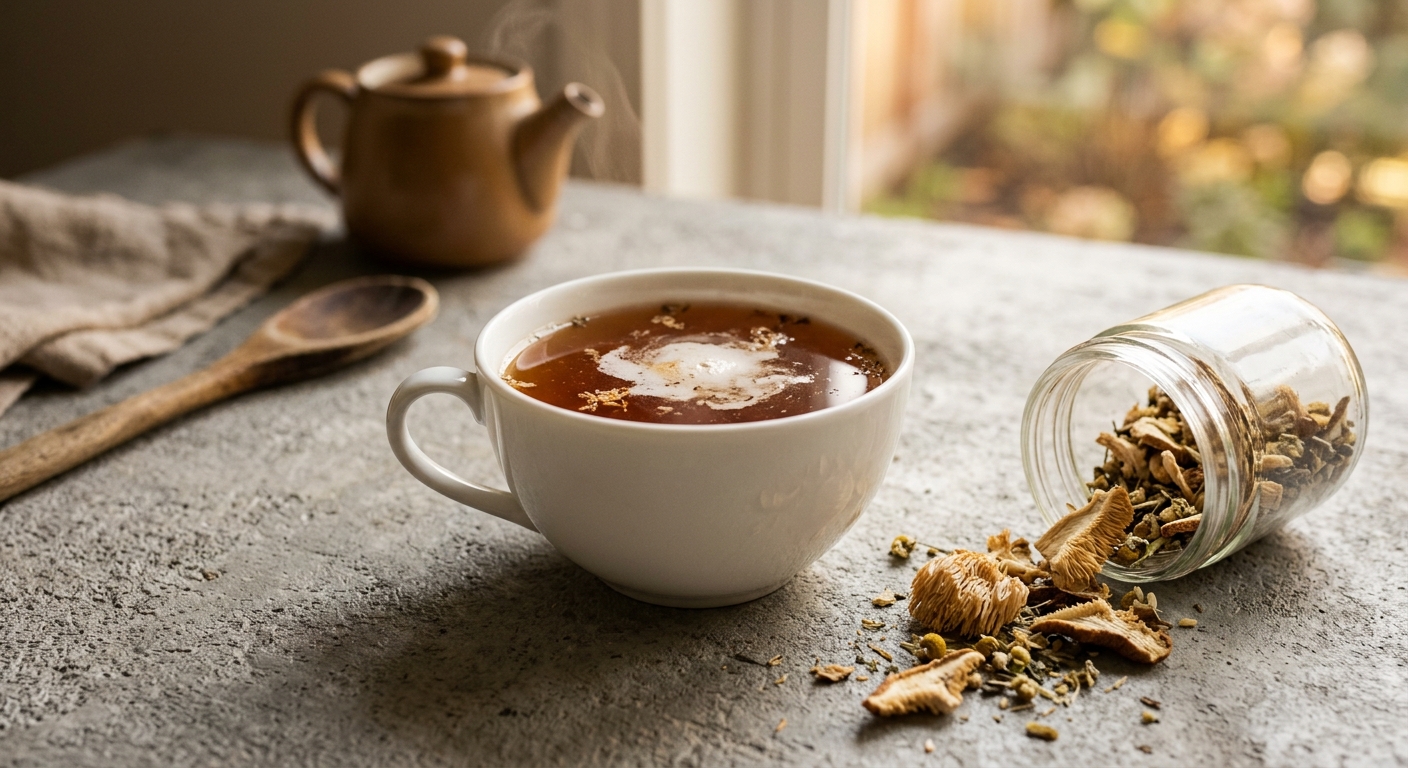
Long before neuroscientists began studying its compounds in laboratories, Buddhist monks in China and Japan were brewing lion’s mane mushroom into teas and broths to sharpen their minds during meditation. Hericium erinaceus, named for its cascading white tendrils that resemble a lion’s flowing mane, grows wild on the trunks of hardwood trees across Asia, Europe, and North America. In traditional Chinese medicine it was classified as a tonic for the spleen and stomach, and revered for what practitioners called its ability to nourish the mind and calm the spirit. Japanese herbalists called it yamabushitake, meaning mountain priest mushroom, a name that speaks to its longstanding association with clarity, contemplation, and elevated awareness.
What sets lion’s mane apart from virtually every other adaptogen used in herbal teas is the unique class of bioactive compounds it contains: hericenones and erinacines. These molecules have been shown in research to stimulate the production of nerve growth factor (NGF), a protein essential for the growth, maintenance, and survival of neurons. No other culinary or medicinal mushroom is known to do this in quite the same way, which is why lion’s mane has attracted so much scientific interest in recent decades. Whether you are seeking sharper focus, reduced brain fog, or a gentler approach to managing everyday stress, this mushroom offers a genuinely rare combination of cognitive and nervous system support.
Lion’s mane tea has a flavour that surprises many first-time drinkers. It is mild, slightly sweet, and reminiscent of seafood or mild umami broth, nothing like the bitter intensity of reishi or the earthiness of chaga. When prepared well, it becomes a warming, deeply satisfying cup that feels nourishing in the way that a good bowl of broth does. You can drink it plain, pair it with a splash of oat milk, or blend it with complementary adaptogens like ashwagandha or ginger. However you choose to enjoy it, lion’s mane tea is one of the most compelling and well-researched herbal preparations available today.
2
cups
Ingredients
- 4 gdried lion’s mane mushroom (sliced or powder)
- 480 mlwater (90 to 95°C / 194 to 203°F)
- —raw honey or maple syrup to taste (optional)
- —splash of oat milk or coconut milk (optional)
How to Brew
Click on an item below to shop for the recommended items for this recipe on Amazon.
As an Amazon Associate, we earn from qualifying purchases.
- Measure 4 grams of dried lion’s mane slices or powder per 480 ml of water. If using slices, break them into smaller pieces to increase surface area and improve extraction.
- Bring filtered water to 90 to 95°C (194 to 203°F). Avoid a full rolling boil, as extremely high heat for prolonged periods can degrade some heat-sensitive compounds. A kettle with temperature control is ideal here.
- Place the lion’s mane pieces or powder into a small saucepan or directly into a large mug with an infuser basket. Pour the hot water over the mushroom and cover with a lid or small plate to trap volatile aromatics and maintain temperature.
- Allow the mushroom to steep for 20 to 30 minutes, stirring once halfway through. The longer end of this range will yield a deeper amber color and a more concentrated, robustly flavored cup.
- Strain through a fine mesh strainer or cheesecloth into your mug, pressing the spent mushroom gently to extract all remaining liquid. Sweeten lightly with raw honey if desired, or add a small splash of oat milk to round out the savory notes.
- Measure 6 grams of dried lion’s mane per 480 ml of filtered water. Use a slightly higher ratio than hot brewing to compensate for the slower cold-water extraction. Powder extracts more readily than slices in cold water.
- Combine the lion’s mane and room-temperature filtered water in a clean glass jar. Stir well to ensure the mushroom pieces or powder are fully submerged, using a spoon to press down any floating material.
- Seal the jar with a lid and leave it at room temperature for the first 1 hour to allow initial hydration, then transfer to the refrigerator and let it steep for 12 to 18 hours overnight is a convenient and effective window.
- When ready, strain the cold brew through a fine mesh strainer lined with cheesecloth into a pitcher or large jar, pressing gently to extract all the liquid. Discard the spent mushroom.
- Serve over ice directly, or warm gently on the stovetop if you prefer a warm cup. Cold-brewed lion’s mane keeps well in the refrigerator for up to 3 days and makes an excellent base for functional lattes.
- Measure 6 to 8 grams of dried lion’s mane per 600 ml of filtered water. For a decoction, you can use larger chunks or whole slices, as the extended simmering process will break down the tough cell walls more effectively than shorter steep methods.
- Combine the lion’s mane and cold filtered water in a small stainless steel or ceramic saucepan. Starting with cold water and bringing it up to temperature slowly encourages a deeper, more complete extraction of the mushroom’s water-soluble polysaccharides.
- Bring the water to a full boil over medium-high heat, then immediately reduce to a gentle, steady simmer. Maintain this simmer for 45 to 60 minutes, adding small amounts of water if the liquid reduces by more than one-third, keeping the mushroom fully submerged throughout.
- After simmering, remove from heat and allow the decoction to rest uncovered for 10 minutes. This resting period allows the liquid to settle and the mushroom material to release any remaining compounds still trapped in the tissue.
- Strain through a fine mesh strainer or cheesecloth into a mug or small teapot, pressing the cooked mushroom firmly to extract every last drop of the concentrated liquid. The finished decoction will be a rich amber-brown. Dilute with hot water if the flavor is too intense, and add honey or a cinnamon stick to taste.
Health Benefits
Erinacines and hericenones stimulate the production of nerve growth factor (NGF), a protein critical for the growth and maintenance of neurons. A double-blind, placebo-controlled clinical trial published in Phytotherapy Research found that adults aged 50 to 80 who consumed lion’s mane for 16 weeks showed significantly improved scores on cognitive function tests compared to the placebo group.
A 2010 study in Biomedical Research found that women who consumed lion’s mane cookies for four weeks reported significant reductions in anxiety and irritability compared to controls. The mechanism is thought to involve amycenone and other polyphenols that modulate serotonin and dopamine activity in the brain.
The erinacines in lion’s mane mycelium have been shown in animal models to support the regeneration of peripheral nerve tissue and may offer protection against neurodegenerative conditions. Early research suggests potential relevance to conditions like Parkinson’s disease and mild cognitive impairment, though large-scale human trials are still ongoing.
The high concentration of beta-1,3 and beta-1,6 glucans in lion’s mane has been shown to activate immune cells, including macrophages and natural killer cells, enhancing the body’s first line of defense. Regular consumption is associated with improved gut immunity through stimulation of Peyer’s patches in intestinal tissue.
Traditional Chinese medicine long used lion’s mane for stomach and digestive complaints. Modern research supports this use: polysaccharides in the mushroom have shown protective effects on the gastric mucosa and may benefit inflammatory bowel conditions by modulating the gut microbiome and reducing intestinal inflammation.
🧪 Key Bioactive Compounds
The Science Behind Lion’S Mane Mushroom
The scientific fascination with lion’s mane centers on two families of bioactive compounds found nowhere else in the fungal kingdom: hericenones, which are extracted from the fruiting body, and erinacines, which are concentrated in the mycelium. Both compound groups have demonstrated the ability to stimulate the synthesis and secretion of nerve growth factor (NGF), a signaling protein discovered by Nobel laureate Rita Levi-Montalcini that is essential for the survival, development, and maintenance of neurons. Crucially, erinacines are small enough to cross the blood-brain barrier, meaning they can act directly on central nervous system tissue rather than only in the periphery, which gives lion’s mane a mechanistic distinction that very few herbal compounds can claim.
Beyond its neurological compounds, lion’s mane is rich in high-molecular-weight polysaccharides, particularly beta-1,3 and beta-1,6 glucans, which are potent immunomodulators. These glucans bind to receptors on immune cells such as macrophages, dendritic cells, and natural killer cells, triggering an enhanced immune response without overstimulating the system. This makes lion’s mane functionally adaptogenic at the immune level, helping to calibrate immune activity rather than simply suppress or amplify it. Research has also identified the compound amycenone, a polyphenol isolated from lion’s mane, which demonstrated significant antidepressant and anxiolytic effects in animal models by influencing monoamine neurotransmitter systems, providing a plausible biochemical explanation for the anxiety-reducing effects reported in human clinical observations.
A landmark double-blind, placebo-controlled trial published in Phytotherapy Research in 2009 remains one of the most cited pieces of human evidence for lion’s mane’s cognitive effects. In this study, older adults with mild cognitive impairment who consumed 3 grams of lion’s mane powder daily for 16 weeks showed significantly greater improvements on the Hasegawa Dementia Scale than those receiving a placebo. Importantly, cognitive scores declined again when supplementation was stopped, suggesting the effect was genuinely compound-dependent rather than a placebo response. While more large-scale human trials are still needed, the convergence of traditional use, animal research, and early clinical data makes lion’s mane one of the most scientifically compelling herbs in the modern apothecary.
Brewing Tips
- If using lion’s mane powder rather than dried slices, whisk it into a small amount of warm water first to form a smooth paste before adding the rest of your hot water. This prevents clumping and ensures even extraction throughout your brew.
- Source your dried lion’s mane from a reputable supplier who tests for heavy metals and confirms species identity. Mushroom products are frequently adulterated or mislabeled, and some products sold as lion’s mane mycelium are grown on grain substrates and contain more starch than actual mushroom compounds.
- For best cognitive and anxiety-reducing results, drink lion’s mane tea consistently over several weeks rather than expecting an immediate effect after a single cup. The neuroprotective and NGF-stimulating benefits are cumulative and tend to become more pronounced with daily or near-daily use over four to eight weeks.