Long before lozenges and throat sprays lined pharmacy shelves, cooks and healers reached into the kitchen garden for relief. Thyme (Thymus vulgaris) and sage (Salvia officinalis) were two of the most trusted remedies. The Latin name Salvia comes from salvare, meaning “to save” or “to heal,” and medieval European herbals praised sage so highly that a popular proverb asked how a person could die with sage growing in the garden. Thyme, meanwhile, was burned as incense in ancient Greece and tucked into Roman soldiers’ bath water for courage and vigor.
Together the two herbs form a natural partnership for the throat. Sage has a long folk reputation as a gargle and tea for hoarseness and inflamed mouth tissues, thanks to its tannins and aromatic oils. Thyme is a classic European remedy for coughs and bronchial irritation, and its essential oil is rich in thymol, a compound studied for its antimicrobial activity. Modern herbalists still reach for both when the first tickle of a cold arrives.
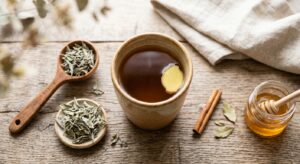
This evening blend is savory, resinous, and gently warming, closer to a broth than a floral tea. It is not a dessert-style cup, and that is part of its charm. Sipped slowly before bed, with a little honey and a squeeze of lemon, it coats the throat, calms the urge to cough, and makes a comforting ritual at the end of a day when you feel run down.
2
cups
Ingredients
- 2 tspdried thyme leaves
- 1 tspdried sage leaves (rubbed or whole)
- 480 mlwater (95°C / 203°F)
- 2 tspraw honey (or to taste)
- —fresh lemon juice, a small squeeze per cup (optional)
- —a thin slice of fresh ginger (optional)
How to Brew
Click on an item below to shop for the recommended items for this recipe on Amazon.
As an Amazon Associate, we earn from qualifying purchases.
- Bring fresh water to a boil, then let it rest for about 30 seconds so it settles near 95°C (203°F).
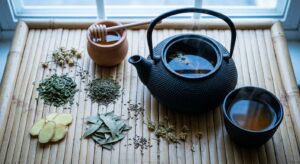
- Measure the dried thyme and sage into a teapot or a large mug. Lightly crush the leaves between your fingers first to release their oils.
- Pour the hot water over the herbs, then immediately cover the vessel with a saucer or lid to trap the volatile oils.
- Steep for 7 to 10 minutes. Closer to 7 gives a gentler cup, while 10 gives a stronger, more medicinal brew with a firmer astringency from the sage.
- Strain through a fine mesh strainer into your cup, pressing the leaves lightly to extract the last of the liquid.
- Stir in raw honey while the tea is still warm, add a squeeze of lemon if you like, and sip slowly while it is comfortably hot.
- Combine 2 teaspoons of dried thyme and 1 teaspoon of dried sage in a clean glass jar. Lightly crush the leaves first to expose their surfaces.
- Add 480 ml of cool, filtered water, stir once, and seal the jar with its lid.
- Refrigerate for 6 to 8 hours. Avoid going much longer, as sage can turn bitter and drying if left too long.
- Strain through a fine mesh strainer or a cloth-lined sieve to remove all herb particles, then transfer to a clean bottle.
- Serve over ice with a slice of lemon, or warm a cup gently on the stove without boiling if you want the throat-soothing comfort of heat. Drink within 48 hours.
- Place 1 tablespoon of dried thyme and 1 tablespoon of dried sage in a small saucepan with 360 ml of water.
- Bring to a gentle simmer over low heat, then cover and simmer for 10 minutes without letting it reach a rolling boil.
- Remove from the heat and keep covered for another 10 minutes so the tannins and oils fully infuse.
- Strain thoroughly and stir in a pinch of fine sea salt, which helps draw fluid from swollen throat tissue.
- Let the liquid cool until it is comfortably warm, never hot. Gargle for 20 to 30 seconds with your head tilted back, then spit it out. Repeat two to three times a day.
Health Benefits
Sage’s tannins and anti-inflammatory compounds have a long traditional use for pharyngitis, and clinical research on sage-based throat sprays has shown relief of throat pain. The warm liquid itself also helps coat and comfort irritated tissue.
Thyme is approved in European herbal monographs for productive coughs. Thymol and the flavonoids in thyme help relax airway muscles and thin mucus so it is easier to clear.
Thymol and carvacrol show strong activity against a range of bacteria and fungi in laboratory settings. This does not replace medical treatment, but it supports the herbs’ long reputation in cold-season remedies.
Rosmarinic acid and luteolin help counter oxidative stress and inflammatory signaling, which may reduce the swelling and discomfort that accompany a throat infection.
A warm, aromatic cup before bed calms the urge to cough and eases the discomfort that can keep you awake, helping you rest while your body recovers.
🧪 Key Bioactive Compounds
The Science Behind Thyme
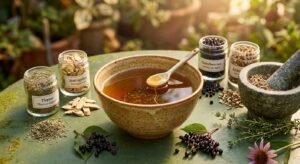
The throat-soothing reputation of this tea rests largely on two families of compounds. Thyme’s essential oil is dominated by thymol and carvacrol, phenolic terpenes that disrupt bacterial and fungal cell membranes in laboratory studies. Thymol is a common ingredient in commercial mouthwashes and cough syrups for exactly this reason. Thyme is also rich in flavonoids such as luteolin, apigenin, and thymonin, which appear to relax smooth muscle in the airways and may explain its traditional use for spasmodic coughs. European regulators recognize thyme as a traditional herbal medicine for coughs associated with colds.
Sage brings a different set of tools. Its leaves are high in rosmarinic acid, carnosic acid, and a range of tannins. Tannins bind to proteins on the surface of mucous membranes, producing the characteristic drying, tightening sensation known as astringency. This is part of why sage has been used for centuries as a gargle for inflamed gums and throats. Small clinical trials of sage-containing throat sprays and lozenges have reported meaningful reductions in throat pain compared with placebo, although the evidence is modest and most studies used standardized extracts rather than tea.
It is worth being honest about the limits of the research. Much of the data on thymol and carvacrol comes from test-tube studies, and a cup of tea delivers far lower concentrations than a concentrated extract. A tea made from these herbs is best understood as a comforting, supportive remedy that eases symptoms and encourages rest, not as a cure for infection. Its real strength is combining mild antimicrobial and anti-inflammatory action with the proven comfort of warm, steaming liquid and honey.
Brewing Tips
- Always cover your cup or teapot while steeping to keep thyme’s and sage’s volatile oils in the tea instead of the air.
- Use dried herbs that are less than a year old. Old, faded herbs lose much of their essential oil and make a flat, dusty-tasting tea.
- Start with the smaller amount of sage if you are new to it. Its astringency is strong, and too much can leave the mouth feeling dry.
- Let the tea cool just enough to sip comfortably. Very hot liquids can irritate an already inflamed throat.
- If you grow your own herbs, use a small handful of fresh sprigs in place of the dried amounts, roughly tripling the quantity.