Spearmint has been woven into human life for thousands of years. Ancient Greeks and Romans scattered it through bathhouses and banquet halls, and Pliny wrote that its scent alone could stir the mind and the appetite. Medieval herbals recommended it for settling the stomach, and across the Middle East, North Africa, and South Asia it remains the heart of everyday hospitality, from Moroccan mint tea poured from a great height to cooling infusions served after heavy meals.
Unlike its sharper cousin peppermint, spearmint contains only trace amounts of menthol. Its dominant aromatic compound is carvone, which gives it that rounder, sweeter, almost candy-like freshness without the cold blast on the tongue. This makes it a gentler cup for the evening, one that soothes rather than stimulates, and it is naturally caffeine-free.
In recent years spearmint has drawn attention from researchers for a more specific reason. Traditional healers in Iran and Turkey have long used it for women with signs of excess hair growth, and modern pilot studies have begun to explore whether regular spearmint tea can reduce androgen levels in women with polycystic ovary syndrome (PCOS) and hirsutism. The evidence is early and modest, but it makes spearmint one of the more interesting herbs in women’s wellness, and a lovely, grounding ritual at the end of the day.
2
cups
Ingredients
- 2 tspdried spearmint leaves (or 1 small handful fresh leaves)
- 480 mlfreshly boiled water, cooled slightly (95°C / 203°F)
- —a squeeze of lemon (optional)
- —a small drizzle of raw honey (optional)
How to Brew
Click on an item below to shop for the recommended items for this recipe on Amazon.
As an Amazon Associate, we earn from qualifying purchases.
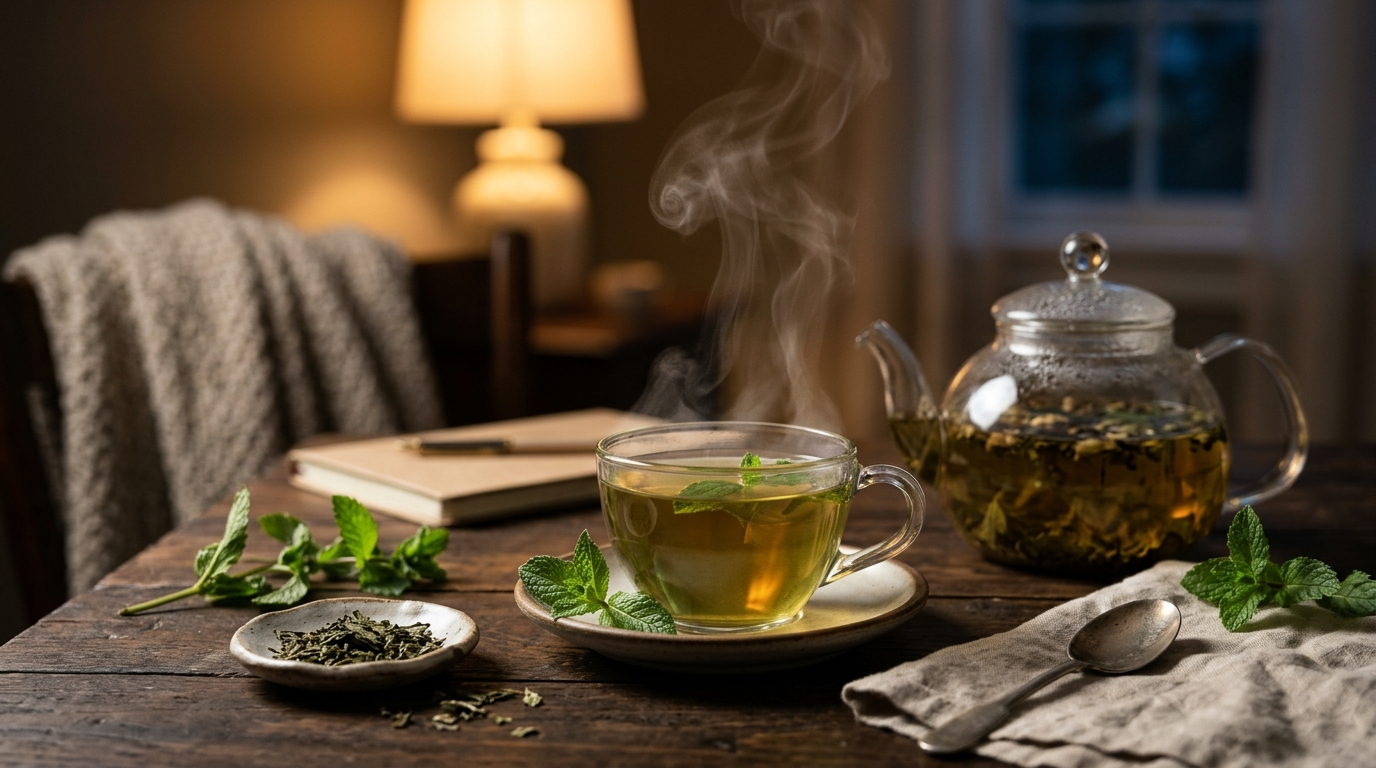
- Bring fresh water to a full boil, then let it rest for about 30 seconds so it settles near 95°C (203°F). Water that is too aggressively boiling can flatten the delicate aroma of the leaves.
- Place 2 teaspoons of dried spearmint (or a generous handful of lightly bruised fresh leaves) into a teapot or large mug. Gently crush dried leaves between your fingers first to wake up the oils.
- Pour the hot water over the leaves and immediately cover with a saucer or lid to trap the aromatic vapors.
- Steep for 5 to 7 minutes. Five minutes gives a light, sweet cup; seven gives a fuller, more herbal infusion without turning bitter.
- Strain into your favorite cup, add lemon or a little honey if you like, and sip slowly. If following the pattern used in studies, this is one of two cups per day, the second taken earlier in the day or the same evening, spaced several hours apart.
- Add 3 tablespoons of dried spearmint (or a large bunch of fresh leaves) to a clean glass jar. Cold extraction is gentler, so you need a slightly higher ratio of herb to water than a hot brew.
- Pour in 1 liter of cold, filtered water. Stir once with a spoon to make sure all the leaves are submerged.
- Seal the jar and place it in the refrigerator. Let it infuse for 8 to 12 hours, or overnight.
- Strain through a fine mesh sieve or a cheesecloth-lined strainer into a clean pitcher, pressing the leaves lightly to release the last of the liquid.
- Serve over ice with a lemon slice or fresh mint sprig. Drink within 48 hours and keep refrigerated.
- Use a double-strength ratio: add 3 teaspoons of dried spearmint to just 240 ml of water heated to 95°C (203°F). This concentrate will be diluted by the ice.
- Cover and steep for 5 minutes. Do not exceed this time, because longer steeping at higher strength can bring out a grassy bitterness.
- Fill a heatproof pitcher or tall glass with 1 to 1.5 cups of ice cubes.
- Strain the hot concentrate directly over the ice. The rapid chilling preserves the volatile aromatics and dilutes the tea to a perfect strength.
- Stir gently, taste, and sweeten lightly if desired. Garnish with a sprig of fresh spearmint and a thin lemon wheel, and serve immediately.
Health Benefits
In small randomized trials, women with PCOS or hirsutism who drank spearmint tea twice daily for 30 days showed significant reductions in free and total testosterone, along with increases in LH and FSH. The studies were short and small, so spearmint should be viewed as a supportive herb rather than a treatment.
Carvone and related compounds have mild antispasmodic effects on smooth muscle in the digestive tract, which may ease bloating, gas, and post-meal heaviness. This has been a core traditional use for centuries.
As a naturally caffeine-free herb with a soothing aroma, spearmint makes an easy wind-down ritual. Aromatherapy research suggests mint scents can lower perceived stress and improve alertness without agitation.
Rosmarinic acid and luteolin give spearmint meaningful antioxidant capacity in laboratory studies, which may help reduce oxidative stress linked to chronic inflammation.
Because of its observed effect on circulating androgens, spearmint tea has been explored for managing hirsutism. Visible changes, if any, typically take weeks to months and vary widely between individuals.
🧪 Key Bioactive Compounds
The Science Behind Spearmint
The most-cited human research on spearmint and hormones comes from small clinical trials in Turkey and Iran. In a 2007 study published in Phytotherapy Research, women with hirsutism who drank spearmint tea twice daily for five days during the follicular phase of their cycle showed reductions in free testosterone and increases in luteinizing hormone, follicle-stimulating hormone, and estradiol. A later randomized trial in women with PCOS extended this to 30 days and found significant drops in both free and total testosterone, though the improvement in self-reported hirsutism was modest.
The mechanism is not fully understood. Researchers have proposed that compounds in spearmint, including flavonoids like luteolin, may influence androgen synthesis or signaling, or act on the hypothalamic-pituitary-gonadal axis. Animal studies have shown that spearmint extract can reduce testosterone and affect ovarian and testicular tissue, which supports an anti-androgenic effect but also underlines why caution is advised around fertility and pregnancy.
It is important to keep the evidence in perspective. The human trials are small, short, and few, and they measured hormone levels more reliably than they measured meaningful clinical change. Spearmint tea is best understood as a gentle, low-risk complement to conventional care, nutrition, movement, and sleep, not a standalone solution. Its other benefits, including digestive comfort and the simple calming value of a warm evening ritual, are real and well supported by long traditional use.
Brewing Tips
- Choose organic, high-quality dried spearmint that still smells sweet and minty when you open the bag. Faded, dusty-smelling leaves have lost most of their active oils.
- Always cover your cup or teapot while steeping to keep the volatile aromatic compounds in the tea rather than in the air.
- Consistency matters more than quantity. If you are exploring spearmint for hormone support, studies used two cups a day for about a month, so a steady routine is more meaningful than occasional large cups.
- Fresh spearmint from your own pot is wonderful, but it is easy to overgrow. Keep it in a container, since it spreads aggressively in garden beds.
- Track how you feel and any cycle or symptom changes in a simple journal, and share the results with your healthcare provider.